Bitcoin is no longer just a speculative asset; it can be used to secure legal residency and, in limited cases, citizenship.
A handful of countries now accept cryptocurrency either as a direct investment or through regulated conversion mechanisms within official citizenship- and residency-by-investment programs.
Key Takeaways:
- Bitcoin can be used to fund residency or citizenship in select countries.
- Crypto-based programs operate through regulated investment structures.
- Bitcoin Citizenship complements but does not replace legal nationality.
- Tax, compliance, and regulatory limits still apply.
My contact details are hello@adamfayed.com and WhatsApp +44-7393-450-837 if you have any questions.
For digital nomad or residence visas that require income, assets, or qualifying investments, we can help structure suitable investment solutions that may align with those requirements, depending on your circumstances.
The information in this article is for general guidance only. It does not constitute financial, legal, or tax advice, and is not a recommendation or solicitation to invest. Some facts may have changed since the time of writing.

How Crypto Citizenship Works in Practice
Bitcoin Citizenship is grounded in real legal programs where crypto assets can be used to satisfy investment requirements for citizenship or long‑term residency.
This is unlike the conceptual idea of citizenship based solely on digital identity or blockchain membership.
There are two main models:
1. Direct Crypto Payment to Government Programs
- El Salvador’s Freedom Visa is the world’s first fully crypto‑native program, offering both residency and a fast path to citizenship in exchange for a ~$1 million investment in Bitcoin (BTC) or Tether (USDT). This program handles direct crypto payments without fiat conversion, making it a true crypto citizenship route for qualified applicants.
2. Crypto‑Funded Investments and Licensed Intermediaries
- Vanuatu’s Citizenship by Investment (CBI) allows payments via licensed migration agents who receive Bitcoin or stablecoins and convert them to fiat to complete the government donation process. Residency and citizenship can be processed remotely, with applications typically finalized in 30–60 days.
- Portugal’s Golden Visa offers EU residency and eventual citizenship through investment in approved funds that may include crypto‑related assets or fiat purchased via crypto conversions. Direct crypto payments are not accepted by the government, but crypto holders can deploy their digital wealth into qualifying investment vehicles.
- Other Caribbean nations (Dominica, St. Lucia) support crypto held by investors by allowing licensed agents to convert digital assets into fiat to satisfy citizenship‑by‑investment requirements.
Some programs, such as St. Kitts & Nevis, now recognize crypto holdings as proof of wealth for citizenship applications even if direct payment isn’t allowed, signaling growing acceptance of digital assets in migration frameworks.
Turning Bitcoin into a Power Strategy
Expats with large crypto holdings are no longer limited to selling, cashing out, or waiting for regulatory clarity.
Crypto-funded residency and citizenship programs allow them to deploy Bitcoin and other digital assets directly into legally recognized mobility, tax planning, and long-term structuring strategies.
This shifts crypto from a passive investment into an active planning tool.
- Strategic mobility: A second passport or long‑term residency enhances visa‑free travel, business access, and diversification of legal residency status.
- Utilization of crypto holdings: Instead of converting crypto assets to cash and triggering taxable events, some programs allow crypto to be used directly at key stages via intermediaries.
- Remote application processes: Many systems accept remote submissions without long physical presence requirements, appealing to digital nomads and international entrepreneurs.
- Potential tax and planning benefits: When combined with favorable local crypto tax regimes, these programs can support broader wealth and relocation strategies. (Example: Portugal long‑term crypto gains may be tax‑favorable)
However, this value must be viewed pragmatically:
- Volatility risk: The crypto market’s price swings mean investment amounts in BTC/crypto may fluctuate significantly during processing.
- Regulatory uncertainty: Governments can change policies governing crypto acceptance or migration rules at any time.
- Complex compliance: International tax, anti‑money‑laundering (AML) rules, and reporting obligations still apply across jurisdictions.
Fiat vs. Crypto: Rethinking How Citizenship Is Earned Today
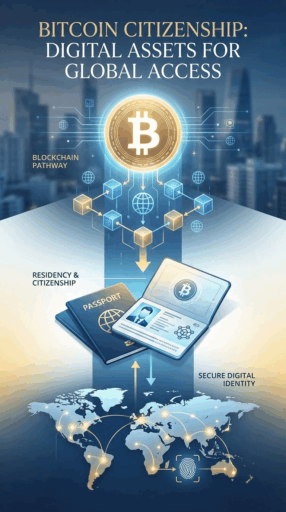
Traditional citizenship‑by‑investment programs rely on fiat contributions to a government fund, real estate purchases, or business investments, often without direct mechanisms for crypto assets.
The integration of crypto is still evolving and usually facilitated through licensed intermediaries rather than direct government acceptance.
Direct crypto acceptance (as in El Salvador’s case) is rare and currently limited to jurisdictions with unique legal frameworks or strong government support for blockchain.
Most other countries require conversion to fiat or structured investment vehicles to satisfy official program requirements.
Crypto Doesn’t Replace the Law and Here’s What You Should Know
Using Bitcoin to access residency or citizenship does not bypass state authority or legal obligations.
Even where crypto is accepted:
- Legal citizenship or residency is granted solely by the issuing country, not by a crypto platform or intermediary.
- Tax residency, reporting, and disclosure rules in the individual’s home country may still apply, regardless of the investment route used.
- Due diligence and AML checks remain mandatory, with crypto source-of-funds verification often more stringent than for traditional assets.
Conclusion
Bitcoin can now be used to access legitimate residency and, in limited cases, citizenship programs, but it does not override state authority or legal frameworks.
Its real value for expats lies in turning digital wealth into a practical mobility and planning tool rather than attempting to replace nationality itself.
As governments cautiously adapt, Bitcoin Citizenship remains a complement to traditional systems, not an alternative to them.
FAQs
How to get El Salvador citizenship Bitcoin?
To get El Salvador citizenship with Bitcoin, invest around $1 million in BTC or USDT through the Freedom Visa Program.
Residency is granted first, with a fast track to citizenship, subject to standard due diligence and legal compliance.
What family bought Bitcoin at $900?
Didi Taihuttu and his family bought Bitcoin when it was around $900 per coin, selling their house, cars, and belongings to invest fully.
Today, he, his wife, two children, and full-time nanny live and travel full-time in exotic destinations.
Who is the richest person with Bitcoin?
The richest known Bitcoin holder is widely believed to be Bitcoin’s creator, Satoshi Nakamoto, who is estimated to control about 1.096 million BTC.
That stake is now worth well over $100 billion and large enough to place them among the world’s top billionaires.
Although Forbes does not include these anonymous crypto holdings in its official billionaire list, analysis suggests Nakamoto’s Bitcoin stash could be worth around $106 billion or more, putting them ahead of many well‑known ultra‑wealthy individuals.
Pained by financial indecision?

Adam is an internationally recognised author on financial matters with over 830million answer views on Quora, a widely sold book on Amazon, and a contributor on Forbes.