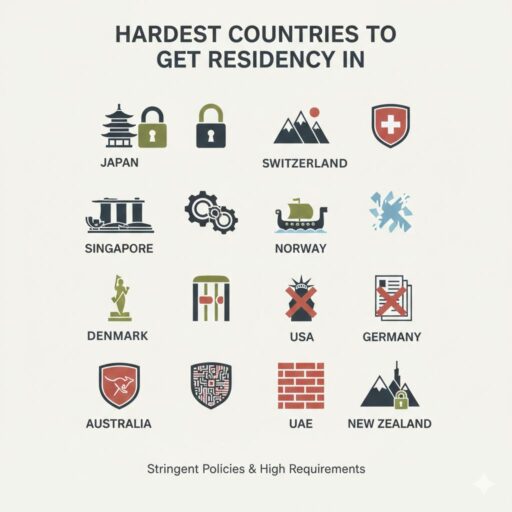
Countries such as Japan, Switzerland, Singapore, and Norway are among the hardest in the world to obtain residency due to strict immigration controls, high income thresholds, and limited approval quotas.
This difficulty is driven less by application volume and more by tightly controlled residency pathways, long qualification timelines, and limited routes from temporary stay to permanent status.
This article covers:
- Which residency is hardest to get?
- What’s the difference between a visa and residence?
- What are the benefits of residency?
- Where is it easiest to get residency?
Key Takeaways:
- Japan, Switzerland, Singapore, and Norway have strict, policy-driven residency requirements.
- Income, skills, language, and integration determine approval chances.
- Visa access does not guarantee long-term residency.
- Portugal, Mexico, Paraguay, and Panama provide faster, simpler, and lower-cost pathways.
My contact details are hello@adamfayed.com and WhatsApp +44-7393-450-837 if you have any questions.
The information in this article is for general guidance only. It does not constitute financial, legal, or tax advice, and is not a recommendation or solicitation to invest. Some facts may have changed since the time of writing.

Factors that make residency hard to get
Several structural and policy-related factors determine why some countries are difficult destinations for residency seekers, including restrictive immigration frameworks, high financial thresholds, and limited long-term settlement pathways.
- Strict immigration laws designed to protect labor markets or national identity
- High income or asset thresholds that exclude average earners
- Limited residency quotas issued annually
- Language, cultural, or integration requirements
- Lengthy physical presence rules before permanent residency eligibility
- Discretionary approval systems with high rejection rates
Countries with strong social welfare systems or limited land and resources tend to impose the toughest residency standards.
What is the difference between residency and visa?
A visa is a short-term permission to enter or stay in a country, while residency is long-term legal status that allows a foreigner to live, work, and access social services in that country.
Visas are typically granted for specific purposes, such as tourism, study, or work, and often have expiration dates or restrictions.
Residency, on the other hand, usually provides a pathway to permanent residence or citizenship and comes with broader rights, such as employment and access to social benefits.
Holding a visa does not guarantee that you can obtain residency, and many visa holders never qualify for long-term settlement especially in countries with restrictive immigration systems like Japan, Switzerland, or Singapore.
Understanding this distinction is essential when evaluating the difficulty and value of pursuing residency abroad.
What is the hardest country to get residency in?
Japan, Switzerland, Singapore, Norway, and other countries with restrictive immigration systems make it extremely difficult to obtain long-term residency, due to high qualifications, limited quotas, and strict integration requirements.
1. Japan
Japan’s residency system is one of the most selective in the world, mainly tightened to protect a shrinking labor market and maintain social cohesion amid an aging population.
- Type of residency available: Work-based, Highly Skilled Professional, Permanent Residency
- Why it’s difficult: Long residency periods, strict employment continuity rules
- Who typically qualifies: Highly skilled professionals with stable, long-term employment
- Common rejection reasons: Insufficient income history, gaps in residency, lack of integration
2. Switzerland
Swiss residency rules are highly restrictive, tightened to manage limited housing and employment opportunities while prioritizing EU citizens for labor market balance.
- Type of residency available: Work permits, Permanent Residency (C Permit)
- Why it’s difficult: Cantonal quotas and strong preference for EU citizens
- Who typically qualifies: High-income professionals, long-term residents
- Common rejection reasons: Quota limits, insufficient economic contribution
3. Singapore
Singapore tightened its PR system to prevent overpopulation, maintain high-quality urban infrastructure, and ensure that newcomers contribute significantly to the economy.
- Type of residency available: Employment Pass leading to Permanent Residency
- Why it’s difficult: Highly selective PR system with opaque and competitive criteria
- Who typically qualifies: Executives, investors, highly skilled professionals
- Common rejection reasons: Salary level below threshold, oversupply in certain industries
4. Norway
Norway’s integration and language requirements were strengthened to ensure newcomers could fully participate in society and support the welfare system without creating social strain.
- Type of residency available: Skilled worker permits, Permanent Residency
- Why it’s difficult: Mandatory language proficiency and integration requirements
- Who typically qualifies: Skilled professionals in shortage occupations
- Common rejection reasons: Language exam failure, insufficient residence duration
5. Denmark
Denmark tightened its points and cultural integration criteria to limit immigration pressure on social services and protect the labor market for local citizens.
- Type of residency available: Work and family reunification visas progressing to Permanent Residency
- Why it’s difficult: Points-based system, strict language and cultural requirements
- Who typically qualifies: Skilled workers with stable local employment
- Common rejection reasons: Low points score, incomplete language benchmarks
6. United Arab Emirates
The UAE restricts permanent settlement to protect citizens’ labor rights and maintain demographic balance, even while allowing long-term investor and work residency.
- Type of residency available: Work, investor, and long-term golden visas
- Why it’s difficult: Strict sponsorship requirements, residency tied to employment or investment
- Who typically qualifies: Significant investors or highly skilled professionals
- Common rejection reasons: No qualifying sponsorship or economic contribution
7. United States
US green card pathways have been tightened to manage high immigration demand, reduce per-country backlog disparities, and protect domestic labor markets.
- Type of residency available: Green Card via employment, family ties, or investment
- Why it’s difficult: Long waitlists, strict background checks, quotas per country
- Who typically qualifies: Skilled workers, close family of citizens, investors
- Common rejection reasons: Backlogs, insufficient documentation, low-priority category
8. Germany
Germany strengthened residency requirements to ensure immigrants can integrate into society and meet labor market needs without overloading social systems.
- Type of residency available: EU Blue Card, permanent residency after meeting conditions
- Why it’s difficult: Language proficiency and job requirement thresholds
- Who typically qualifies: Skilled workers with job offers
- Common rejection reasons: Language gaps, temporary employment exemptions
9. Australia
Australia’s points-based system was made stricter to target high-skilled workers in occupations in demand and limit pressure on infrastructure and social services.
- Type of residency available: Skilled Migration, Business, or Employer-sponsored pathways
- Why it’s difficult: High points requirements and long processing times
- Who typically qualifies: High-scoring skilled migrants or investors
- Common rejection reasons: Low points, occupation mismatch
10. New Zealand
New Zealand capped investor visa and skilled migrant approvals to manage population growth and ensure new residents contribute meaningfully to the economy.
- Type of residency available: Skilled Migrant, Investor, Entrepreneur categories
- Why it’s difficult: Limited quotas and competitive points-based criteria
- Who typically qualifies: Skilled workers and investors with high point scores
- Common rejection reasons: Low points, insufficient financial backing
What country is the easiest to get residency?
Portugal, Mexico, Paraguay, and Panama are among the easiest countries to obtain residency in, as they have lower financial requirements and more flexible pathways for foreigners.
These nations typically offer:
- Lower income thresholds
- Passive income or retirement visas
- Faster residency processing
Are Hard-to-Get Residency Countries Worth It?
Countries with hard residency to get can be worth it for applicants seeking long-term stability, high-quality public services, and strong legal protections.
However, they require significant financial resources, patience, and careful planning due to complex approval processes and strict eligibility criteria.
These countries often offer benefits that make the effort worthwhile for the right candidates:
- Strong economic stability: Low unemployment, robust markets, and protection against inflation.
- High quality of life: Safe cities, clean environments, and cultural amenities.
- Reliable legal systems: Transparent laws and property rights for residents and investors.
- World-class healthcare and education: Access to top hospitals, medical care, and internationally recognized schools.
However, these advantages come with trade-offs:
- Long waiting periods: Permanent residency or citizenship may take years or even decades to obtain.
- High financial requirements: Minimum income thresholds, investment amounts, or property purchases are often substantial.
- Uncertain approval outcomes: Applications may be rejected for reasons beyond the applicant’s control, such as quota limits or policy changes.
For some applicants, easier residency countries may provide better overall value and flexibility, offering faster processing, lower costs, and simpler pathways, even if the lifestyle or economic benefits are comparatively more modest.
Conclusion
Hard-to-get residency often reflects a nation’s attempt to balance economic needs, social cohesion, and public services, rather than arbitrary exclusivity.
Navigating the world’s most restrictive residency systems requires more than just resources; it demands strategic planning, patience, and a clear understanding of each country’s priorities.
For prospective residents, success comes from aligning personal skills, financial capacity, and long-term goals with the country’s immigration philosophy.
Ultimately, the difficulty of residency should be weighed not just in terms of barriers, but in terms of whether the benefits justify the effort.
FAQs
Which country gives PR very easily?
Countries with relaxed permanent residency pathways include Paraguay, Panama, and Portugal, especially for retirees or individuals with passive income.
Which country has the toughest citizenship?
Countries like North Korea, Saudi Arabia, and Liechtenstein make citizenship nearly impossible for foreigners.
Among accessible nations, Japan and Switzerland are the toughest, requiring long-term residence, language proficiency, integration, and often renunciation of previous citizenship.
Which country has the highest visa approval rate?
Countries with open immigration policies, such as Mexico, several Southeast Asian nations, and Caribbean states, often have the highest short-term visa approval rates.
Developed nations like Canada, Australia, and the UK also maintain high approval rates for applicants who meet financial, educational, and documentation requirements.
What are red flags in residency applications?
Authorities often flag applicants for insufficient income or financial backing, gaps in legal stay, lack of language or integration skills, incomplete or inconsistent documents, and criminal or immigration violations.
These issues can significantly reduce the chances of approval.
Pained by financial indecision?

Adam is an internationally recognised author on financial matters with over 830million answer views on Quora, a widely sold book on Amazon, and a contributor on Forbes.