The Portugal D8 visa is a residence permit for digital nomads, remote workers, and entrepreneurs who want to live in Portugal while earning income from abroad.
It allows foreigners to legally reside in Portugal without a local employer.
This article covers:
- What is a D-8 visa?
- How long is a D8 visa valid for?
- How do you qualify for D8 visa Portugal?
- Which documents are required for a Portugal visa?
- What is the difference between D7 and D8 visa in Portugal?
- What are the benefits of D8 visa in Portugal?
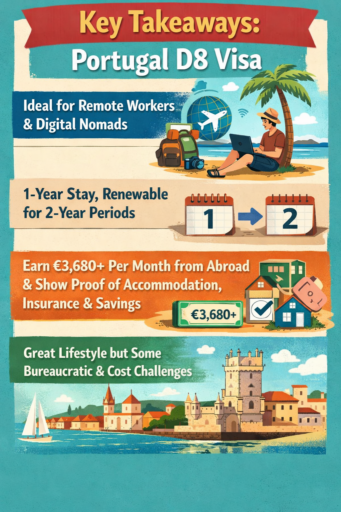
Key Takeaways:
- The D8 visa is ideal for remote workers and digital nomads.
- Initial stay is one year, renewable for two-year periods.
- Applicants must show at least €3,680 monthly foreign income, valid health insurance, and proof of accommodation.
- Portugal offers high-quality living but has some bureaucratic and cost challenges.
My contact details are hello@adamfayed.com and WhatsApp +44-7393-450-837 if you have any questions.
For digital nomad or residence visas that require income, assets, or qualifying investments, we can help structure suitable investment solutions that may align with those requirements, depending on your circumstances.
The information in this article is for general guidance only. It does not constitute financial, legal, or tax advice, and is not a recommendation or solicitation to invest. Some facts may have changed since the time of writing.

What is a Portugal D8 visa?
The Portugal D8 visa is a special residence visa tailored for digital nomads, remote workers, and entrepreneurs who want to live in Portugal while earning income from outside the country.
It is designed to attract international professionals who contribute to the local economy without taking up a traditional Portuguese job.
Unlike standard work visas, the D8 visa does not require a local employment contract, making it ideal for freelancers, online business owners, and remote employees of foreign companies.
Holders of the D8 visa enjoy legal residence in Portugal and can access certain rights, including healthcare and eventual pathways to permanent residency or citizenship.
The D8 visa is part of Portugal’s effort to position itself as a hub for global remote work, offering a high quality of life, beautiful surroundings, and a favorable tax environment for foreign workers.
How long can you stay in Portugal on a D8 visa?
You can stay in Portugal on a D8 visa for up to one year (temporary stay) or long term through a renewable residence permit that can lead to permanent residency and citizenship.
There are two main D8 visa pathways, as per Get Golden Visa.
- Temporary stay visa: Valid for up to 1 year, ideal for short-term stays without committing to residency.
- Residence visa (long-term D8): Issued as a 4-month entry visa, which allows you to enter Portugal and convert it into a 2-year residence permit.
After the initial residence permit:
- It can be renewed for additional 3-year periods
- You can maintain continuous legal residence in Portugal
Over time, this opens the door to:
- Permanent residency after 5 years
- Portuguese citizenship, subject to eligibility requirements
Our team helps clients navigate these programs efficiently while optimizing for compliance and tax planning.
How to get a D8 visa in Portugal?
You can get Portugal’s D8 visa by applying through a Portuguese consulate, completing the visa process, and finalizing your residence permit after arrival.
The process includes:
1. Prepare documents – Gather all required paperwork, including proof of income, accommodation, insurance, and identification.
2. Submit application – File your D8 visa application at the Portuguese consulate or embassy in your country of residence.
3. Attend interview – Complete any required visa interview or biometric appointment as part of the application process.
4. Enter Portugal and register – Once approved, travel to Portugal and attend your appointment to obtain your residence permit.
While parts of the D8 visa application can be completed online, applicants are still required to attend an in-person appointment at a Portuguese consulate.
What are the requirements for a D8 visa in Portugal?
The D8 visa requirements in Portugal include meeting a minimum income of €3,680 from remote work abroad and submitting documents that prove your financial stability, identity, and legal status.
- Proof of stable remote income – such as employment contracts, freelance agreements, or business ownership documents
- Minimum income threshold – applicants must show a stable gross monthly income of €3,680 (4 × Portugal’s 2026 minimum wage of €920), earned from work or business outside Portugal
- Bank statements – showing consistent income and sufficient funds
- Criminal record certificate – issued by your country of residence
- Health insurance – valid in Portugal with adequate coverage
- Valid passport – with sufficient remaining validity
- Proof of accommodation – such as a lease agreement, property ownership, or host declaration
- Completed application forms and photos – as required by the consulate
How much is the D8 visa for Portugal?
The D8 visa Portugal costs around €90–€120 for the initial application, but the total cost is higher once you include residence permit fees, service charges, and supporting expenses.
Main government fees
- D8 visa application fee – typically €90–€120, depending on the consulate and location
- Residence permit fee – around €160–€180, paid after arrival in Portugal
- Renewal fees – generally within a similar range (~€82–€170 depending on the type and process)
Additional required costs
Beyond official fees, applicants should budget for:
- Visa center service fees (VFS/BLS) – about €20–€50
- Health insurance – typically €300–€800 per year depending on coverage
- Document preparation – translations, notarization, and apostilles can add €100+ to €1,000+ depending on complexity
Total estimated cost
In practice, most applicants spend roughly:
- €300 to €600+ in core visa-related fees, excluding travel, accommodation, and relocation expenses
While the base visa fee is relatively low, the total cost of obtaining a D8 visa can be significantly higher once all required steps and documentation are included.
How long does it take to get a D8 visa in Portugal?
The digital nomad visa Portugal D8 usually takes 60–90 days for the consulate to process a complete application. However, the total timeline from application to receiving your residence permit can take 4–8 months.
Typical timeline:
- Consulate decision: 60–90 days after submission, sometimes up to 4 months in busy seasons.
- Travel window: You generally have up to 120 days to enter Portugal once approved.
- Residence permit issuance: 30–90 days after your AIMA appointment, with appointment availability sometimes causing further delays.
Factors affecting timing:
- Missing or incomplete documents
- Consulate workload and seasonal demand
- Availability of AIMA appointments
What is the difference between D7 and D8 visa?
While both are Portuguese residence visas, the D7 visa targets retirees and passive income earners, whereas the D8 visa is designed specifically for digital nomads and remote workers.
The D7 visa is ideal for those who live off passive income such as pensions, rental income, or dividends.
Applicants must show that they have a steady source of income sufficient to support themselves without engaging in local employment in Portugal.
The D8 visa, in contrast, is for individuals who earn active income from work or business outside Portugal.
Applicants must provide proof of ongoing remote work or entrepreneurial activity, such as employment contracts, invoices, or business registration documents.
What are the benefits of D8 visa?
The D8 visa allows remote workers and digital nomads to maintain their foreign income while legally living in Portugal, combining financial freedom with long-term residency options.
- Legal residence and work flexibility – live in Portugal without a local employment contract while continuing your international work.
- Access to public healthcare – once registered, residents (including D8 visa holders) can use Portugal’s healthcare system, which is generally high-quality and more affordable than private alternatives.
- Renewal and path to citizenship – the visa is renewable and can lead to permanent residency or even Portuguese citizenship after continuous residence.
- High-quality European lifestyle – enjoy Portugal’s mild climate, vibrant culture, safety, and modern infrastructure while working remotely.
- Schengen mobility – as a resident, you can travel freely within the 29-country Schengen Area.
- Competitive cost of living compared to other Western European countries– many digital nomads can live comfortably on a moderate income, especially outside Lisbon and Porto.
What are the cons of living in Portugal?
The main drawbacks of living in Portugal include higher living costs in major cities, bureaucratic processes, and practical challenges for newcomers.
- High cost of living in major cities – Lisbon and Porto are noticeably more expensive than smaller towns, especially for housing and dining.
- Bureaucracy for visas and permits – obtaining residence permits, tax numbers, and other official documents can be slow and require multiple visits.
- Language barriers outside urban areas – Portuguese is dominant, and English is less commonly spoken in smaller towns.
- Seasonal crowds – popular tourist areas can become congested during peak months, affecting housing and local services.
- Slower public services – even in cities, some processes (appointments, paperwork, administrative tasks) can take longer than expected.
- Regional healthcare differences – access and quality may vary between urban centers and smaller towns, especially outside major cities.
Comparing Living in Portugal vs Other Nomad-Friendly Countries
Portugal offers digital nomads a combination of affordable living, reliable infrastructure, and a residence visa that supports long-term remote work.
With this unique blend, how does it stack up against other popular destinations?
Those considering multiple destinations may also want to review how Portugal compares with other European digital nomad visas such as Spain and Bulgaria.
Cost of Living:
- Portugal is generally more affordable than Western European countries like France, Germany, and the Netherlands, especially outside Lisbon and Porto.
- Compared with many Eastern European countries such as Estonia and Croatia, Portugal’s cost of living is often similar or somewhat higher overall, though specific expenses like dining or transportation can be lower depending on location.
Visa Flexibility:
- The D8 visa allows remote workers to maintain foreign income while living legally in Portugal, similar to Spain’s digital nomad visa.
- Some countries, like Estonia, offer shorter-term visas, while Portugal provides a clear pathway to long-term residency and eventual citizenship.
Lifestyle and Infrastructure:
- Portugal has a mild climate, vibrant culture, modern cities, and reliable internet, making it ideal for remote work.
- Other nomad-friendly countries may have lower costs but less developed infrastructure, limited coworking spaces, or language barriers.
Healthcare and Safety:
- Public healthcare access in Portugal is an advantage for residents, although service speed varies regionally.
- Portugal ranks higher in safety and quality of life compared to some alternative destinations in Eastern Europe or Latin America.
Portugal balances affordability, lifestyle quality, and long-term residency benefits, making it a top choice for digital nomads and remote workers who want both a European base and the stability of a residence visa.
Conclusion
Living in Portugal on a D8 visa offers freedom and flexibility, but making it work long-term requires practical planning.
Consider city choice carefully. Lisbon and Porto offer convenience but higher costs, while smaller towns can stretch your budget further.
Organize finances in advance, secure reliable health coverage, and familiarize yourself with local bureaucracy to avoid delays.
Engaging with expat and coworking communities can also help navigate daily life and create a support network, turning your stay into a sustainable and rewarding remote-work experience.
FAQs
Is D8 visa taxable in Portugal?
Income earned from foreign sources while living in Portugal on a D8 visa is generally taxable if you meet Portuguese tax residency criteria, which typically applies if you reside in Portugal for more than 183 days in a year or establish your main economic interests there.
Consulting a tax advisor is recommended to ensure compliance with Portuguese tax law.
What are the three reasons for visa rejection?
The D8 visa can be rejected if applicants fail to provide sufficient proof of income, submit incomplete or inaccurate documents, or have a criminal record or security concerns.
Is 3000 euros a good salary in Portugal?
A €3000 monthly income is considered above average in Portugal and is generally sufficient for a comfortable lifestyle in most cities.
What are the different types of visas in Portugal?
Portugal offers several visa types: D7 for retirees and passive income earners, D8 for remote workers and digital nomads, work visas for employment in Portuguese companies, and student visas for education.
Is Portugal strict on immigration?
Portugal is moderately strict on immigration, requiring proper documentation and adherence to visa rules, but it is generally welcoming to skilled workers, investors, retirees, and digital nomads.
Pained by financial indecision?

Adam is an internationally recognised author on financial matters with over 830million answer views on Quora, a widely sold book on Amazon, and a contributor on Forbes.