In 2026, passport strength is no longer just a measure of travel convenience. While the world’s most powerful passports allow visa-free or visa-on-arrival access to nearly 190 countries, the weakest restrict citizens to fewer than 40.
For high-net-worth individuals, expatriates, and global entrepreneurs, passport power is increasingly a strategic asset.
It shapes not only where you can go, but also your access to international banking, global investments, residency options, and personal security.
Understanding which countries dominate mobility and which lag behind has become essential for anyone who wants to leverage global opportunities, mitigate geopolitical risks, and plan wealth strategically.
Key Takeaways:
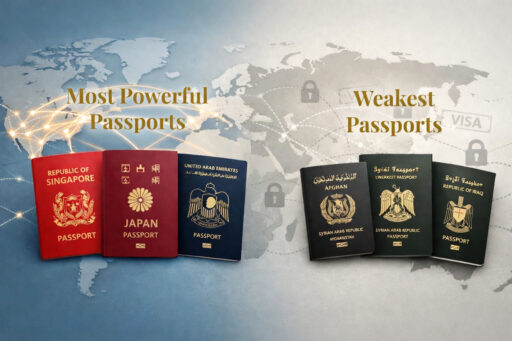
- Singapore, Japan, and UAE lead global mobility in 2026.
- Strong passports provide mobility that directly impacts wealth, banking, and investment access.
- Weak passports limit opportunities and highlight the growing global mobility gap.
- Passport diversification is a core wealth strategy.
My contact details are hello@adamfayed.com and WhatsApp +44-7393-450-837 if you have any questions.
For digital nomad or residence visas that require income, assets, or qualifying investments, we can help structure suitable investment solutions that may align with those requirements, depending on your circumstances.
The information in this article is for general guidance only, does not constitute financial, legal, or tax advice, and may have changed since the time of writing.
Strongest Passports: Most Powerful Countries
The world’s most powerful passports are a reflection of diplomatic influence, economic integration, and international trust.
In 2026, top passports combine visa-free access with strategic advantages for investors, expatriates, and international travelers.
Singapore Leads in Asia (Tops Henley’s Rankings)
Singapore retains the top spot, offering visa-free or visa-on-arrival access to up to 192 countries, based on the Henley Passport Index, one of the most widely cited mobility rankings.
Its passport provides seamless global mobility that translates directly into global investment opportunities, seamless business operations, and an unparalleled safety net for relocation if needed.
Note that while Henley places Singapore first, other mobility rankings such as Arton Capital’s Passport Index and Nomad Capital Passport Index may show slight variations in country positions.
These are due to differences in methodology, visa calculations, and update frequency.
Japan and South Korea Maintain Top Positions
Japan’s passport grants access to 188 destinations, while South Korea remains among the top-ranked passports. These rankings reflect stable economies, strong diplomacy, and trusted international reputations.
United Arab Emirates Rises Fastest
The UAE has climbed rapidly, granting entry to 184 countries. Its strategic bilateral agreements and investor-focused policies make it a powerful passport for global business and lifestyle flexibility.
United States Re‑enters the Henley Top 10
One of the biggest stories in passport rankings this year is not who is on top, but who has shifted relative positions.
After briefly falling out of Henley’s top 10 in late 2025 for the first time in the index’s history, the US passport climbs back into tenth place in the 2026 rankings with access to 179 visa‑free destinations.
Europe’s Passport Leaders
Malta, Ireland, Germany, Spain, and Italy dominate European rankings, offering access to around 180 destinations and EU freedom of movement, enhancing residency and investment flexibility.
North, Central, and South America
Canada leads in North America, with roughly 180 visa-free destinations. Costa Rica is the top passport in Central America, while Chile ranks strongest in South America with access to around 170 countries.
What Changed, And What Didn’t
- Singapore’s leadership is consistent. It remains the benchmark against which other passports are measured in Henley’s analysis.
- No major removal from the top tier occurred in 2026 — but the US decline and recovery illustrate how competitive mobility has become as other countries pursue proactive diplomatic and visa liberalization efforts.
- Asia’s presence at the top continues, with Japan and South Korea tied for second in Henley’s 2026 list, each offering access to 188 destinations.
Weakest Passports: Least Powerful Countries
At the other end of the spectrum, the world’s weakest passports expose the geopolitical and economic fragility that limits freedom of movement and access to opportunity.
Citizens of these countries face significant barriers to travel, financial integration, and global mobility.
Afghanistan Remains Least Powerful Passport
Afghanistan continues to hold the last position globally, with visa-free access to only roughly 24 countries.
Political instability, ongoing conflict, and limited international recognition keep Afghan citizens largely dependent on bureaucratic approvals for international travel.
This extreme limitation underscores how passport strength can dictate access to opportunities and security abroad.
Syria and Iraq Near the Bottom
Syria and Iraq rank similarly low, with access to 26–29 destinations.
Years of conflict, international sanctions, and weak diplomatic ties restrict mobility, making travel planning complex and uncertain.
For the global wealthy, these passports serve as a cautionary example: national stability directly influences global options.
Pakistan and Yemen Face Persistent Restrictions
Pakistan and Yemen remain near the bottom of the list, with only around 31 countries accessible without prior visas.
Diplomatic isolation and security concerns amplify travel restrictions, highlighting the strategic disadvantage of these passports for cross-border investment and relocation flexibility.
What Changed, And What Didn’t
- Consistent bottom placement: Afghanistan, Syria, and Iraq have consistently ranked among the weakest passports, reflecting longstanding diplomatic and security challenges rather than short‑term policy changes.
- The difference between the weakest and strongest passports remains dramatic. In 2026, Singapore tops the Henley Index with visa‑free access to 192 destinations, creating a mobility gap of roughly 168+ countries compared to Afghanistan’s score.
- Unlike the top of the rankings where diplomatic initiatives can quickly improve mobility, the bottom of the list sees little upward mobility because underlying structural issues (such as conflict and lack of bilateral agreements) are slow to change.
Why does passport strength matter?
The disparity between strong and weak passports is not merely a convenience; it is a strategic lever in global wealth management.
Passport strength can influence:
- Residency and Relocation Flexibility: Strong passports allow rapid response to tax changes, political instability, or new investment opportunities abroad.
- Banking and Financial Access: International banks consider nationality in risk assessments, often giving preference to strong-passport holders.
- Investment Mobility: Some investment or business opportunities require physical presence or less bureaucratic friction.
For high-net-worth individuals and expatriates, mobility is no longer ancillary but a core dimension of wealth strategy.
Strong vs Weak Passports Gap
The gap between the strongest and weakest passports continues to widen. Top passports allow access to 190+ countries; least powerful passports restrict citizens to fewer than 40.
This growing divide reflects geopolitical alignment, economic integration, and global trust, rather than mere geography.
Passport strength is increasingly a signal of international credibility and opportunity, not just a travel document.
High-Net-Worth Individuals Invest in Multiple Passports
An emerging trend is the use of multiple citizenships and residencies for strategic advantage, known as passport arbitrage.
Examples include:
- Caribbean citizenships to secure visa-free global access
- European residency for lifestyle, education, and stability
- Low-tax jurisdictions for wealth structuring
By layering multiple passports and residencies, globally mobile individuals optimize freedom, mitigate risk, and maximize access to opportunities—turning mobility itself into an asset class.
Future Passport Trends
Future passport power will increasingly be shaped by geopolitical alignment, mobility agreements, and strategic citizenship planning.
- Mobility blocs are expanding: Regional visa agreements and diplomatic partnerships are becoming key drivers of passport strength. Countries that actively negotiate travel corridors and visa waivers will likely climb rankings.
- Citizenship and residency planning will accelerate: As geopolitical risk and tax competition increase, more globally mobile individuals are expected to pursue second residencies or citizenships as part of long-term wealth planning.
- Digital borders and travel screening will expand: Biometric systems, digital visas, and pre-clearance programs are changing how mobility works, potentially altering how passport strength is measured in the future.
For those with wealth and global ambitions, understanding the strategic implications of passport power is essential.
Final Thoughts
The strongest and weakest passports in the world highlight more than just travel convenience—they reflect geopolitical influence, economic stability, and global trust.
Citizens of top-ranking countries enjoy nearly frictionless access to international opportunities, while those with weaker passports face significant limitations in travel, banking, and investment access.
For high-net-worth individuals and global entrepreneurs, understanding passport strength is no longer optional.
Strategic planning, including consideration of multiple citizenships or residency options, can transform mobility into a tangible asset that supports wealth preservation, international business, and personal security.
Ultimately, passport power is a core component of global strategy. The gap between strong and weak passports continues to widen, making informed planning essential for anyone seeking to optimize their global freedom and opportunity.
FAQs
Which passport is the best in the world 2026?
The best passport in 2026 is generally considered to be Japan, offering visa-free or visa-on-arrival access to the most countries worldwide.
What is the best passport in Asia?
Japan holds the strongest passport in Asia, followed closely by Singapore and South Korea, based on travel freedom and global acceptance.
What is the weakest passport in Southeast Asia?
The weakest passport in Southeast Asia is typically Myanmar, with limited visa-free access and stricter travel restrictions.
Which passport is hardest to get?
The hardest passports to obtain are from countries with strict naturalization laws, such as Switzerland, Liechtenstein, and some Gulf states.
Which country is easiest to get citizenship?
Countries offering citizenship by investment or fast naturalization—like Dominica, St. Kitts & Nevis, and Vanuatu—are among the easiest for foreigners.
Who has the cheapest passport in the world?
The cheapest passports are usually from Caribbean citizenship-by-investment programs, such as Dominica and St. Lucia, with investment costs starting around $100,000 USD or less.
Pained by financial indecision?

Adam is an internationally recognised author on financial matters with over 830million answer views on Quora, a widely sold book on Amazon, and a contributor on Forbes.