UK immigration changes have tightened visa eligibility, raised income and salary thresholds, and restricted dependents across work, study, and family routes.
These reforms are designed to reduce net migration while prioritizing higher-skilled and higher-paid applicants.
This article covers:
- What is the UK border bill? pass?
- What are the new UK visa rules for students?
- Is the UK still taking care workers?
- Will there be any changes to the Skilled Worker visa in the UK?
Key Takeaways:
- UK visa rules now favor higher-paid, degree-level applicants with stricter eligibility.
- Skilled Worker visas require higher salaries and stronger English from 2026.
- Dependent routes are significantly restricted, especially for students and care workers.
- Existing visa holders are protected, but renewals and switches face tougher rules.
My contact details are hello@adamfayed.com and WhatsApp +44-7393-450-837 if you have any questions.
The information in this article is for general guidance only. It does not constitute financial, legal, or tax advice, and is not a recommendation or solicitation to invest. Some facts may have changed since the time of writing.

Reasons for UK immigration changes
The UK changed its immigration system primarily to reduce historically high net migration that reached record levels in recent years, alongside pressures on public services and labor market shifts.
According to Office for National Statistics (ONS) data, net migration peaked at around 906,000 in the year to June 2023, an unprecedented figure by historical standards.
The primary reasons for UK immigration changes include:
- Record-high net migration, with figures near or above historic highs in recent years
- Growing pressure on housing, healthcare, and public services
- Government commitment to reduce overall immigration numbers
- Labor market restructuring following Brexit
- Public concern over visa misuse and asylum system backlogs
The government’s stated goal is to balance economic demand for skilled workers with stricter migration control and enforcement.
What is the new immigration bill in the UK?
The new immigration bill in the UK refers to the Border Security, Asylum and Immigration Act 2025, a piece of legislation designed to strengthen border control, expand enforcement powers, and reform parts of the asylum and removal system.
Unlike the Immigration Rules, which regulate visas and residency eligibility, this Act focuses on border security and enforcement rather than work, study, or family visa requirements.
Its primary objective is to deter irregular migration, disrupt people-smuggling networks, and improve coordination between border, law-enforcement, and security agencies.
The Act introduces new legal powers affecting border checks, data-sharing, detention, removals, and compliance within the UK’s digital immigration framework, forming the legislative backbone of the government’s current immigration strategy.
What are the new immigration rules for the UK?
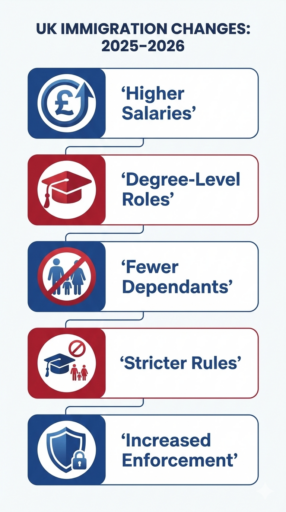
The new immigration rules for the UK raise salary and income thresholds, restrict dependent visas, and tighten eligibility across work, study, care, and family routes, making the system more selective than before.
These reforms aim to reduce net migration while prioritizing higher-skilled, higher-paid applicants, and ensuring stricter compliance across all visa categories.
Key changes include substantial salary increases for Skilled Worker and family visas, the closure of the care worker route to new overseas applicants, tighter rules on bringing dependents for students and workers, and a shift toward degree-level roles and stronger English language requirements.
The UK has also transitioned to a fully digital eVisa system, changing how applicants prove their immigration status.
While transitional protections apply to some existing visa holders, most new applicants now face higher financial, educational, and evidentiary barriers.
What are the new rules for family visa in the UK?
Family visas now require significantly higher household income to sponsor a partner or family member than in the past.
Before:
- Minimum income requirement: £18,600 per year (unchanged since 2012)
- Applications were largely paper-based with physical visa stickers
- Standard five-year route to settlement for partners/spouses
Changed into (2026):
- Minimum income requirement: £29,000 per year (planned rises to £38,700 were paused)
- Transition to a fully digital eVisa system, phasing out physical visa stickers
- Tighter evidential and suitability checks for all family visa applicants, including financial proof and relationship documentation
- Standard five-year settlement (ILR) route continues for partners/spouses
When you still qualify:
- If your income meets the £29,000 minimum requirement
- If your original visa was granted before 11 April 2024, you may use the older £18,600 threshold when extending or applying for settlement
- If you can meet the requirement through combined income or permitted savings
- If you can provide the documentation and evidence required under the updated 2026 rules
What are the new immigration rules for care workers in the UK?
Care worker visas have undergone major changes, with the route for new overseas applicants now closed and strict limits on dependents, reflecting a significant tightening of this lower-paid work pathway.
Before:
- Care worker visa had a lower salary threshold (£29,000 per year)
- Dependants generally allowed
Changed into (post-closure / 2025 onwards):
- New visas from overseas for care workers (SOC 6135) and senior care workers (SOC 6136) are no longer issued as of 22 July 2025
- Dependents no longer permitted for care workers who are already eligible under transitional rules
When you still qualify / transitional rules:
- Workers already in the UK on care worker visas can continue to work, extend their visas, and apply for settlement
- Those in the UK on other visas may switch into care worker roles until 22 July 2028, if employed by an approved sponsor for at least three months
- If you applied before the closure and dependent ban, transitional provisions still apply
What are the new changes in Student visa in the UK?
Student visas now severely restrict the ability to bring family members, with only certain postgraduate research students or government-sponsored students eligible.
Before:
- Most international students could bring dependents (partner/children) under the Student visa route.
Changed into:
- Dependents are now limited to postgraduate research students (e.g., PhD or research-based higher degree) and government-sponsored students on long courses.
- Tighter compliance requirements for education providers and eligibility are applied under the updated Immigration Rules.
When you still qualify:
- If you are enrolled in a PhD or other research-based postgraduate program that meets the qualifying criteria.
- If you already hold a Student visa with dependents under transitional arrangements and your visa was granted before the new rules took effect.
What are the new rules for a Skilled Worker visa in the UK?
The Skilled Worker visa now prioritizes degree-level roles, higher salaries, and stricter compliance, reflecting tighter skill and pay controls under the 2025–2026 immigration reforms.
Before:
- Minimum salary requirement: £38,700 per year (general Skilled Worker route)
- Lower thresholds applied for some occupations (e.g., new entrants, PhDs, shortage/immigration salary lists)
- Most roles allowed family dependents
- English language requirement: CEFR B1
Changed into (post-July 2025 / January 2026):
- Degree-level requirement: Most new Skilled Worker visas now require a degree-level qualification (RQF Level 6+) for the job.
- Shortage-sector exception: Until end of 2026, applicants for roles in sectors facing staff shortages may qualify without a degree, but family dependents are not permitted.
- Minimum salary requirement: £41,700 per year (general Skilled Worker route, based on ASHE 2024 data)
- Discounted thresholds: New entrant, PhD, and other special categories have increased thresholds
- English requirement: From 8 January 2026, applicants must meet CEFR B2, up from the previous B1 level.
When you still qualify:
- If your salary meets or exceeds the new £41,700 threshold or the relevant discounted threshold for your category.
- If your role remains on the eligible occupation list or the temporary shortage list for exception cases.
- If you are extending an existing Skilled Worker visa under transitional rules (lower bands may still apply).
- If you meet the English language requirement appropriate to your application date (B1 before 8 Jan 2026, B2 from 8 Jan 2026 onward).
Will the new immigration rules affect those already in the UK?
Yes. While the Border Security, Asylum and Immigration Act 2025 and updated Immigration Rules primarily target new applicants, several provisions also affect people already in the UK:
- Transitional protections: Existing visa holders such as Skilled Workers, family visa holders, and students may continue under the old rules when extending or switching visas, depending on their application date.
- Care worker visas: Workers already in the UK on care worker visas can continue working, extend their visas, and apply for settlement under transitional arrangements.
- Dependants: Some transitional rules allow current dependants to remain on visas even if new restrictions now apply.
- Compliance and reporting: All residents remain subject to enforcement and compliance obligations under the new digital immigration system, which may require updated identity checks, biometrics, or documentation.
Understanding these transitional rules is essential to avoid unintentional breaches, and anyone affected should seek guidance to ensure their continued legal status under the updated framework.
What is the main reason immigrants come to the UK?
The main reasons immigrants come to the UK are work and study, which consistently account for the largest share of long‑term immigration, followed by family reasons and other factors such as asylum and humanitarian protection.
According to the latest ONS and Home Office data, in the year ending December 2024, work‑related and study‑related reasons remained the most common for non‑EU migrants entering the UK.
Roughly 266,000 arrived in the country for study and 262,000 for work (including dependents) while family and other categories made up smaller shares of total immigration.
Immigration for family reasons including spouses, partners, and children also remains significant and has even increased in recent years, with almost 90,000 family‑related visas granted in 2024, up from the prior year.
Beyond these core categories, some migrants come for reasons related to safety and asylum or to join family already settled in the UK.
Work and study remain the dominant drivers, reflecting the country’s strong employment market and globally attractive higher education sector.
Immigration Reform Around the World: Key Countries to Watch
The UK’s immigration changes do not happen in isolation. Governments worldwide are recalibrating migration systems in response to economic needs, labor market pressures, and demographic trends.
This backdrop provides a broader context for understanding the UK’s approach.
Europe: Many EU countries are updating their systems.
Denmark is tightening its immigration and work permit system effective 1 January 2026, with higher minimum salary thresholds, increased application fees, and revised job lists for foreign workers.
These changes are part of an effort to balance labor market needs with stronger compliance and integration standards.
The European Union is rolling out a new digital Entry/Exit System for passport control across member states by late 2025, modernizing border tracking.
Spain has taken an opposite approach on some fronts by approving a major regularization program that aimed to grant legal status to around 500,000 undocumented migrants and asylum seekers residing in the country before the end of 2025.
Poland has overhauled its foreign worker rules with a new act that digitalizes hiring and removes traditional labor‑market tests, aiming to streamline work permits and improve compliance.
Europe and OECD Trends: Across several OECD countries, numerical limits and quotas for foreign workers have been adjusted, with places like Lithuania and Hungary revising quota systems and wage levels for permits.
Some countries (like Finland, Hungary, and the Netherlands) are also tightening residence and citizenship requirements.
United States: The US State Department has introduced rules requiring some non-immigrant visas to be filed in the applicant’s country of residence or nationality, tightening application procedures.
Separately, proposed changes and broader shifts in US policy are prompting debate over work visas, security checks, and pathways to residency.
OECD‑Wide Patterns: Globally, migration policy trends show both tightening and targeted expansion.
Some countries restrict low‑skilled routes, while others seek to attract highly skilled workers or streamline digital processes to meet labor and demographic needs.
Conclusion
The UK’s immigration reforms signal a clear shift toward a more selective, skills- and income-driven system, reflecting broader economic and social priorities.
Beyond thresholds and rules, the changes highlight a government strategy to balance labor market needs with migration control, while leveraging technology through digital visas and stricter compliance checks.
For applicants and employers alike, success will increasingly depend not just on meeting numeric criteria, but on strategic planning, careful documentation, and awareness of transitional provisions.
Understanding these nuances is now as critical as meeting the baseline eligibility requirements.
FAQs
Why can’t the UK deport people?
The UK cannot always carry out deportations because of legal and practical barriers.
Human rights and asylum protections, ongoing appeals, and backlogs in the immigration system can delay or prevent removals.
In addition, the absence of return agreements with some countries and the presence of stateless or undocumented individuals make deportation legally or logistically impossible in certain cases.
Why is the UK government letting in so many immigrants?
The UK continues to admit immigrants because the economy depends on them.
Employers need foreign workers to fill skill shortages, universities rely on international students, and critical sectors like healthcare and infrastructure face ongoing staffing gaps.
Even with stricter rules, immigration remains necessary to support the country’s labor market and public services.
Is the UK government reducing immigration?
Yes, the UK is actively aiming to reduce net migration, even though overall arrivals continue.
Measures include higher visa salary thresholds, limits on dependents, cuts to lower‑skilled routes, and stricter enforcement.
Early data show declines in some visa categories, particularly students and care workers.
Pained by financial indecision?

Adam is an internationally recognised author on financial matters with over 830million answer views on Quora, a widely sold book on Amazon, and a contributor on Forbes.