A US visa bond is a financial guarantee required by US immigration authorities to ensure visa holders comply with the terms of their stay, including timely departure if required.
It is increasingly used to reduce visa overstays and enforce immigration accountability.
This article covers:
- What does US visa bond mean?
- What is the visa bond pilot program 2025?
- Which countries require bond for US visa?
- How much is the bond for a US visa?
Key Takeaways:
- A US visa bond is a refundable compliance guarantee, not a fee.
- Bond requirements vary by country, visa type, and individual assessment.
- The 2025 Visa Bond Pilot Program expands when bonds may be required.
- Bonds can range from $5,000 to $15,000 or more depending on the case.
My contact details are hello@adamfayed.com and WhatsApp +44-7393-450-837 if you have any questions.
The information in this article is for general guidance only. It does not constitute financial, legal, or tax advice, and is not a recommendation or solicitation to invest. Some facts may have changed since the time of writing.

What is the US visa bond?
A US visa bond serves as a government-mandated financial safeguard, authorized under existing US immigration law rather than a single standalone statute.
It is applied when immigration authorities assess a higher risk of visa overstay, non-compliance, or failure to depart the US as required.
The authority to require a visa bond comes from provisions within the Immigration and Nationality Act and related federal regulations, which allow the Department of Homeland Security to impose conditions on visa issuance, entry, parole, or release.
Unlike standard visa fees, the bond is conditional.
It is forfeited only if the visa holder violates immigration terms, such as overstaying, unauthorized work, or ignoring departure instructions.
When all conditions are met, the bond may be refunded after the individual exits the US in accordance with their visa terms.
What is the new visa bond rule 2025?
The new visa bond rule refers to the Visa Bond Pilot Program (VBPP) introduced by the US Department of State, which formalizes and expands when bond requirements can be applied to certain visa applicants.
This pilot program, effective from August 20, 2025 through August 5, 2026, requires some B-1 (business) and B-2 (tourist) visa applicants from designated countries to post a refundable bond before a visa is issued.
Under this rule, applicants from specific countries initially Malawi and Zambia and later expanded to others, may be required to pay a bond as a condition of B-1/B-2 visa issuance.
The exact amount is set by the consular officer.
Who is affected by the US visa bond?
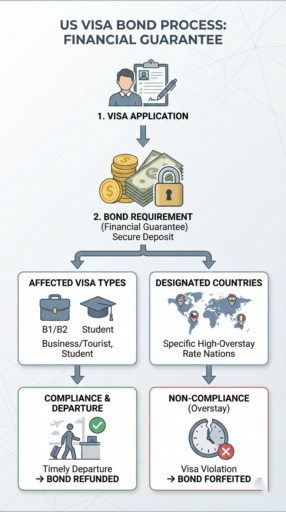
The US visa bond affects foreign nationals assessed as having a higher risk of visa overstay or non-compliance with US immigration rules.
This most commonly includes:
- Individuals with prior immigration violations
- Applicants flagged for potential non-compliance during screening
- Foreign nationals applying for certain non-immigrant or immigrant visas
- Individuals under removal or deportation proceedings
Even first-time applicants may be required to post a bond if their application is flagged during enhanced review or risk-based screening, regardless of nationality.
How much is the US visa bond?
A US visa bond typically ranges from $5,000 to $15,000 for applicants covered under the Visa Bond Pilot Program, with higher amounts possible in cases with greater likelihood of overstay or non-compliance.
The exact amount depends on the visa category, the applicant’s immigration history, and the risk assessment made by US authorities.
For applicants outside the pilot program or in removal-related cases, bond amounts may vary more widely and can reach significantly higher levels depending on individual circumstances.
US Visa Bond Countries List
Nationals of certain countries, including Nigeria, Bangladesh, Nepal, and Venezuela, may be required to post a bond when applying for a US visa under the Visa Bond Pilot Program.
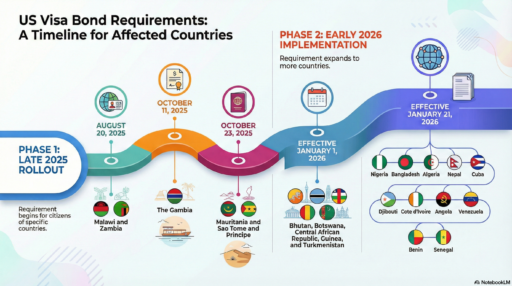
As of January 8, 2026, the following countries are subject to US visa bond requirements, with implementation dates shown:
| Country | Implementation Date |
|---|---|
| Malawi | August 20, 2025 |
| Zambia | August 20, 2025 |
| The Gambia | October 11, 2025 |
| Mauritania | October 23, 2025 |
| Sao Tome and Principe | October 23, 2025 |
| Tanzania | October 23, 2025 |
| Bhutan | January 1, 2026 |
| Botswana | January 1, 2026 |
| Central African Republic | January 1, 2026 |
| Guinea | January 1, 2026 |
| Guinea Bissau | January 1, 2026 |
| Namibia | January 1, 2026 |
| Turkmenistan | January 1, 2026 |
| Algeria | January 21, 2026 |
| Angola | January 21, 2026 |
| Antigua and Barbuda | January 21, 2026 |
| Bangladesh | January 21, 2026 |
| Benin | January 21, 2026 |
| Burundi | January 21, 2026 |
| Cabo Verde | January 21, 2026 |
| Cote d’Ivoire | January 21, 2026 |
| Cuba | January 21, 2026 |
| Djibouti | January 21, 2026 |
| Dominica | January 21, 2026 |
| Fiji | January 21, 2026 |
| Gabon | January 21, 2026 |
| Kyrgyzstan | January 21, 2026 |
| Nepal | January 21, 2026 |
| Nigeria | January 21, 2026 |
| Senegal | January 21, 2026 |
| Tajikistan | January 21, 2026 |
| Togo | January 21, 2026 |
| Tonga | January 21, 2026 |
| Tuvalu | January 21, 2026 |
| Uganda | January 21, 2026 |
| Vanuatu | January 21, 2026 |
| Venezuela | January 21, 2026 |
| Zimbabwe | January 21, 2026 |
These country designations are policy-based and subject to change, and not all applicants from listed countries will automatically be required to post a bond.
The US Department of State makes these designations based on visa overstay rates, compliance history, and screening considerations.
Comparing US Visa Bonds to Immigration Bonds
While both involve financial guarantees, US visa bonds under the Visa Bond Pilot Program (VBPP) and immigration/detention bonds serve different purposes.
Visa bonds are conditional guarantees required for certain B‑1/B‑2 visa applicants to ensure compliance with US immigration laws and are refundable if all conditions, such as timely departure, are met.
Immigration or detention bonds, in contrast, are posted for individuals in removal proceedings or detained by US Immigration and Customs Enforcement (ICE).
These bonds secure release from custody while a case is pending and are generally higher, set by ICE or immigration courts based on factors like compliance history and flight risk.
Most reporting on the VBPP focuses solely on visa bonds, so this comparison is provided to clarify the distinction and help applicants understand the financial and legal responsibilities associated with different US immigration processes.
Conclusion
The US visa bond is more than a procedural requirement. It reflects a broader shift toward ensuring accountability and predictability in US immigration processes.
While it may seem like an added hurdle, it also provides a structured mechanism for applicants to demonstrate compliance and secure their travel legally.
Understanding when a bond may apply and how it functions can help applicants navigate the visa system more confidently, plan financially, and avoid unexpected complications.
Ultimately, the bond underscores a key principle: responsible compliance benefits both the traveler and the immigration system, creating a clearer path for lawful entry while protecting US regulatory interests.
FAQs
What is the purpose of the US waiver visa?
A US waiver visa allows travelers who are otherwise ineligible for the Visa Waiver Program (VWP) to enter the United States legally for tourism or business.
Under the 2015 VWP Improvement and Terrorist Travel Prevention Act, travelers who visited certain countries or hold dual nationality with restricted nations must obtain a visa instead of using the VWP.
Why are visas getting revoked in the USA?
Visas may be revoked if new information shows a visa holder is ineligible due to overstays, criminal activity, misrepresentation, or security concerns.
In recent years, the US has expanded revocations as part of broader immigration enforcement, including stricter background checks and social media screening.
Tens of thousands of visas have been canceled under these policies to ensure compliance with US immigration law.
Does immigration check social media?
Yes, US immigration authorities may review social media accounts as part of the visa application or enforcement process.
They look for inconsistencies in information, security risks, or evidence of violations of US law.
What is the highest immigration bond?
US immigration bonds can exceed $100,000 in exceptional cases involving serious violations, criminal history, or risk of flight.
These high bonds are usually set in removal or detention cases, not standard visa applications, and are based on prior compliance and enforcement factors.
Pained by financial indecision?

Adam is an internationally recognised author on financial matters with over 830million answer views on Quora, a widely sold book on Amazon, and a contributor on Forbes.