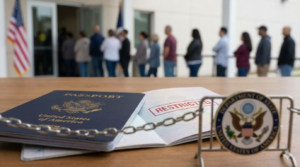
US visa restrictions in 2026 are tightening who can enter, how long they can stay, and what they’re allowed to do once inside the country.
While visas are not outright banned, new rules, country-specific suspensions, and stricter enforcement are reshaping travel, tourism, and work access to the United States.
Understanding these changes is critical before applying, re-entering, or attempting to extend any US visa.
This article covers:
- How has US visa policy changed recently?
- What are the restrictions on a US visitor visa?
- Which countries have visa processing suspended?
- Which countries are good alternatives to the US for travel?
Key Takeaways
- US visas are not banned in 2026, but some countries face suspensions or delays.
- B1/B2 visas allow short-term visits only and strictly prohibit work or study.
- H-1B visas now require stricter employer checks and electronic registration.
- Frequent travel or rule violations can result in entry denial or penalties.
My contact details are hello@adamfayed.com and WhatsApp +44-7393-450-837 if you have any questions.
The information in this article is for general guidance only. It does not constitute financial, legal, or tax advice, and is not a recommendation or solicitation to invest. Some facts may have changed since the time of writing.

Is the US visa banned in 2026?
No, the US has not imposed a blanket visa ban in 2026. However, certain countries face temporary suspensions or processing delays due to diplomatic issues, security concerns, or administrative changes.
Immigrant visa processing were placed on hold for applicants from 75 countries.
Travelers should check the US State Department updates for country-specific guidance.
US Visa Suspension List of Countries
As of January 21, 2026, the US has paused immigrant visa issuance for nationals of Brazil and Russia, along with dozens of other countries under a broad public-charge and security review.
Other countries affected include:
- Afghanistan
- Albania
- Algeria
- Antigua and Barbuda
- Armenia
- Azerbaijan
- Bahamas
- Bangladesh
- Barbados
- Belarus
- Belize
- Bhutan
- Bosnia and Herzegovina
- Burma
- Cambodia
- Cameroon
- Cape Verde
- Colombia
- Cote d’Ivoire
- Cuba
- Democratic Republic of the Congo
- Dominica
- Egypt
- Eritrea
- Ethiopia
- Fiji
- The Gambia
- Georgia
- Ghana
- Grenada
- Guatemala
- Guinea
- Haiti
- Iran
- Iraq
- Jamaica
- Jordan
- Kazakhstan
- Kosovo
- Kuwait
- Kyrgyz Republic
- Laos
- Lebanon
- Liberia
- Libya
- Moldova
- Mongolia
- Montenegro
- Morocco
- Nepal
- Nicaragua
- Nigeria
- North Macedonia
- Pakistan
- Republic of the Congo
- Rwanda
- Saint Kitts and Nevis
- Saint Lucia
- Saint Vincent and the Grenadines
- Senegal
- Sierra Leone
- Somalia
- South Sudan
- Sudan
- Syria
- Tanzania
- Thailand
- Togo
- Tunisia
- Uganda
- Uruguay
- Uzbekistan
- Yemen
This suspension applies to immigrant visa issuances and is tied to a Department of State review focused on financial self-sufficiency and public-charge risk, with potential spillover effects on processing times and scrutiny for other visa categories.
What are the new changes in the US visa?
New US visa changes introduced in 2025 and carried into 2026 include tighter eligibility screening, expanded background checks, and stricter enforcement of financial self-sufficiency rules.
Applicants from certain nationalities now face higher scrutiny, while employment-based visas require more detailed employer documentation and wage verification.
The US has also expanded biometric data collection, accelerated the shift to digital visa applications, and strengthened inter-agency data sharing to identify security and immigration risks earlier in the process.
What are the limitations of a B1 B2 visa?
A B1/B2 visa strictly limits visitors to short-term business or tourism purposes only. Holders cannot:
- Work for a US employer or receive US-based compensation
- Stay beyond the period authorized by Customs and Border Protection
- Engage in unauthorized activities such as internships, freelance work, or long-term study
Violating these limitations can result in visa revocation, removal from the US, or denial of entry on future visits, making compliance essential for all B1/B2 holders.
What is the new rule for H-1B visa?
The new H-1B visa rules in 2026 require stricter wage verification, tighter employer screening, and updated electronic registration procedures.
This visa is a non-immigrant visa that allows US employers to hire foreign workers in specialty occupations requiring specialized knowledge or a bachelor’s degree or higher.
Key changes include:
- Stricter wage and employer verification to ensure compliance with US labor standards
- Increased scrutiny on cap-exempt applications, including nonprofit and research positions
- Streamlined electronic registration process for lottery and application submission
Applicants must follow these updated documentation requirements carefully to avoid rejection or delays.
What is the 30 day rule for US visa?
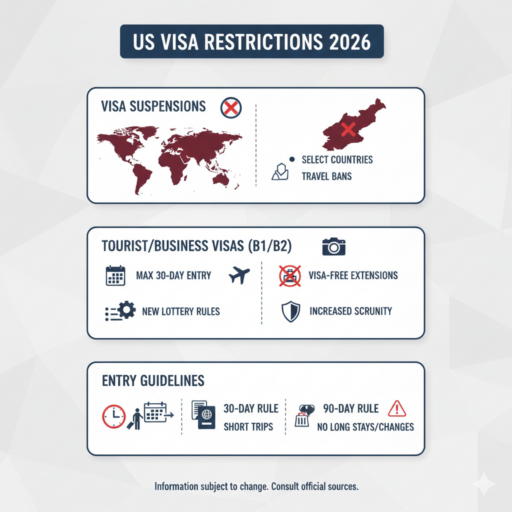
Under the Immigration and Nationality Act (INA), all aliens 14 years of age or older who were not registered and fingerprinted when applying for a US visa and who remain in the United States for 30 days or longer, must apply for registration and fingerprinting.
- Parents or legal guardians must ensure that aliens under 14 are registered, and previously registered aliens must re-register within 30 days of turning 14.
- Once registration and fingerprinting are completed, aliens over 18 must carry evidence of registration at all times.
- Failure to comply with this 30-day rule can result in criminal and civil penalties, including fines, misdemeanor prosecution, or incarceration.
- Registration is not an immigration status, does not provide work authorization, and does not create any other legal benefits.
- USCIS has established Form G-325R (Biographic Information) and an online process to help unregistered aliens comply with this requirement.
- The Alien Registration Requirement (ARR) Determination Tool can help determine if registration is needed.
Can I leave the US after 90 days and come back?
Yes, you may be allowed to leave the US after 90 days and re-enter, but re-entry is never guaranteed.
Admission is decided at the port of entry by US Customs and Border Protection (CBP), which evaluates your travel purpose, frequency of visits, visa type, and evidence that your stay is temporary.
For travelers under the Visa Waiver Program (ESTA), each visit is limited to 90 days, and frequent or back-to-back trips can raise concerns.
For B1/B2 visa holders, a valid multiple-entry visa improves re-entry prospects, but CBP will still assess overall travel patterns and intent on every arrival.
Alternative Countries Offering Easier Visit or Residency Options Than the US
As US visa rules become more complex and enforcement tighter in 2026, many travelers, remote professionals, and globally mobile families are reassessing whether the United States is still the most practical destination.
Several countries now offer simpler entry, clearer residency pathways, and fewer compliance risks, while providing comparable lifestyle, business, or mobility benefits.
Canada: Predictable Entry and Transparent Residency Pathways
Canada remains a leading alternative for long-term planning.
Visitor visas are generally easier to obtain than US B1/B2 visas, and Canadian residency routes such as Express Entry and Provincial Nominee Programs, offer structured, points-based pathways with less discretionary risk at the border.
For professionals and families, Canada’s system emphasizes intent clarity rather than suspicion, making it more predictable for repeat travelers and eventual residents.
United Kingdom: Clear Rules and Defined Stay Limits
The UK’s visitor visa framework is stricter than before but remains more rules-based than discretionary.
Travelers know exactly how long they can stay, and compliance is judged primarily on overstays rather than travel frequency alone.
Skilled Worker visas and Global Talent routes also provide clearer employment-based residency options compared to US H-1B uncertainty.
Portugal: Flexible Residency for Global Lifestyles
Portugal continues to attract non-EU nationals through residency options tied to income, employment, or independent means.
While some programs have tightened, the process remains far more transparent than US immigration, with clear renewal paths and fewer sudden denials once approved.
Portugal is often chosen by those seeking long-term stability without needing immediate employment sponsorship.
United Arab Emirates: Fast Access and Minimal Entry Friction
The UAE offers visa-free or visa-on-arrival access for many nationalities and has expanded long-term residence options through employment, golden visa, and remote work pathways.
For business owners and mobile professionals, the UAE provides legal certainty, fast processing, and low enforcement ambiguity, especially compared to frequent US entry scrutiny.
Singapore: Short-Term Access With Strong Regional Mobility
Singapore’s short-term visit rules are strictly enforced but highly predictable.
For those doing regional business or seeking an Asia-based hub, it offers efficient processing, strong infrastructure, and low tolerance for gray-area activities, reducing unexpected enforcement risks.
Mexico: Practical Proximity Without US-Level Scrutiny
Mexico remains a practical alternative for those who need proximity to the US without US visa pressure.
Visitor stays are generous, and temporary or permanent residency options are relatively accessible for retirees, remote earners, and investors.
Mexico’s approach prioritizes economic self-sufficiency over travel frequency analysis, making it attractive for longer-term planning.
Conclusion
US visa rules in 2026 continue to evolve, balancing security, diplomacy, and public health considerations.
Staying informed about restrictions, limitations, and procedural changes is essential for a smooth travel experience.
Planning ahead and consulting official sources will help ensure compliance and reduce the risk of entry denial.
FAQs
Are tourist visas suspended to the US?
Tourist visas (B2) are generally not suspended nationwide, but applicants from specific countries may experience delays or temporary restrictions.
Travel advisories and pandemic-related measures can also impact visa approvals.
What is the penalty for entering the US illegally?
Penalties include fines, detention, deportation, and a ban from re-entry for several years. Severe cases can also result in criminal charges.
Can I convert my B1 B2 visa to green card?
No, a B1/B2 visa cannot be converted directly into a green card.
However, holders may apply for permanent residence through a separate immigrant pathway, such as family sponsorship, employment-based sponsorship, or other eligible immigrant categories.
They must meet all requirements and did not violate the terms of their visitor visa.
What are the US visa categories?
US visas are broadly divided into:
– non-immigrant visas, which cover temporary stays such as tourism, study, and work (including B1/B2, F1, H-1B, and L-1)
– immigrant visas, which are for permanent residence through family sponsorship, employment-based pathways, the diversity visa lottery, and other approved categories.
What are the latest US visa requirements?
The latest US visa requirements generally include:
– a valid passport
– a completed DS-160 or applicable visa form
– payment of visa fees
– attendance at a consular appointment with biometric submission
– supporting documents proving the purpose and eligibility of the visit
– compliance with any applicable health or entry-related mandates
Pained by financial indecision?

Adam is an internationally recognised author on financial matters with over 830million answer views on Quora, a widely sold book on Amazon, and a contributor on Forbes.