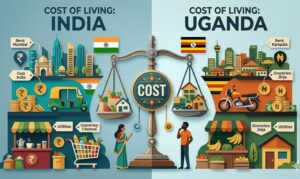
Living in Uganda is generally more expensive than India for everyday essentials, especially for expats.
India offers lower costs across most categories, along with better infrastructure and purchasing power.
This article covers:
- How much money do you need to live in Uganda?
- How much does it cost to live comfortably in India?
- How much does food cost in Uganda?
- How much do groceries cost in India?
- Which country is cheaper, India or Uganda?
Key Takeaways:
- India is cheaper than Uganda in most daily expenses.
- Uganda can be costly due to imports and expat housing.
- Salaries and purchasing power are generally higher in India.
- Uganda suits niche expat lifestyles, while India offers broader affordability.
My contact details are hello@adamfayed.com and WhatsApp +44-7393-450-837 if you have any questions.
The information in this article is for general guidance only. It does not constitute financial, legal, or tax advice, and is not a recommendation or solicitation to invest. Some facts may have changed since the time of writing.

What is the connection between Uganda and India?
The connection between Uganda and India goes back over a century, largely shaped by migration, trade, and colonial history.
During British rule, many Indians were brought to East Africa including Uganda to work on railways and in commerce.
Today, the Indian community in Uganda plays a significant role in sectors like manufacturing, retail, and hospitality.
Bilateral trade has also strengthened, with India being one of Uganda’s key trading partners.
This historical and economic relationship makes Uganda a familiar destination for Indian expats and investors.
What is the economic situation in Uganda?
Uganda is officially classified as a low-income economy by the World Bank, although it has been experiencing steady growth of around 6–7% driven by agriculture, services, and infrastructure development.
Key sectors include coffee exports, gold trading, tourism, and emerging oil production, which is expected to support future economic expansion.
Inflation has remained relatively moderate in recent years, but challenges persist, including income inequality, reliance on imports, and rising public debt.
While the economy is growing, the benefits are unevenly distributed.
For expats, the cost of living can vary significantly depending on lifestyle especially in urban areas like Kampala, where imported goods and housing can drive up expenses.
How is the current economic situation in India?
India has a larger, more diversified economy than Uganda, with growth driven primarily by services, technology, manufacturing, and domestic consumption.
It is classified as a lower-middle-income country by the World Bank and continues to expand as one of the world’s fastest-growing major economies.
Unlike Uganda’s reliance on agriculture and commodity exports, India benefits from a broad industrial base and strong global integration, particularly in IT services and outsourcing.
This diversification helps stabilize the economy and keeps the cost of many goods and services relatively low.
However, economic conditions vary sharply by region.
Major cities like Mumbai, Bangalore, and Delhi are significantly more expensive, while smaller cities and rural areas remain highly affordable.
Income inequality and job distribution challenges also persist despite overall growth.
For cost of living, this means India offers greater pricing flexibility from very low-cost living to high-end urban lifestyles, generally making it more affordable than Uganda for most everyday expenses.
How much money do you need to live in Uganda vs India?
A single person typically needs around $700–$1,200/month in Uganda and $300–$1,200/month in India.
Uganda (Kampala estimate):
- Budget lifestyle: $300–$600/month
- Mid-range lifestyle: $700–$1,200/month
- Expat lifestyle: $1,500–$2,500+
A comfortable expat lifestyle in Kampala typically falls around $700–$1,200/month, largely driven by rent and imported goods.
India (major cities):
- Budget lifestyle: $200–$500/month
- Mid-range lifestyle: $600–$1,200/month
- Expat lifestyle: $1,200–$2,500+
Rent and daily expenses remain significantly lower in most Indian cities, especially outside prime urban centers.
Is the cost of living cheaper in India than Uganda?
In most cases, yes, India is cheaper than Uganda, especially for food, transport, and services. However, certain categories like rent in major Indian cities can rival or exceed Uganda based on location.
The monthly cost of living in Uganda vs India varies based on whether you live locally or as an expat, but Uganda tends to have a higher baseline for expat living, while India offers a wider low-cost range.
Food and Grocery Costs
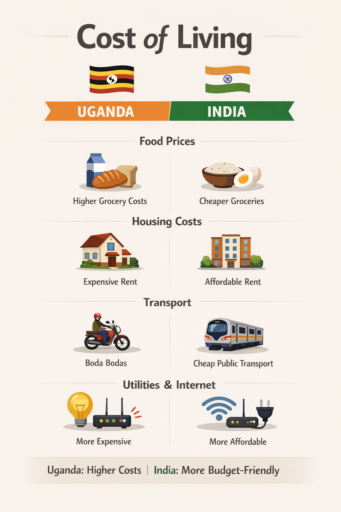
When comparing basic food prices, India generally offers much lower grocery costs than Uganda, especially for staple items and everyday groceries.
In India, typical prices for common groceries are relatively low:
- Milk (1 L) ~ ₹60–₹75 (~$0.70–$0.90 USD)
- Rice (1 kg) ~ ₹40–₹100 (~$0.50–$1.20 USD)
- Eggs (12) ~ ₹60–₹120 (~$0.75–$1.50 USD)
- Bananas (1 kg) ~ ₹40–₹110 (~$0.50–$1.35 USD)
Prices vary by city but remain modest across the country.
In Uganda, similar grocery items cost more when converted to USD (according to current exchange rates):
- Milk (1 L) ~ 2,540 USh (~$0.70+)
- Rice (1 kg) ~ 4,800 USh (~$1.30+)
- Eggs (12) ~ 6,400 USh (~$1.70+)
- Apples (1 kg) ~ 9,600 USh (~$2.60+)
Imported items like cheese and chicken fillets are particularly high.
Comparison:
- Staple items like rice, milk, and eggs are often cheaper in India even after accounting for local market differences.
- Uganda’s grocery costs tend to be higher in USD terms, because many food products are imported or have less domestic supply scale, which pushes prices up.
Transportation Expenses
Transportation costs are generally lower in India due to well-developed and widely available public transport systems, including trains, buses, metro networks, and affordable ride-hailing services.
India:
- One-way local transport ticket: ~$0.20–$0.40
- Monthly public transport pass: ~$10–$25
- Taxi start (normal tariff): ~$1, with ~$0.30 per km
- Petrol (1 L): ~$1.00–$1.10
Uganda:
- Local transport relies on minibuses and motorcycle taxis (boda bodas).
- One-way ticket on public minibus: ~$0.25–$0.50
- Boda boda rides for 5 km: ~$1.00–$1.50
- Petrol (1 L): ~$1.10–$1.20
Comparison:
- While fares for basic trips may seem similar, India’s structured public transport and metro systems make daily commuting much cheaper and more reliable in urban centers.
- Uganda’s transport is flexible but less organized, and frequent use of boda bodas or taxis can quickly raise monthly commuting costs.
Utilities and Internet Costs
Utilities and internet are generally more affordable and reliable in India than in Uganda.
India:
- Basic utilities (electricity, heating, cooling, water, garbage) for a 85 m² apartment: ~$50–$80/month
- Internet (60 Mbps or more, unlimited data): ~$10–$15/month
- Mobile prepaid data (1 GB): ~$0.50–$1.00
Uganda:
- Basic utilities (85 m² apartment): ~$80–$120/month
- Internet (unlimited home broadband, 10–20 Mbps): ~$40–$60/month
- Mobile data (1 GB): ~$2–$3
Comparison:
- Electricity and water are more expensive and less reliable in Uganda, often requiring backup solutions in urban households.
- India benefits from competitive telecom markets, making broadband and mobile data cheaper and faster.
Healthcare Costs
Healthcare is significantly more affordable in India while offering a wider range of quality options compared to Uganda.
India:
- General practitioner visit: ~$10–$20
- Specialist visit: ~$15–$30
- Private hospital stay (per day, mid-range): ~$50–$100
- Health insurance premiums vary widely but basic coverage for a single adult starts around ~$30–$50/month
Uganda:
- General practitioner visit: ~$20–$30
- Specialist visit: ~$40–$60
- Private hospital stay (per day, mid-range): ~$100–$200
- Expats often rely on international health insurance or emergency evacuation coverage due to limited high-quality facilities outside Kampala
Comparison:
- India offers a broader selection of affordable healthcare, with competitive pricing for consultations, procedures, and hospital stays.
- Uganda’s healthcare infrastructure is improving, but high-quality services are concentrated in Kampala and costs for private or expat-standard care are relatively high.
Education Costs
Education costs vary significantly between India and Uganda, with India generally offering more options across different price ranges.
India:
- Public schools are free or charge minimal fees.
- Private schools range from $1,000–$5,000 per year depending on city and curriculum.
- International or elite schools (IB, Cambridge, American curriculum) cost $5,000–$20,000+ per year, with additional fees for transportation, uniforms, and extracurriculars.
- Universities and higher education also offer a wide range of pricing, including highly affordable government colleges and premium private institutions.
Uganda:
- Local public schools are inexpensive but often limited in quality.
- International schools catering to expats charge $5,000–$25,000+ per year, depending on curriculum (IB, British, or American systems).
- Costs for schooling make up a significant portion of an expat family’s budget, especially for multiple children.
Comparison:
- India provides a broader spectrum of educational options, making it easier for families to find quality education at lower cost.
- Uganda’s high-quality international schools are concentrated in Kampala and can be very expensive, limiting affordability for expat families.
- Overall, India offers greater flexibility in education expenses, while Uganda can be costly for families seeking international-standard schooling.
Salary Levels and Purchasing Power
Salaries and purchasing power differ significantly between India and Uganda, reflecting economic size, labor markets, and living costs.
India:
- Average monthly net salary: $400–$700 for general workers; skilled professionals in IT, finance, and multinational companies can earn $1,000–$3,000+.
- Strong purchasing power due to lower daily living costs, especially for groceries, transport, and utilities outside major metros.
- Salaries in major cities may be higher, but so are urban living costs; still, many skilled professionals enjoy a good standard of living relative to local prices.
Uganda:
- Average monthly net salary: $200–$400 for general workers; skilled professionals can earn $500–$1,200.
- Purchasing power is lower because salaries are modest while urban expenses especially rent and imported goods are comparatively high.
- Expat professionals often earn more through international contracts, but local wages limit overall purchasing capacity for residents.
Comparison:
- India generally provides higher salaries and better purchasing power, particularly in skilled sectors.
- Uganda’s salaries are lower relative to the cost of living, which can make urban life more expensive for locals and expats relying on local wages.
- For someone moving from India, the combination of higher salaries and lower daily costs makes India a stronger option for overall financial comfort.
Lifestyle and Entertainment Costs
Lifestyle and entertainment expenses are generally more affordable and varied in India compared to Uganda, offering options for every budget.
India:
- Cinema ticket: ~$2–$5 in most cities
- Dining at a mid-range restaurant: ~$5–$15 per person
- Gym membership: ~$15–$40/month
- Weekend domestic travel or short trips: ~$20–$100 depending on location and transport
- Wide availability of cultural events, music concerts, cafes, and affordable leisure activities across cities
Uganda:
- Cinema ticket: ~$5–$8
- Dining at a mid-range restaurant: ~$10–$25 per person
- Gym membership: ~$25–$50/month
- Weekend travel or leisure activities can be expensive due to limited infrastructure and fewer budget options
- Lifestyle and entertainment offerings are concentrated in Kampala, with fewer low-cost alternatives compared to India
Comparison:
- India provides greater variety and lower costs for entertainment and lifestyle activities, from cinemas to dining and short trips.
- Uganda’s lifestyle options are growing, but many experiences cost more relative to local salaries, and choices outside Kampala are limited.
Which country is better, India or Uganda?
For most people, India is the better choice overall due to lower daily costs, stronger infrastructure, and wider job opportunities.
According to Numbeo, rent in Uganda is nearly 170% higher than in India, and restaurant prices are 67.5% higher, highlighting the affordability gap.
- Choose India if you want affordable living, reliable utilities, better healthcare, and diverse professional prospects.
- Choose Uganda if you prefer a quieter lifestyle, emerging-market business opportunities, or proximity to East African trade.
While India provides practical advantages for housing, dining, and purchasing power, Uganda offers the opportunity to experience a slower-paced lifestyle and growth in an emerging market environment.
Inflation and Economic Trends Impacting Cost of Living
Inflation and economic shifts are driving up living expenses faster in Uganda than in India.
Uganda’s inflation has been moderate but positive, with annual consumer price inflation around 3–3.4%, and food prices among the key contributors to rising living costs in recent months.
- Currency stability: The Ugandan shilling has shown more volatility against major currencies, which can affect the cost of imported goods for residents and expats. In contrast, the Indian rupee has been relatively stable, helping keep imported goods and international travel more predictable.
- Future cost projections: Rising global energy and food prices may increase day-to-day expenses in both countries, but Uganda’s higher reliance on imports could amplify the impact.
- Impact on expats: Those planning to live in Uganda should budget for potential price increases in groceries, utilities, and transportation, while India offers slightly more predictability for long-term financial planning.
While India remains more cost-stable, Uganda’s inflation and economic trends make budgeting more challenging, particularly for expats relying on fixed-income arrangements.
Conclusion
Choosing between Uganda and India goes beyond numbers. It’s about the type of lifestyle and opportunities you value.
Living in Uganda often encourages creative problem-solving and adaptability due to less structured systems and emerging infrastructure, while India’s environment fosters scale-driven innovation and networking because of its size and density.
The real distinction lies in how each country shapes daily habits, mindset, and personal growth, not just wallets.
Ultimately, the choice reflects the kind of challenges and experiences you want to immerse yourself in, shaping both your personal and professional journey.
FAQs
What is the average salary in Uganda for Indians?
Indian expats in Uganda earn between $1,000 and $5,000+ per month, often above the local average.
Higher pay reflects their specialized skills, managerial experience, and employment with multinational or international companies.
Which country is cheaper than India to live in?
No major country is consistently cheaper than India for overall living costs.
Among countries with relatively low costs, Pakistan, Egypt, and Bangladesh come closest as affordable alternatives, but in many categories including rent, groceries, and transportation, India still offers better value.
Do a lot of Indians live in Uganda?
Yes, the Indian community in Uganda numbers around 35,000, mainly concentrated in Kampala and Jinja.
Despite being less than 0.1% of the population, Indians and PIOs play a leading role in trade, industry, and entrepreneurship, contributing significantly to the Ugandan economy.
Which country is better to move from India?
For most Indians, countries like the UAE, Canada, or Australia are better for higher salaries, reliable infrastructure, and quality of life.
Uganda is more suitable for business opportunities and exposure to an emerging market environment.
Pained by financial indecision?

Adam is an internationally recognised author on financial matters with over 830million answer views on Quora, a widely sold book on Amazon, and a contributor on Forbes.