Uganda is generally cheaper to live in than Kenya, while Kenya offers better infrastructure, higher salaries, and more modern amenities.
The real difference to the cost of living in Uganda vs Kenya comes down to housing prices, daily expenses, lifestyle quality, and earning potential.
This article covers:
- What is the main economy of Uganda?
- What is the main economy of Kenya?
- How much is the cost of living in Uganda?
- How much is the cost of living in Kenya?
- What are the pros and cons of living in Uganda?
- What are the pros and cons of living in Kenya?
Key Takeaways:
- Uganda is more affordable for day-to-day living compared to Kenya.
- Kenya has higher costs but better infrastructure and services.
- Housing and education are significantly more expensive in Kenya.
- Kenya offers higher salaries, but costs offset the advantage.
My contact details are hello@adamfayed.com and WhatsApp +44-7393-450-837 if you have any questions.
The information in this article is for general guidance only. It does not constitute financial, legal, or tax advice, and is not a recommendation or solicitation to invest. Some facts may have changed since the time of writing.

How is the economy of Uganda compared to Kenya?
Uganda’s economy is smaller and less diversified than Kenya’s, with agriculture playing a dominant role.
Kenya, by contrast, has a larger and more developed economy, offering more opportunities for business, trade, and skilled employment.
Uganda:
- GDP (2026 projection): ~$66 billion to $72.46 billion
- Main sectors: Agriculture (~25% of GDP), services, and small-scale manufacturing
- Economic growth is steady but slower; job opportunities in high-skill sectors are limited.
Kenya:
- GDP (2026 estimate): $576 billion
- Main sectors: Services (finance, tourism, ICT), agriculture, and manufacturing
- Kenya has a more diversified economy, larger labor market, and higher foreign investment, especially in urban centers.
How much money do you need to live in Uganda?
You need roughly $700 to $1,200 per month to live comfortably in urban Uganda, and this range still holds based on the latest 2026 cost-of-living estimates.
Uganda is generally one of the more affordable countries in East Africa.
A modest but comfortable lifestyle can cost:
- Single person (urban areas like Kampala): $700–$1,200/month
- Family of four: $1,500–$2,800/month
Key cost drivers:
- Rent is relatively low outside prime areas
- Local food is inexpensive
- Imported goods can be costly
If you live like a local and avoid imported products, your expenses can drop significantly.
How much does it cost to live comfortably in Kenya?
You need roughly $900 to $1,800 per month to live comfortably in urban Kenya, with higher costs in major cities like Nairobi.
Kenya is more developed than many of its regional peers, but that comes with higher living costs. A comfortable lifestyle typically ranges:
- Single person: $900–$1,800/month
- Family of four: $2,500–$4,500/month
Higher costs are driven by:
- Premium housing in urban centers
- Private healthcare and international schools
- More developed lifestyle options
That said, Kenya offers better infrastructure, stronger job opportunities, and more modern amenities overall.
Which country is more expensive, Kenya or Uganda?
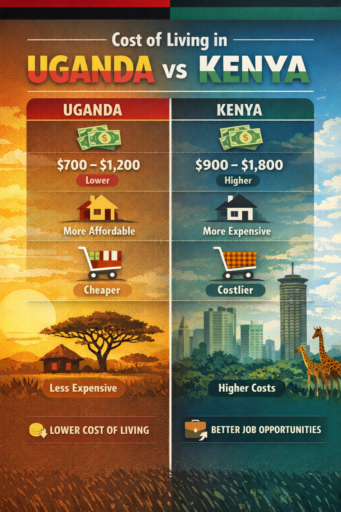
Kenya is generally more expensive than Uganda, especially for expat-style living and in major urban areas.
However, the higher cost in Kenya often reflects better infrastructure, more reliable services, and broader economic opportunities.
Housing Costs
- Uganda:
- 1-bedroom city-center: ~$400/month
- 1-bedroom outside city center: ~$185/month
- Affordable housing is available, especially outside major city centers.
- Kenya:
- 1-bedroom city-center: ~$260/month
- 1-bedroom outside city center: ~$140/month
- Urban housing is more expensive overall, especially for larger or prime-location apartments.
Food and Grocery Prices
- Uganda:
- Milk (1 L): ~$0.68
- Rice (1 kg): ~$1.28
- Loaf of bread: ~$1.03
- Local meals (budget restaurant): ~$3.00
- Everyday groceries and local meals are generally lower‑priced than in Kenya.
- Kenya:
- Milk (1 L): ~$0.75
- Rice (1 kg): ~$1.44
- Loaf of bread: ~$0.51
- Local meals (budget restaurant): ~$4.00
- Groceries and eating‑out costs are higher on average, especially for imported or processed items.
Transportation Costs
- Uganda:
- One-way local transport ticket: ~$0.54–$ 1.34
- Monthly public transport pass: ~$ 32.22–$46.70
- Taxi/Boda-boda rides: Short trips typically ~$1.00–$1.50
- Transport is generally cheap, especially buses and motorcycle taxis, but public networks are informal and less regulated.
- Kenya:
- One-way local transport ticket: ~$0.62–$1.54
- Monthly public transport pass: ~$23.06–$50.14
- Matatus and boda-boda rides: Short trips ~$0.30–$3.00 depending on route
- Kenya’s transport system is more structured and varied, including ride-hailing options, but costs are slightly higher.
Utilities and Internet Expenses
- Uganda:
- Basic utilities (electricity, water, garbage) for an 85 m² apartment: ~$21.48–$174.53/month
- Mobile phone plan (calls + data): ~$8.06–$26.85/month
- Broadband internet (unlimited, ~60 Mbps): ~$32.22–$134.25/month
- Utilities and internet in Uganda are affordable overall but internet reliability can vary outside urban centers.
- Kenya:
- Basic utilities (electricity, water, garbage) for an 85 m² apartment: ~$19.22–$76.88/month
- Mobile phone plan (calls + data): ~$7.69–$30.75/month
- Broadband internet (unlimited, ~60 Mbps): ~$23.06–$76.88/month
- Kenya often has slightly lower monthly utilities and internet costs, plus generally faster and more reliable internet.
Healthcare Costs and Quality
- Uganda:
- Private doctor consultation: ~$20–$55 per visit in Kampala private clinics.
- Private health insurance: ~$150–$550/year for basic expat plans.
- Healthcare in Uganda is cheaper for basic private care, but public facilities are underfunded and limited; expats often rely on private clinics for reliable service.
- Kenya:
- Private GP visit (urban): ~$30–$60 per consultation in reputable private clinics.
- Expat comprehensive health insurance: ~$1,000–$3,000/year for wide coverage.
- Kenya’s private healthcare, especially in cities like Nairobi and Mombasa, is higher quality and more modern, but costs more and generally requires insurance.
Education Costs (for Expats)
- Uganda:
- International school tuition typically ranges from around $5,000–$15,000+ per year for many primary/younger grades, with premium programs often higher in Kampala’s top schools.
- Uganda’s international school fees can be significant but generally fall below the mid‑to‑upper bands seen elsewhere in the region.
- Kenya:
- International school tuition in Kenya broadly ranges from roughly $6,000–$25,000+ per year depending on school, curriculum, and grade level.
- Kenya offers a wider variety of international schooling options, including several premium institutions with higher fees.
Salary Levels and Purchasing Power
- Uganda:
- Average monthly net salary: ~$200
- Salaries are low by global standards, but the lower living expenses in Uganda helps maintain basic purchasing power for local lifestyles.
- Kenya:
- Average monthly net salary: ~$350
- Salaries are higher, especially in cities like Nairobi, but higher living costs reduce the overall purchasing power advantage.
Safety, Infrastructure, and Hidden Costs
- Uganda:
- Power and water reliability: Occasional outages; backup generators or bottled water may add ~$10–$30/month for households.
- Private security (optional for expats): ~$50–$150/month for gated apartments or compound security.
- Lower living costs come with some hidden expenses for reliability and personal safety.
- Kenya:
- Infrastructure reliability: Fewer outages; internet and utilities more dependable.
- Security costs: Gated communities, private guards, and alarms can cost ~$100–$300/month in major cities.
- Better infrastructure and services come with higher associated costs, especially in urban centers.
Is Kenya or Uganda better?
Uganda is better if your priority is affordable living and simplicity, while Kenya is better if you value career opportunities, modern infrastructure, and urban amenities.
Here are the main advantages and disadvantages of living in each country.
Uganda – Pros & Cons
Pros
- Lower cost of living: Daily expenses, housing, and groceries are more affordable than in Kenya.
- Friendly, laid-back lifestyle: Social pace and local culture are relaxed and welcoming.
- Affordable housing and food: Urban and suburban areas provide budget-friendly options for expats.
Cons
- Limited infrastructure: Roads, public transport, and utilities are less developed and sometimes unreliable.
- Lower healthcare quality: Public healthcare is basic, and private facilities are fewer and smaller.
- Fewer job opportunities: Employment options are limited, especially for high-paying professional roles.
Kenya – Pros & Cons
Pros
- Better infrastructure and healthcare: Modern roads, reliable utilities, and higher-quality private hospitals.
- More job opportunities: Cities like Nairobi and Mombasa offer diverse professional careers.
- Modern lifestyle and amenities: International schools, shopping malls, restaurants, and entertainment options are widely available.
Cons
- Higher cost of living: Daily expenses, housing, and groceries are significantly more expensive than in Uganda.
- Expensive housing and schooling: Premium apartments and international schools increase overall monthly costs.
- Urban congestion: Traffic and crowded city areas can reduce convenience and quality of life.
Kenya vs Uganda: Expat Considerations and Lifestyle Adjustments
Uganda offers a lower-cost, slower-paced expat lifestyle with fewer modern conveniences, while Kenya provides a more developed, globally connected environment at a higher cost of living.
These differences shape how expats experience daily life, from work opportunities to access to services.
The key factors below highlight what to expect when living in each country as an expat.
Visa and Residency:
- Uganda: Options include the Special Pass (short-term work), Work Permit (Classes A–G depending on profession/investment), and the East Africa Tourist Visa (short stay); however, long-term work permits can involve significant bureaucracy and documentation.
- Kenya: Common options include the Work Permit (Class D for employment), Class G (investors/business owners), and the Digital Nomad Visa (recently introduced), with relatively more structured processes for professionals, especially in cities like Nairobi.
Cultural Adaptation:
- Uganda: Life is generally relaxed, and communities are close-knit, especially outside major cities.
- Kenya: Urban areas have a faster, cosmopolitan lifestyle, with a more globalized social scene.
Shopping and Services:
- Uganda: Local markets provide affordable essentials; imported goods are more expensive but still accessible in Kampala.
- Kenya: Wider variety of global brands and modern shopping centers, but costs are higher.
Language and Communication:
- English is widely spoken in both countries, but regional languages and accents may require adaptation.
- Expat networks and online communities can ease integration in both Uganda and Kenya.
Conclusion
Choosing between Uganda and Kenya ultimately comes down to how you balance cost, opportunity, and lifestyle expectations.
While Uganda clearly wins on affordability, Kenya’s stronger economy and infrastructure create advantages that go beyond monthly expenses.
For many expats, the decision isn’t just about which country is cheaper, but which environment better supports their long-term goals.
If your income is fixed or remote, Uganda’s lower costs can stretch your budget significantly.
If you rely on local opportunities or value convenience and connectivity, Kenya’s higher costs may be justified.
FAQs
Is Uganda richer than Kenya?
No. Kenya’s economy is significantly larger and more developed, with stronger industries in finance, technology, and services.
Uganda’s economy is smaller and more agriculture-driven, which limits overall national wealth.
What is a good salary in Uganda?
A good monthly salary in Uganda is typically around $800 to $2,000, based on your lifestyle and location.
This range allows for comfortable living in urban areas and covers housing, food, and basic services.
How much is $100,000 taxed in Kenya?
On $100,000 of taxable income, you can expect to pay roughly $25,000 to $30,000 in tax after applying progressive bands.
Kenya taxes income up to a top rate of 35%.
Which is the best country in Africa to live in?
South Africa and Mauritius are often ranked among the best countries in Africa to live in.
In comparison, Kenya offers strong career opportunities and modern infrastructure, while Uganda provides a lower-cost, relaxed lifestyle.
Pained by financial indecision?

Adam is an internationally recognised author on financial matters with over 830million answer views on Quora, a widely sold book on Amazon, and a contributor on Forbes.