In today’s podcast I discuss some of the news stories that have caught my eye in the last few days such as Nikkei highest in 29-years.
Those included:
- Stock markets hitting record highs in the US and the Japanese stock market hitting the highest point since the early 1990s
- What trends could we see in 2021
- The situation with AliBaba
- Could house prices crash in big cities?
For your convenience, and to give credit to the original writers, I have included links to the articles I referred to and copied them below.
NEW YORK (Reuters) — Asian shares jumped on Tuesday, with Japanese stocks hitting a 29-year high, as hopes that a long-awaited U.S. pandemic relief package would be expanded and a Brexit trade deal supported investor risk appetites.
Japan’s Nikkei leapt 0.9% to its highest since March 1991, while Australian shares climbed 0.7% and futures for the S&P 500 added 0.3%.
The U.S. House of Representatives had voted earlier to increase stimulus payments to qualified Americans to $2,000 from $600, sending the measure on to the Senate for a vote.
While it is not clear how the measure will fare in the Senate, President Donald Trump’s signing on Sunday of a $2.3 trillion pandemic bill, which included the $600 payments, had sent shares on Wall Street to record highs overnight as it increased optimism about an economic recovery.
“With the Brexit…and the U.S. stimulus deal now in the rear-view mirror, there is a sense of relief that we have avoided the respective worst-case scenarios,” said Stephen Innes, chief global market strategist at Axi, a broker.
Firmer demand for riskier assets kept the U.S. dollar, which is often seen as a “safe-haven” asset, on the back foot. It was down 0.02% against a basket of major currencies.
Shorting the dollar has been a popular trade recently and calculations by Reuters based on data released by the Commodity Futures Trading Commission on Monday suggested this could endure. Short positions on the dollar swelled in the week ended Dec. 21 to $26.6 billion, the highest in three months.
Sterling softened to $1.3462 as investors continued to take profits in the currency following the confirmation last week of a trade UK-EU trade deal that was widely expected.
A sluggish dollar bolstered gold prices, which rose 0.4% to $1,878.76 an ounce.
Oil prices recovered a touch after falling overnight on concerns that new travel restrictions on the back of the COVID-19 pandemic would weaken fuel demand, and as the prospect of increased supply dragged on prices.
U.S. crude was up 0.48% to $47.85 a barrel.
2. China orders Alibaba founder Jack Ma to break up fintech empire – Theguardian
China has escalated its campaign to rein in the vast tech empire controlled by Jack Ma, the co-founder of Alibaba and one of the country’s richest people.
Authorities in Beijing, who had on Christmas Eve ordered an investigation into allegations of “monopolistic practices” by Ma’s online retail giant, have now ordered his financial technology company Ant Group to scale back its operations.
Pan Gongsheng, a deputy governor of China’s central bank, said Ant’s corporate governance was “not sound” and ordered it to “return to its origins” as a payment services provider.
Pan, who had summoned Ant representatives to a meeting with regulators in Beijing on Saturday, said Ant must “strictly rectify illegal credit, insurance and wealth management financial activities”. Ant divisions offering those services are the business’s fastest-growing and most profitable operations, analysts said.
n a statement, Ant Group said it would establish a “rectification working group” and “fully implement requirements” sought by the regulator.
“We will enlarge the scope and magnitude of opening up for win-win collaboration, review and rectify our work in consumer rights protection, and comprehensively improve our business compliance and sense of social responsibility,” the company said. “Ant will make its rectification plan and working timetable in a timely manner and seek regulators’ guidance in the process.”
The latest salvo in Beijing’s battle against Ma – who had been feted as China’s greatest modern-day entrepreneur until he started speaking out against strict regulations – wiped 8% off the value of Alibaba’s share price in Hong Kong trading on Monday.
Alibaba’s shares have lost more than a quarter of their value since 24 October, when Ma accused China’s financial regulators and state-owned banks of operating a “pawnshop” mentality at a high-profile summit in Shanghai.
Chinese Communist party officials hit back, accusing Ma’s company’s of breaching various regulations and intervened to block the $37bn (£27bn) flotation of Ant Group just two days before dealing was due to begin in Shanghai and Hong Kong.
The crackdown on Ma’s business activities has wiped more than $10bn (£7.4bn) from his fortune, and knocked him into second place on the list of China’s richest people with an estimated $49bn, according to the Bloomberg billionaires index. The wealthiest person in China is now Pony Ma (no relation), the chairman and chief executive officer of the rival tech firm Tencent.
Zhang Zihua, chief investment officer of the asset manager Beijing Yunyi Asset, said investors were concerned that Beijing’s campaign against Ma’s companies could continue even if they implemented all the changes required. “The antitrust investigation into Alibaba has yet to specify the penalties, which is worrying investors a lot,” he said.
Li Chengdong, a Beijing-based technology analyst, said the action against Ant was also weighing heavily on other Chinese tech companies. “The new regulations are hurting big internet platforms, so Tencent and other tech companies are also seeing their share prices going down,” Li said. “Alibaba now is the target of the regulators so the reaction is stronger.”
On Christmas Eve China’s state market supervision administration said it had ordered an investigation into Alibaba Group Holdings Ltd over “suspected monopolistic practices”.
An editorial in the People’s Daily Chinese state mouthpiece said efforts to prevent monopoly and anti-competitive practices were “requirements for improving the socialist market economy system and promoting high-quality development.
“This investigation does not mean that the country’s attitude towards the encouragement and support of the platform economy has changed.”
Analysts and policy experts said Beijing’s action against Ma’s companies was likely to have been sparked by the blunt speech he gave to the Bund summit in Shanghai on 24 October, criticising overbearing regulation and the state dominance of banking.
“We shouldn’t use the way to manage a train station to regulate an airport,” Ma said, according to a transcript. “We cannot regulate the future with yesterday’s means.
“It is impossible for the pawnshop mentality to support the financial demand of global development over the next 30 years,” said Ma, who started Alibaba in a one-bedroom flat in China 21 years ago. “We must leverage our technological capabilities today and build a credit system based on big data, to get rid of the pawnshop mentality.”
Ma was speaking alongside senior officials such as Wang Qishan, a former security tsar and the Chinese leader Xi Jinping’s right-hand man; Yi Gang, the governor of China’s central bank; and Zou Jiayi, vice-minister at the ministry of finance. Ma’s comments went viral on Chinese social media and were seen as a direct attack on government officials.
In November, Ant Group was preparing for what would have been the world’s largest initial public offering when it was suddenly shut down by Beijing, 48 hours before trading would have begun in Shanghai and Hong Kong. Before the suspension, investors had valued Ant at $316bn (£234bn), more than the valuations of China’s biggest banks and those of the US and the UK.
At the time the halt was blamed on “changes to the financial technology regulatory environment and other major issues”, but analysts interpreted the intervention as a warning to Ma.
“The party has once again reminded all private entrepreneurs that no matter how rich and successful you are it can pull the rug out from under your feet at any time,” wrote Bill Bishop, author of the China-focused newsletter Sinocism.
As the government prepares to roll out the first coronavirus vaccines, much of the nation will be anticipating a return to a more ‘normal’ life in 2021. But for London’s housing market there may be no going back to normal. New research from flatshare site SpareRoom shows that 49 per cent of the capital’s renters who intend to move plan to quit the city for good once the pandemic is over.
According to the research, 27 per cent of renters in London plan to move after the pandemic has come to an end, with half of them (49 per cent) determined to leave the city. The upshot is a projected 13 per cent net exodus of renters from London. What’s more, with 60 per cent of all renters who plan on moving post-Covid-19 are not looking to move to a major city, a wider shift away from city living looks likely.
SpareRoom’s survey also shows that one in ten (9 per cent) renters have moved during the pandemic. This figure more than doubles for 23-29-year olds however, with 24 per cent of this age group having moved within the last nine months. Overall, reasons for moving mid-pandemic included needing to save money (22 per cent), loss of job and income (9 per cent), a desire to live in a different area (26 per cent), to be closer to family and friends (15 per cent) and to live with a partner (15 per cent).
The research also highlights a huge affordability crisis for young people, with one in three people (33 per cent) aged 23-29 saying they live with their parents. This figure only drops to one in five (18 per cent) for people in their thirties.
Matt Hutchinson, SpareRoom Director said, “We’re looking at a redrawing of the UK’s rental map in 2021 and London will be the biggest loser. Whether it’s down to the catastrophic effects of Covid on tourism, hospitality and the arts, driven more by lifestyle factors like wanting outdoor space, or simply the realisation that many jobs can now be done from anywhere, London living is losing its appeal for many.
“We’ve already seen the effects on London rents, with averages falling consistently since spring. What happens next is the interesting thing. This could be the start of a changing UK economy that relies less on London and the South East, as remote working becomes the new norm. If that’s the case, London rents are unlikely to recover quickly and house prices could follow suit once the stamp duty holiday ends.”
4. Future shock: how will Covid change the course of business?
Coronavirus has changed lives and industries across the UK, accelerating fundamental shifts in behaviour and consumption that were already on their way. Debates about home working, preserving local high streets and the ethics of air travel were bubbling away before coronavirus rampaged across the world, but the consequences of the worst pandemic in more than a century have either settled those arguments or boosted the momentum behind certain lifestyle changes. Here we look at how those debates have been changed – or resolved – by Covid-19.
Streaming will take away cinema’s pre-eminence
Coronavirus won’t kill cinema, but it will forever change the movie-going experience. This year the global box office is likely to be just a quarter of the record $42bn (£31bn) set in 2019 and UK cinema admissions are set to hit their lowest level since records began.
At the start of the pandemic theatre owners were confident that once the virus had been tamed, the blockbusters and their fans would return. However, Hollywood studios, fearful of empty seats making for box office flops, spied an unprecedented chance to bypass cinemas and make films available via streaming services. This has broken the sacrosanct tradition of months of big-screen exclusivity, outraging theatre owners who rely on that model to make their businesses viable.
Warner Bros has said its entire slate of 21 films, from Dune to The Suicide Squad, will debut on its streaming service, HBO Max, at the same time as in US cinemas next year. The same thing has already happened to Wonder Woman 1984, which was simultaneously released to US theatres and living rooms on Christmas Day. A precedent has been set over separating cinema release from streaming availability.
Cinema still has a role to play. The economics of blockbusters, which cost hundreds of millions to make and distribute, means films of such scale need the multimillion-dollar returns from the big-screen global box office. But in the future it is likely that movie fans will no longer have to wait endless months before streaming the latest blockbuster from their sofa. Mark Sweney
Should rail be nationalised?
Rail was regarded as a privatisation too far even by Margaret Thatcher, before her Conservative successors went ahead in 1994. Then state spending on the industry vastly increased after Railtrack collapsed and the infrastructure behind it was brought under government control as Network Rail, although the franchise owners who operated the trains remained privately controlled.
Private train operators liked to take credit for the passengers who flocked back in record numbers; but most voters still backed nationalisation, polls showed. Even though a decade of intermittent franchising troubles showed reform was desperately needed, and the government had to step in twice to take over the east coast mainline, only Labour under Jeremy Corbyn gave a full-throated commitment to return the rest of rail into public hands.
But Covid-19 and lockdown restrictions meant passengers all but disappeared for parts of 2020. Following years of unresolved debate and inquiry over the best format for the industry, franchises were summarily scrapped overnight in March. Emergency contracts are more or less embedded until 2022: the industry now runs on Treasury cash, and is likely to do so for some time to come. British Rail may be history but nonetheless, by July the Office for National Statistics had reclassified the industry as, de facto, renationalised. Gwyn Topham
Do we need a third Heathrow runway?

At the start of the millennium the Labour government concluded expansion of Heathrow was the answer to airport capacity constraints, granting planning permission which was overturned by the coalition in 2010. After another commission re-examined all the options, a third Heathrow runway was again approved by MPs in 2018.Advertisement
A legal challenge to the policy on environmental grounds was first rejected, then upheld on appeal, before finally being dismissed by the supreme court this month.
In the long term, the climate crisis arguments might indeed prove the most compelling. But for now it is coronavirus that has all but swept aside the arguments for expansion. At its peak, Heathrow was constrained to its maximum permitted movements: a plane taking off or landing every 45 seconds, and passenger numbers growing beyond 70 million a year only through bigger, fuller planes.
Yet November’s traffic figures showed only a tenth of the usual number of passengers passing through, leaving the airport using only one runway. Given the potential for a permanent decline in long-haul and business travel since the world turned to Zoom, the airport may struggle to present a compelling business case for expansion for some time to come. Gwyn Topham
The high street is in terminal decline
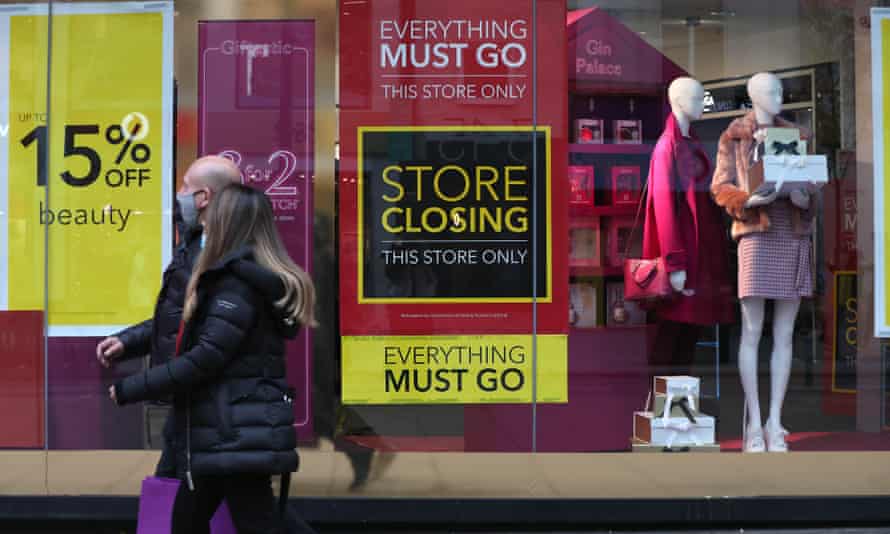
The tumbleweed bowled down high streets this year as home working supercharged the growth of online shopping, with Debenhams and Topshop-owner Arcadia among the big casualties. And the shift is clear. In the third quarter of this year, 27% of retail sales were online compared with 18% the year before, according to the Office for National Statistics.
The pandemic pressed fast-forward on the painful restructuring process of an industry where fewer stores are needed to meet the needs of shoppers in the internet age. With each year more clothing, homeware and food will be bought online. This will create jobs for delivery drivers and in warehouses but not in shops, which employ around 3 million people across the UK.Advertisement
What will happen with these empty stores? Rents have fallen sharply as landlords adjust to the post-pandemic reality, and changed working patterns show how neighbourhoods can blossom when people live and work nearby. This creates opportunities for businesses with the right offer and cost base. For instance, empty department stores are being converted into flats, food halls and crazy-golf courses. The high street is dead, long live the high street – but not as we knew it. Zoe Wood
Working from home will replace office life

Technology rode to the rescue for British businesses when they had to send their staff home in the spring. High-speed internet, video-conferencing, chatrooms: everything required to work remotely was already widely available.
As a result, the year of working from home has generally been considered a great success. Banks are leading the drive for a permanent shift with Lloyds Banking Group and Barclays reviewing the amount of office space they use and Standard Chartered permanently shifting to flexible routines. Google and Facebook, which have substantial workforces in the UK, will embrace partial homeworking permanently.
But working from home isn’t without its challenges. The impact on creativity, loss of interaction and serendipitous conversations, and lack of support for younger staff, are all cited as good reasons to return to offices. Workers juggling childcare and their job, and employees living in cramped flats, have also missed their desks.
Nonetheless, it appears that home working has been a bigger hit in the UK than elsewhere. British office workers were spending an average of 2.7 days per week at home in November, according to the US bank Morgan Stanley, compared with 2.1 days in France and Italy, and slightly less than that in Germany and Spain. Research found that UK workers spent just over a third (39%) of their working hours in the office in November, lagging the European average of 56%. The trend looks set to continue, with UK employees expected to request flexible working for 2.3 days per week, more than in the other four European nations. Joanna Partridge
Renewables can provide the UK’s energy needs

Any lingering doubt that the UK’s wind turbines and solar farms can provide a backbone for the electricity system were cast aside during the pandemic as renewable energy set new records through the year.
The collapse in energy demand following the lockdown of office blocks, schools and restaurants – combined with the UK’s bright, breezy weather – helped renewable energy make up almost half of all electricity in the early months of the year. New records for solar power and wind generation followed in June and December respectively.
Stephen Stead, a director at energy provider SSE, said the low electricity demand levels in 2020 “gave us an unprecedented peek at a future electricity market dominated by renewables – and we learned that we can do it”.
Wind and solar power will be able to play an even greater role in the future as investment in battery storage and flexible energy use becomes the norm. But in 2020 renewables proved they are already prepared to exceed expectations.Jillian Ambrose
Cash is (eventually) doomed
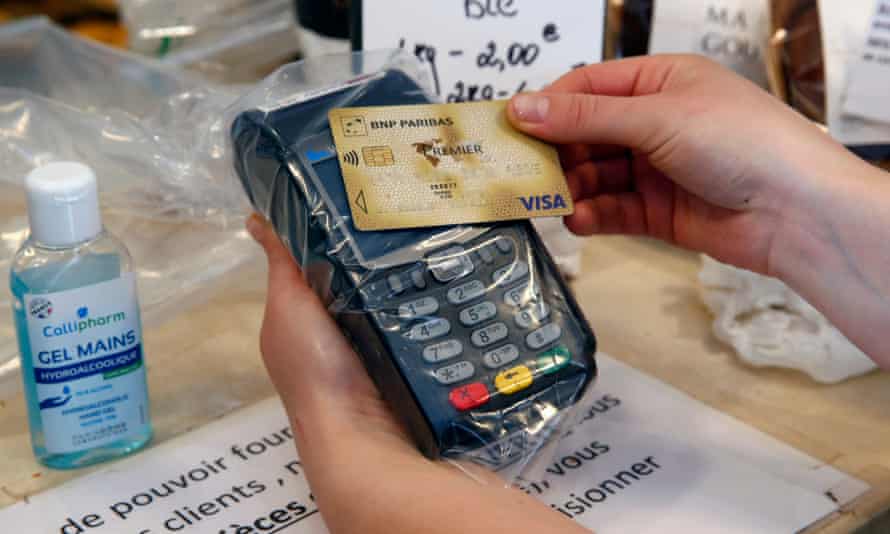
The move to cashless payments accelerated this year, partly because so much spending moved online, and partly because of fears of infection through notes and coins. The contactless limit was raised to £45 and many outlets went cash-free.
According to the ATM provider Link, in the first full week of the spring lockdown withdrawals fell by 57% in value compared with the same week in 2019. Numbers went up as restrictions were eased, but by October the value of cash withdrawals was still down by 30% year-on-year.
However, throughout the year there have been queues outside banks, and the Bank of England has reported that the value of notes in circulation has increased since March, to approaching £80bn. In the days prior to November’s lockdown, cash withdrawals surged.
There is still a core of people who use and depend on cash, and holding physical money seems to be a safety measure for some. Early on in lockdown, a Link survey found 14% consumers were keeping more cash at home in case of emergencies. The decline of cash as a payment method has been speeded up, but there is still a long way to go before we give it up.