Asset confidentiality refers to the legal and structural mechanisms used to limit public visibility of ownership over wealth, investments, or corporate interests.
For high-net-worth individuals (HNWIs), confidentiality is not about hiding wealth or avoiding taxes. Instead, it is about reducing exposure to litigation, financial surveillance, political risk, and targeted fraud.
Effective asset confidentiality relies on legal structures, jurisdictional diversification, and compliant reporting frameworks that separate personal identity from asset ownership while remaining fully lawful.
Without such structures, personal wealth can become highly visible in corporate registries, property records, and banking systems, increasing vulnerability to disputes, creditor claims, and opportunistic legal actions.
Key Takeaways:
- Asset privacy protects HNWIs from unnecessary financial exposure.
- Legal structures and multi-jurisdiction planning are central to effective privacy.
- Compliance with global reporting standards ensures lawful protection.
My contact details are hello@adamfayed.com and WhatsApp +44-7393-450-837 if you have any questions. We also offer bespoke structuring solutions tailored to your situation.
The information in this article is for general guidance only, does not constitute financial, legal, or tax advice, and may have changed since the time of writing.

What is the difference between privacy and secrecy in asset protection?
Asset privacy uses legal structures and compliant frameworks to limit unnecessary exposure of wealth while remaining fully above board. Asset secrecy tries to hide ownership or assets from regulators, which can be quite risky.
The difference is critical in the modern regulatory environment shaped by transparency initiatives such as:
- Financial Action Task Force (FATF)
- Organisation for Economic Co‑operation and Development (OECD)
- Common Reporting Standard
These initiatives have significantly reduced the viability of secrecy-based wealth planning by increasing financial information sharing and compliance requirements across jurisdictions.
Privacy vs Secrecy in Asset Protection
| Concept | Meaning | Compliance Risk |
| Privacy | Limiting public visibility of asset ownership through legal structures | Low |
| Confidentiality | Controlled disclosure to regulators while limiting public exposure | Low |
| Secrecy | Concealing assets from authorities or regulators | High |
What Is Asset Confidentiality?
Asset confidentiality refers to the legal separation between asset ownership and public identity.
This is typically achieved through structures such as:
These structures create layers of legal ownership, meaning the individual is not always directly listed in registries or corporate filings.
For example:
- A trust may hold a family investment portfolio.
- A holding company may own real estate across multiple countries.
- An SPV may hold a private equity investment.
Why Asset Confidentiality Matters for High-Net-Worth Individuals
For wealthy families and international investors, asset confidentiality is about controlling how assets appear in public records and legal proceedings, limiting unnecessary exposure of personal financial information.
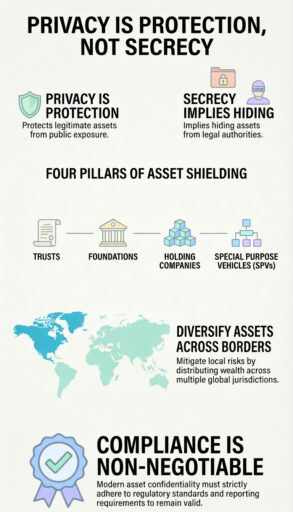
One key reason is litigation and creditor risk. When assets are held directly in an individual’s name, they are easier to identify and target.
Structuring ownership through legal entities or fiduciary arrangements separates personal identity from asset ownership, reducing direct legal exposure.
Asset confidentiality also supports personal security.
High-profile individuals and wealthy families are often more exposed to financial scams, targeted fraud, and—in some regions—kidnapping risks.
Cross-border privacy is another factor. Many high-net-worth investors hold assets across multiple jurisdictions.
Without confidentiality structures, wealth can become scattered across corporate registries, property databases, and financial disclosures, making it easier to map an individual’s global financial profile.
Offshore vs Onshore Confidentiality Structures
Asset confidentiality structures can exist both offshore and onshore. The distinction lies primarily in jurisdictional privacy laws and registry transparency requirements.
Offshore Structures
Offshore jurisdictions often provide:
- stronger confidentiality protections
- private corporate registries
- specialized trust legislation
Common jurisdictions used for confidentiality planning include:
- Cayman Islands
- British Virgin Islands
- Singapore
- Nevis
However, most reputable offshore jurisdictions now participate in global reporting frameworks.
Onshore Structures
Some developed countries such as the United States, Switzerland, and Luxembourg also offer strong confidentiality structures, including:
- domestic trusts
- private investment companies
- family offices
These structures often prioritize legal robustness over anonymity.
Can Banks Guarantee Confidentiality for HNWIs?
Banks provide client confidentiality, but they cannot guarantee absolute privacy.
Modern financial institutions must comply with international reporting frameworks such as:
As a result, structural planning is the primary method of maintaining confidentiality today, not banking secrecy.
How Trusts Keep Wealth Private
Trusts are one of the most widely used tools for asset confidentiality.
A trust separates three roles:
- Settlor – the person who establishes the trust
- Trustee – the legal owner managing the assets
- Beneficiary – the person benefiting from the assets
Because the trustee is the legal owner, the assets are often not directly linked to the beneficiary in public registries.
This structure can provide confidentiality, succession planning, creditor protection, and centralized wealth management.
Compliance Risks of Offshore Confidentiality Structures
Poorly structured offshore arrangements can trigger serious compliance issues if assets are not properly declared or transparency rules ignored.
Aggressive secrecy-based structures are increasingly difficult to maintain under global frameworks like the Common Reporting Standard (CRS).
Today, offshore structures must be designed for full regulatory compliance rather than relying on concealment, or investors risk penalties and scrutiny.
What Is the Safest Way to Protect Assets as an Expat?
The safest way for cross-border HNWIs to protect assets is a layered, compliant approach that balances privacy, legal protection, and regulatory adherence.
Key elements typically include:
- Jurisdiction diversification
- Legal ownership structures
- tax-compliant reporting
- professional fiduciary oversight
Asset protection strategies should always be designed in coordination with legal and tax advisors to ensure full compliance.
How to Protect Personal and Corporate Assets
Protecting wealth requires separating personal risk from business risk while structuring ownership in a way that reduces legal exposure, financial visibility, and operational vulnerability.
For high-net-worth individuals and expat entrepreneurs, asset protection is typically achieved through legal structuring, jurisdictional planning, and risk diversification rather than a single protective mechanism.
Separate Personal and Business Assets
The most fundamental asset protection rule is legal separation of ownership.
When personal and corporate finances are mixed, creditors or litigants may attempt to pierce the corporate veil and claim personal wealth in legal disputes.
Typical separation methods include:
- Establishing limited liability companies or corporations
- Holding personal investments outside operating companies
- Avoiding commingling of business and personal bank accounts
- Using formal shareholder structures for business ownership
Limited liability structures exist in many jurisdictions, including:
- United Kingdom limited companies
- Singapore private limited companies
- United Arab Emirates free-zone companies
These structures ensure that business debts generally remain confined to the company rather than the owner.
Use Holding Companies to Ring-Fence Risk
Many wealthy entrepreneurs avoid owning assets directly through operating businesses.
Instead, they create a holding company structure:
Holding Company
↓
Operating Company
↓
Assets or investments
Under this model, the operating company runs the business while the holding company owns the shares or valuable assets.
Consider Trusts or Foundations for Long-Term Asset Protection
Trusts and private foundations are widely used by wealthy families to separate ownership from control.
Because the assets are owned by the trust rather than the individual, they may be better protected from personal liabilities, estate disputes, and creditor claims.
Trust legislation in certain jurisdictions has been specifically designed to enhance asset protection, including:
- Nevis
- Cook Islands
- Cayman Islands
- UK Non-Resident Trusts (primarily for tax-efficient estate planning)
These jurisdictions have developed specialized trust laws tailored for international wealth planning.
Diversify Assets Across Jurisdictions
Geographic diversification is another key element of protecting wealth.
Holding all assets in a single country can expose individuals to political risk, currency restrictions, legal system changes, and regulatory shifts.
Many HNWIs therefore diversify wealth across multiple financial centers, such as Singapore, Zurich, and Dubai.
Use Special Purpose Vehicles (SPVs) for Individual Assets
High-value assets are often held through special purpose vehicles (SPVs) rather than directly in an individual’s name.
Examples include:
- real estate holding companies
- aircraft ownership companies
- investment SPVs for private equity
By isolating assets within dedicated legal entities, liabilities associated with one asset do not automatically affect the owner’s broader wealth structure.
Maintain Strong Compliance and Documentation
Asset protection strategies must always operate within regulatory and reporting frameworks.
For this reason, compliant asset protection requires:
- proper beneficial ownership disclosures
- tax reporting where required
- audited corporate records
- professional fiduciary oversight
Combine Structures Rather Than Relying on One Strategy
The most resilient asset protection strategies typically combine several mechanisms simultaneously, such as:
- corporate separation
- holding companies
- trusts or foundations
- multi-jurisdiction banking
- diversified investment platforms
This layered approach ensures that no single legal challenge can easily compromise an individual’s entire wealth structure.
Why Most Asset Protection Strategies Fail HNWIs
Most asset protection strategies fail because they are designed too late, structured incorrectly, or rely on outdated assumptions about financial secrecy.
High-net-worth individuals (HNWIs) often assume that a single offshore company, trust, or bank relationship will safeguard their wealth.
In reality, effective asset protection requires layered legal structures, jurisdictional planning, and strict compliance with international transparency rules.
Without these elements, wealth structures can be vulnerable to litigation, regulatory scrutiny, creditor claims, and cross-border reporting obligations.
The Core Problem: Asset Protection Is Often Reactive
A fundamental reason asset protection fails is timing.
Many individuals attempt to protect assets after a legal dispute, business crisis, or creditor threat has already emerged. At that point, restructuring assets may be challenged under fraudulent transfer laws.
Courts in many jurisdictions can reverse asset transfers if they believe the restructuring was designed to avoid creditors.
The Future of Asset Confidentiality and Asset Protection
The global financial system is becoming increasingly transparent, with expanded beneficial ownership registers, reporting frameworks, and international data-sharing agreements.
Yet transparency does not eliminate the need for asset protection; it merely changes the objective.
The future of wealth protection will focus less on secrecy and more on legally compliant confidentiality, jurisdictional diversification, and professional wealth structuring.
For high-net-worth individuals operating internationally, the goal is no longer hiding assets but safeguarding wealth while remaining fully compliant and resilient in a transparent financial system.
FAQs
What is the purpose of an asset protection trust?
An asset protection trust separates legal ownership of assets from the beneficiary, shielding wealth from creditor claims, litigation, and personal liability while remaining fully compliant.
It also supports succession planning, centralized wealth management, and cross-border privacy.
Where can I put my money where I can’t touch it?
Funds can be placed in legally structured trusts, foundations, or locked investment vehicles that restrict direct access by the settlor or account holder.
These arrangements are designed to enforce long-term wealth preservation and governance rules.
Where to put your money if you don’t trust banks?
Alternative structures include private investment companies, holding companies, special purpose vehicles (SPVs), and compliant offshore trusts.
Diversifying across jurisdictions and using professionally managed structures mitigates the risk of relying on a single financial institution.
What is the best jurisdiction for asset protection?
The optimal jurisdiction varies based on your residency, tax obligations, and asset types. Common options for strong privacy and legal protection include:
Offshore: Cayman Islands, Nevis, British Virgin Islands, Cook Islands
Onshore: Switzerland, Singapore, Luxembourg, United States (certain trusts)
While these jurisdictions offer robust legal frameworks and specialized trust laws, effective asset protection depends primarily on proper legal structures and compliance — it’s not about jurisdiction alone.
Pained by financial indecision?

Adam is an internationally recognised author on financial matters with over 830million answer views on Quora, a widely sold book on Amazon, and a contributor on Forbes.