For high-net-worth investors, FATCA, CRS, and CARF compliance isn’t just mandatory—it can be leveraged strategically for structuring investments efficiently.
This involves designing entities and beneficiary arrangements with reporting outcomes in mind, embedding bank-ready data flows with annual reconciliations, and maintaining a fast-response tax and support channel for multi-country issues.
When these processes are in place, transparency becomes governance that preserves access to global banking and investment opportunities. Without them, investors face avoidable friction, higher costs, and regulatory escalation.
Key Takeaways:
- Compliance with FATCA, CRS, and CARF is mandatory but can be leveraged strategically.
- Transparency now serves as a competitive advantage in global wealth management.
- Designing entities with reporting in mind ensures legal protection and operational efficiency.
- Proactive planning prevent penalties and maintain long-term flexibility.
My contact details are hello@adamfayed.com and WhatsApp +44-7393-450-837 if you have any questions. We also offer bespoke structuring solutions tailored to your situation.
The information in this article is for general guidance only, does not constitute financial, legal, or tax advice, and may have changed since the time of writing.

How FATCA, CRS, and CARF Have Changed Wealth Planning Forever
The Foreign Account Tax Compliance Act (FATCA), the Common Reporting Standard (CRS), and the Crypto-Asset Reporting Framework (CARF) have made cross-border reporting mandatory.
These has fundamentally reshaped international wealth planning for high-net-worth investors.
FATCA now anchors US-linked reporting, CRS spans more than 100 jurisdictions, and CARF is extending that framework to digital assets.
Together, these regimes have turned international transparency into a baseline requirement rather than an optional consideration.
Ignoring them no longer just creates legal exposure; it actively restricts access to reliable banking, institutional-grade investment platforms, and credible multi-jurisdictional structures.
Non-compliance narrows opportunity, while structured compliance expands it.
- Compliance now determines access, not just legality.
- Wealth structures must be disclosure-ready to remain viable.
- Jurisdiction choice affects stability and counterparties as much as tax outcomes.
- Using non-reporting jurisdictions as a privacy workaround often increases risk with limited upside.
What strategies protect wealth under FATCA, CRS, and CARF?
Even with mandatory reporting, investors can protect wealth and maintain flexibility using jurisdictional diversification, entity structures, digital asset oversight, and integrated advisory teams.
- Jurisdictional diversification: Blend compliant and non-reporting jurisdictions carefully to balance privacy, access, and risk.
- Entity structuring: Trusts, foundations, and holding companies still provide governance, succession, and asset protection—if fully integrated with reporting.
- Asset allocation: Multi-jurisdictional portfolios require oversight to meet reporting obligations without disrupting strategy.
- Digital asset oversight: CARF requires crypto compliance; proactive structuring is essential.
- Integrated advisory teams: Coordinated legal, tax, and investment advisors prevent gaps and optimize decisions.
Modern wealth planning is no longer about hiding assets but about leveraging compliance.
Investors can design compliant structures that preserve legal privacy, expand opportunity, and reduce exposure to regulatory risk.
How trusts or foundations function in a reporting world
Despite automatic exchange of information and enhanced compliance, trusts and foundations still provide legal structuring, estate planning, and asset protection.
They require careful governance, documentation, and reporting to preserve their legal and strategic advantages.
- Transparency obligations: Many jurisdictions now require trusts and foundations to report their beneficial owners to domestic or international authorities (e.g., EU Beneficial Ownership Registers, CRS reporting).
- Tax compliance: Income, distributions, and capital gains are generally reported to the relevant tax authority of the settlor, founder, or beneficiaries, depending on the trust/foundation type and local law.
- Purpose remains: Despite reporting, they continue to facilitate succession planning, wealth preservation, philanthropy, and centralized management of assets.
- Professional administration matters: Experienced trustees or foundation boards ensure that reporting, compliance, and governance obligations are met while maintaining the legal and strategic benefits of the structure.
- Global mobility impact: For international clients, trusts and foundations are no longer hidden vehicles. They are transparent but flexible, allowing legitimate global planning without secrecy, which aligns with modern compliance standards.
Not all levers carry equal weight, and the interplay between compliance regimes and strategic planning can be complex.
A clear, structured approach shows investors which actions matter most.
It allows compliance to be integrated into broader wealth strategies without sacrificing optionality or exposure.
Why Non-CRS and Non-CARF Jurisdictions Are Not a Free Pass
Non-participating countries can offer limited tactical advantages, but home-country compliance always dominates.
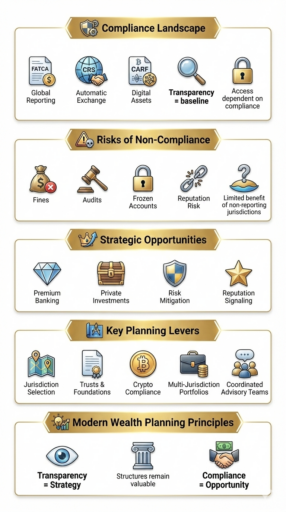
Investors frequently overestimate the privacy benefits of non-CRS and non-CARF jurisdictions, assuming that the absence of formal reporting equates to insulation from scrutiny.
That assumption is increasingly unreliable as banks, counterparties, and regulators apply enhanced due diligence standards regardless of a jurisdiction’s reporting status.
These jurisdictions can still serve specific functions within a compliant structure, including estate planning, digital asset management, or geographic diversification.
Their value lies in how they are integrated, not in their ability to bypass disclosure.
Investors who treat non-reporting jurisdictions as a substitute for compliance expose themselves to enforcement risk, banking restrictions, and reputational consequences without achieving meaningful long-term privacy.
How can compliance become a strategic advantage for investors?
Compliance is not merely a legal obligation. It unlocks access to premium banking, investment opportunities, and risk mitigation advantages.
- Banking and credit: Fully compliant clients access premium services, global credit, and investment platforms.
- Investment opportunities: Structured products and private placements often require transparency.
- Reputation signaling: Transparency builds trust with banks, advisors, and partners.
- Risk mitigation: Proactive compliance reduces audits, penalties, and account freezes.
Transparency is increasingly a form of currency in global wealth management.
Investors embracing it strategically gain advantages over peers who focus solely on privacy or non-reporting jurisdictions.
Which Compliance and Planning Strategies Should Investors Prioritize?
High-net-worth investors should prioritize jurisdiction selection, entity structures, digital asset management, investment timing, and coordinated advisory teams.
These levers remain essential in a FATCA, CRS, and CARF reporting backdrop.
| Planning Lever | Key Action | Strategic Benefit | Compliance Notes |
| Jurisdiction Selection | Choose reporting-friendly yet stable jurisdictions; blend compliant & non-reporting carefully | Access to banking, investment platforms, and reduced enforcement risk | Must align with CRS/FATCA/CARF requirements |
| Entity Structures | Use trusts, foundations, holding companies with proper reporting | Estate planning, asset protection, succession, governance | Beneficial ownership and reporting obligations remain mandatory |
| Digital Asset Management | Integrate CARF-compliant crypto oversight | Avoid penalties, access institutional-grade crypto services | Reporting of crypto holdings and transactions is required |
| Investment Timing & Allocation | Coordinate multi-jurisdictional portfolios with tax reporting | Optimize growth, reduce friction from audits or freezes | Must ensure accurate reporting of income, gains, and distributions |
| Coordinated Advisory Teams | Legal, tax, and investment advisors work in unison | Gap-free compliance, risk mitigation, strategic alignment | Collaboration ensures all reporting regimes are fully covered |
FAQs
What is CARF reporting?
CARF (Crypto-Asset Reporting Framework) is an international standard for reporting crypto-asset holdings and transactions.
It enables tax authorities to automatically receive information on cross-border crypto accounts and trades, promoting transparency and preventing tax evasion in the digital asset space.
What is CRS used for?
CRS (Common Reporting Standard) is used to collect and exchange financial account information between participating countries.
Its main purpose is to ensure tax authorities can identify offshore holdings of their residents and enforce correct taxation.
Who needs to declare FATCA?
FATCA (Foreign Account Tax Compliance Act) requires US persons, including citizens, residents, and certain entities, to report foreign financial accounts and assets to the IRS.
Foreign financial institutions also report on US account holders.
What is the difference between CARF and CRS?
CARF is a framework for the automatic exchange of financial information at a global level, while CRS is a specific standard under CARF used by over 100 countries to report cross-border accounts for tax purposes.
These are complementary OECD frameworks for global tax planning and transparency.
What is the difference between FATCA and CRS reporting?
FATCA is US-specific, targeting US taxpayers’ foreign assets, while CRS is multilateral and covers many jurisdictions worldwide.
Both require reporting of foreign accounts, but CRS is reciprocal among participating countries, whereas FATCA primarily serves US tax enforcement.
Can non-CRS or non-CARF jurisdictions still be used strategically?
Yes—but only when combined with full compliance in the investor’s home country.
Using non-reporting jurisdictions without transparency can expose investors to legal risk.
Does CARF reporting make crypto planning impossible?
No. Crypto planning is still possible, but it requires proactive oversight, careful tracking of holdings, and strategic selection of jurisdictions to ensure compliance with reporting obligations.
What are the consequences of ignoring FATCA/CRS/CARF?
Ignoring these requirements can lead to multi-jurisdictional fines, frozen accounts, reputational damage, and in some cases, criminal liability for tax evasion or failure to report assets.
How often should strategies be reviewed?
Strategies should be reviewed annually—or sooner if new assets, jurisdictions, or reporting requirements are introduced—to ensure continued compliance and optimal structuring.
Are non-reporting countries a safe haven for wealth?
Not inherently. Non-reporting countries may offer temporary privacy, but true security comes from lawful compliance, proper structuring, and alignment with home-country obligations.
Relying solely on non-reporting status carries significant legal and financial risk.
Pained by financial indecision?

Adam is an internationally recognised author on financial matters with over 830million answer views on Quora, a widely sold book on Amazon, and a contributor on Forbes.