A Qualified Domestic Trust (QDOT) is a US estate planning tool that allows a US citizen spouse to leave assets to a non-US citizen surviving spouse while deferring US estate taxes.
It ensures that wealth can pass legally and efficiently across borders, even when the surviving spouse is not a US citizen.
This article covers:
- How does a QDOT work for surviving spouse?
- What are the requirements for a QDOT?
- How to create a QDOT?
- What are the advantages of using QDOTs?
Key Takeaways:
- Qualified Domestic Trusts (QDOTs) defer US estate taxes when assets pass to a non-US citizen spouse.
- The trust must meet strict IRS requirements, including appointing a US trustee.
- QDOTs are typically used for estates exceeding the US estate tax exemption.
- QDOTs offer asset protection, flexibility, and legal compliance for international families.
My contact details are hello@adamfayed.com and WhatsApp +44-7393-450-837 if you have any questions. We also offer bespoke structuring solutions tailored to your situation.
The information in this article is for general guidance only, does not constitute financial, legal, or tax advice, and may have changed since the time of writing.

What Is a Qualified Domestic Trust?
A Qualified Domestic Trust (QDOT) is a specific type of trust established to hold assets for a surviving spouse who is not a US citizen.
The QDOT allows the surviving spouse to receive income and principal from the trust while deferring US estate taxes that would normally apply at the death of the first spouse.
Unlike standard trusts, a QDOT must meet strict requirements set by the Internal Revenue Service (IRS) to qualify for estate tax deferral.
These requirements are codified under US federal estate tax law, specifically Section 2056(d) of the Internal Revenue Code (IRC), which governs marital deduction rules for non-US citizen spouses.
QDOTs are most commonly used when a US citizen dies leaving a significant estate to a non-US citizen spouse.
Without a QDOT, the estate would be subject to immediate US estate taxes, which can be substantial for large estates.
By placing assets in a QDOT, the surviving spouse can receive income over time, and estate taxes are paid only when distributions are made, rather than immediately at death.
Common assets held in a QDOT include:
- Cash and bank accounts
- Real estate in the US
- Stocks, bonds, and other investments
- Retirement accounts that allow QDOT arrangements
Can a non-US citizen create a QDOT?
A non-US citizen generally cannot create a Qualified Domestic Trust for their own benefit before the US citizen spouse’s death.
Typically, a QDOT is established by a US citizen spouse or their estate to transfer assets to a non-US citizen surviving spouse.
This is the most common scenario and ensures eligibility for the marital deduction and estate tax deferral.
However, under IRS rules, a non-US citizen surviving spouse can also create a QDOT after the death of the US citizen spouse.
This is done by irrevocably assigning inherited assets into the QDOT before the estate tax return is due.
This assignment method allows the surviving spouse to establish the trust themselves, as long as all IRS requirements are met.
To qualify as a QDOT, the trust must meet these requirements:
- The trust must have at least one US trustee, who is either a US citizen or a US-based bank or financial institution
- The trust must include provisions to allow the IRS to collect estate taxes on certain distributions
- The surviving spouse must be legally married to the US citizen at the time of death
Both the standard creation method and the assignment method are recognized by law.
How is a QDOT taxed?
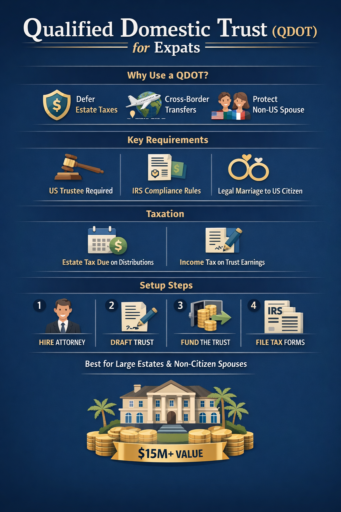
A Qualified Domestic Trust allows the deferral of US estate taxes until the non-US citizen surviving spouse receives distributions from the trust.
This structure ensures compliance with US tax laws while giving the surviving spouse access to income and principal over time.
Key tax points:
- Income tax: The surviving spouse must pay US income tax on any income generated by trust assets. This includes interest, dividends, and other earnings, even if they are reinvested in the trust rather than distributed.
- Estate tax: US estate taxes on the assets placed in a QDOT are deferred until distributions are made to the surviving spouse. The deferred tax must generally be paid by the trustee when principal is distributed or if the trust fails to meet IRS requirements.
- Special rules and withholding: Certain distributions of principal may trigger estate tax withholding, and the trustee is responsible for ensuring the correct amount is remitted to the IRS. If the QDOT rules are not properly followed, the deferred estate tax can become immediately due.
- Reporting and compliance: The trustee must file annual US tax returns for the QDOT and keep accurate records of distributions. This ensures the trust remains in compliance with US estate tax laws and avoids penalties.
How to set up a QDOT?
A Qualified Domestic Trust is set up by drafting a trust that meets IRS requirements and appointing a qualified US trustee before transferring estate assets into the trust.
Setting up a QDOT involves several steps:
1. Hire a qualified attorney: Engage a US estate planning attorney experienced in QDOT rules to ensure proper structuring and compliance.
2. Draft the trust document: Prepare a legally valid trust agreement that includes all provisions required by the IRS for estate tax deferral.
3. Appoint a US trustee: Designate at least one US citizen trustee or a US-based bank to oversee the trust and handle tax obligations.
4. Fund the trust: Transfer eligible assets from the US citizen spouse’s estate into the QDOT, either during estate administration or via assignment.
5. File required tax forms: Submit the necessary filings, including the estate tax return, to formally elect QDOT treatment and secure tax deferral.
Professional guidance is essential to avoid errors that could disqualify the trust and trigger immediate estate taxes.
What is the minimum amount to create a trust?
While there is no legally fixed minimum, a Qualified Domestic Trust is typically established for estates valued above the federal estate tax exemption of $15 million in 2026, since smaller estates generally do not owe federal estate tax.
A QDOT is practical only when the estate’s value exceeds this threshold, because estates below $15 million usually do not benefit from the complex setup, trustee costs, and IRS compliance requirements.
Even for large estates, the trust should be funded with enough assets to cover potential estate taxes while providing meaningful support to the surviving non-US citizen spouse.
Costs of setting up a QDOT:
- Legal fees: Drafting a QDOT requires specialized US estate planning attorneys, and legal costs can range from $5,000 to $25,000 or more, based on complexity.
- Trustee fees: Trustees charge for administration, investment management, and tax filings, typically 0.5% to 1% of the trust assets annually.
- Filing and compliance costs: Ongoing IRS reporting, tax filings, and potential professional accounting services add additional expenses.
Considering these costs, a QDOT is generally most beneficial for high-value estates, where the tax deferral advantages significantly outweigh setup and ongoing administration expenses.
When to use a QDOT trust?
A Qualified Domestic Trust should be used when a US citizen leaves a high-value estate to a non-US citizen spouse and wants to defer estate taxes while ensuring controlled access to assets.
It is most appropriate in situations where:
- Non-US citizen spouse: The surviving spouse does not hold US citizenship, making the marital deduction otherwise inapplicable.
- Large estates: The estate exceeds the US estate tax exemption (over $15 million in 2026), creating potential estate tax liability.
- Wealth preservation: You want to provide structured income and protect principal for the surviving spouse and future generations.
- Cross-border or mixed citizenship families: The estate involves international assets or beneficiaries, requiring careful US tax compliance.
By focusing on these specific conditions, a QDOT becomes a targeted and effective tool for international estate planning.
Common pitfalls and mistakes when using a QDOT
A Qualified Domestic Trust can be disqualified, and trigger immediate US estate taxes, if trustees, provisions, funding, or IRS compliance are not handled correctly.
Key pitfalls to watch for:
- Improper trustee selection: Failing to appoint a qualified US trustee or bank can invalidate the QDOT. The trustee must meet IRS standards and be capable of withholding and remitting estate taxes on distributions.
- Incomplete trust provisions: Missing or vague language regarding estate tax withholding, distributions, or IRS compliance can disqualify the QDOT. All required provisions must be clearly included in the trust document.
- Incorrect funding or timing: Delays in transferring assets or improperly assigning inherited assets to the QDOT (especially using the assignment method for non-US citizen spouses) can lead to tax penalties.
- Noncompliance with IRS reporting: Annual tax filings, recordkeeping, and proper reporting of income and distributions are mandatory. Failure to comply may trigger penalties or cause the trust to lose its QDOT status.
- Ignoring cross-border complications: For expats, foreign assets, accounts, or property must be carefully integrated into the QDOT structure. Overlooking foreign tax rules or currency issues can create unexpected liabilities.
By proactively addressing these pitfalls, families can ensure the QDOT functions as intended, protecting wealth and deferring estate taxes for non-US citizen spouses.
Conclusion
A QDOT transforms estate planning for families navigating cross-border and citizenship complexities.
Its value extends beyond tax deferral: it allows families to align wealth transfer with long-term goals, manage risk, and provide structured support for surviving spouses.
For expats, timing and foresight are crucial. Setting up a QDOT early in the planning process ensures smoother administration, clearer distribution strategies, and fewer surprises with US tax authorities.
Thoughtful trustee selection, proper funding, and meticulous compliance turn the QDOT from a regulatory requirement into a tool for intentional legacy planning.
Ultimately, a QDOT is most effective when it is treated as a strategic bridge between legal compliance, financial planning, and family continuity, allowing international families to protect wealth while preserving flexibility for future generations.
FAQs
What are the 4 types of trusts?
The four main types of trusts are revocable, irrevocable, testamentary, and living trusts.
Revocable and living trusts are set up during the grantor’s lifetime, while irrevocable and testamentary trusts provide tax or probate advantages and cannot be easily changed.
What is the best type of trust for tax purposes?
Irrevocable trusts generally offer the best tax advantages, including estate tax reduction and asset protection, because assets are removed from the grantor’s estate.
What type of trust is best to avoid probate?
A living trust is commonly used to avoid probate, allowing assets to pass directly to beneficiaries without court involvement.
Can a foreigner be a beneficiary of a trust?
Yes, foreigners can be beneficiaries, but certain restrictions and tax obligations apply, particularly for non-US citizens inheriting US assets.
QDOTs are specifically designed to address these situations.
Pained by financial indecision?

Adam is an internationally recognised author on financial matters with over 830million answer views on Quora, a widely sold book on Amazon, and a contributor on Forbes.