When comparing annuities vs bonds, the core distinction comes down to how income is generated and guaranteed.
Bonds are tradable debt investments whose returns depend on interest rates and issuer credit, while annuities are insurance contracts built to deliver predictable income, often as part of retirement planning.
This article covers:
- What is the difference between a bond and an annuity?
- How does an annuity generate income?
- How do bonds generate income?
- What are the risks of annuities?
- Are there risks in bonds?
Key Takeaways:
- Bonds offer liquidity and market pricing; annuities offer income guarantees.
- Annuities transfer longevity risk to insurers; bonds do not.
- Bond returns fluctuate with interest rates; annuity payments are contract-based.
- Many income strategies use both rather than choosing one exclusively.
My contact details are hello@adamfayed.com and WhatsApp +44-7393-450-837 if you have any questions.
The information in this article is for general guidance only. It does not constitute financial, legal, or tax advice, and is not a recommendation or solicitation to invest. Some facts may have changed since the time of writing.

Is a bond a type of annuity?
A bond is not a type of annuity. While both can provide income, they are fundamentally different financial instruments.
A bond is a debt security issued by governments, corporations, or municipalities.
When you buy a bond, you are lending money to the issuer in exchange for interest payments and the return of principal at maturity.
An annuity, on the other hand, is an insurance contract.
It is designed primarily to provide income, often during retirement, either immediately or at a future date.
The guarantees of an annuity depend on the financial strength of the insurance company, not on market issuers.
What is the purpose of an annuity?
The primary purpose of an annuity is to provide predictable income, often for a specific period or for life.
Annuities are commonly used in retirement planning to reduce the risk of outliving one’s savings.
Depending on the type, annuities can offer:
- Guaranteed income streams
- Tax-deferred growth
- Protection from market volatility
- Longevity risk management
They are typically used to convert a lump sum of money into stable, long-term cash flow.
What is the purpose of a bond?
The purpose of a bond is to generate interest income while preserving capital. Bonds are often used to:
- Diversify investment portfolios
- Reduce overall volatility
- Provide steady income through coupon payments
- Preserve capital relative to equities
Bonds are widely used by conservative investors, institutions, and retirees seeking income without equity-level risk.
What is the difference between an annuity and a perpetual bond?
The key difference is that annuities are designed for income planning, while perpetual bonds are investment instruments with ongoing credit risk.
An annuity typically pays income for a defined period or for life, based on a contract. Once payments end, there may be no remaining value.
A perpetual bond, by contrast, has no maturity date.
It continues paying interest indefinitely, as long as the issuer remains solvent.
Unlike annuities, perpetual bonds do not provide insurance-backed guarantees or longevity protection.
What are some advantages and disadvantages of bonds vs annuities?
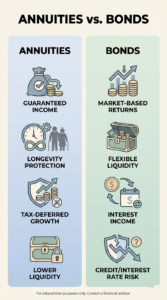
The advantages and disadvantages of bonds vs annuities differ mainly in how much flexibility versus income certainty they provide, with bonds offering market access and liquidity, and annuities offering contractual income guarantees.
Benefits of bonds
- High liquidity
Most bonds can be bought or sold on secondary markets, allowing investors to access their capital relatively quickly. - Transparent pricing
Bond prices and yields are publicly available, making it easier to evaluate value, risk, and market conditions. - Broad market availability
Bonds are issued by governments, municipalities, and corporations, offering a wide range of maturities, credit qualities, and income levels. - Potential for capital gains
Bond prices can increase when interest rates fall or when an issuer’s credit profile improves, creating opportunities beyond interest income.
Disadvantages of bonds
- Interest rate risk
Bond prices generally decline when interest rates rise, which can reduce the market value of existing holdings. - Credit risk
There is a risk that the issuer may default or experience a credit downgrade, potentially reducing income or principal. - No lifetime income guarantee
Bonds pay interest only for a defined period and do not provide income protection if the investor outlives the investment term.
Benefits of annuities
- Guaranteed income options
Many annuities offer contractually guaranteed payments, providing predictable income regardless of market conditions. - Protection against longevity risk
Lifetime annuities ensure income continues even if the annuitant lives longer than expected. - Tax-deferred growth
Earnings inside an annuity typically grow tax-deferred until withdrawals begin, which can enhance long-term accumulation. - Predictable cash flow
Annuities can be structured to deliver fixed or formula-based payments, supporting consistent budgeting and planning.
Disadvantages of annuities
- Limited liquidity
Withdrawals beyond allowed limits may trigger surrender charges or penalties, especially in the early years of the contract. - Complexity
Annuity contracts can be difficult to compare due to varying features, riders, and payout structures. - Fees and surrender charges
Some annuities carry administrative costs, rider fees, and penalties that can reduce net returns. - Dependence on insurer solvency
Annuity guarantees rely on the financial strength of the issuing insurance company rather than on market performance.
What is better, bonds or annuities?
Bonds are better for investors who want flexibility and market-based returns, while annuities are better for those who need guaranteed, long-term income.
- Bonds provide access to principal, the ability to adjust holdings with changing conditions, and potential gains from interest rate movements.
- Annuities offer structured payments for a defined period or life, delivering income certainty and protection against outliving savings.
Who is best suited for each:
- Annuities: Investors needing guaranteed payments for long-term expenses, preferring structured income without active portfolio management, seeking longevity protection, and comfortable trading liquidity for certainty.
- Bonds: Investors seeking income over a specific time horizon, wanting access to principal, comfortable with credit and interest rate risk, and preferring a more hands-on investment approach.
Many long-term strategies combine both: annuities act as income anchors, while bonds provide flexible income and capital management, helping investors balance stability with adaptability.
Conclusion
Understanding annuities vs bonds goes beyond comparing payouts. It’s about aligning investments with the uncertainties of life.
While annuities mitigate longevity and spending risk, bonds offer tools to respond to evolving markets and financial needs.
Investors who consider timing, interest rate trends, and personal life circumstances can use these instruments strategically, not just for income, but as levers to manage risk, preserve capital, and maintain optionality in an unpredictable financial landscape.
FAQs
Why are annuities a poor investment choice?
Annuities may be considered a poor investment choice for investors who prioritize growth, flexibility, or short-term access to funds.
High fees, surrender charges, and limited upside potential can make them inefficient compared to market-based investments for certain investors.
Which bond is paying 7.5% interest?
One real‑world example is the Belong Limited 7.5% Social Bonds due 2030, issued through RCB Bonds PLC.
These bonds pay a fixed 7.5% per annum interest, typically in two equal semi‑annual installments on 7 January and 7 July each year, and are expected to mature on 7 July 2030 (with a possible legal maturity in 2032).
These are high-risk investments, though, so financial advice is recommended.
How much does a $1,000,000 fixed annuity pay per month?
A $1 million fixed annuity may pay approximately $4,000 to $6,000 per month, based on the annuitant’s age, payout structure, and prevailing interest rates.
Actual payments vary by insurer and contract terms.
What is the primary difference between an annuity and a compound annuity?
The primary difference between an annuity and a compound annuity is timing.
A standard annuity focuses on income payouts, while a compound annuity emphasizes accumulation, where interest compounds over time before income begins.
What are the 4 types of investments?
The four main types of investments are:
1. Cash and cash equivalents
2. Bonds and fixed-income securities
3. Equities (stocks)
4. Alternative investments, including real estate and commodities
Annuities often combine features of insurance and fixed-income investments but are classified separately due to their contractual nature.
Pained by financial indecision?

Adam is an internationally recognised author on financial matters with over 830million answer views on Quora, a widely sold book on Amazon, and a contributor on Forbes.