Mexico and Paraguay are among the countries with the easiest residency rules, thanks to low income or bank balance requirements and simple approval processes.
Countries like Panama, Georgia, and Greece also stand out for offering fast, low-friction residency routes without demanding high investment or long physical stays.
This article covers:
- Which country gives fastest citizenship without investment?
- Which country is the cheapest to obtain residency in?
- What is the most tax-efficient country?
- What is the difference between PR and visa?
Key Takeaways:
- Paraguay, Panama, and Mexico have the lowest barriers to residency.
- Investment-based residency is faster but more costly.
- Tax outcomes hinge on residency rules, not passports.
- Easy residency prioritizes speed, flexibility, and simplicity.
My contact details are hello@adamfayed.com and WhatsApp +44-7393-450-837 if you have any questions.
The information in this article is for general guidance only. It does not constitute financial, legal, or tax advice, and is not a recommendation or solicitation to invest. Some facts may have changed since the time of writing.

Defining What Makes a Country Easy for Residency
The easiest countries to get residency are those with low financial barriers, simple eligibility rules, and minimal long-term obligations.
In practical terms, easy usually means one or more of the following:
- Low or no investment requirements
- Simple income or savings thresholds
- Fast processing timelines
- Minimal physical stay rules
- Straightforward documentation
- Clear renewal and permanent residency pathways
Easiest Countries to Get Residency Without Investment
These countries offer legal residency based on income, savings, work, or long-stay visas, such as Mexico, Panama, Paraguay, and Georgia, without requiring property purchases or large capital commitments.
Mexico (Temporary Resident Visa – Economic Solvency)
Mexico offers temporary and permanent residency based on monthly income or bank balance, with no investment requirement.
- Temporary residency can later convert to permanent residency
- No minimum stay for maintaining status
- Popular with retirees, freelancers, and digital nomads
Panama (Pensionado and Friendly Nations Visa)
Panama’s Friendly Nations framework and pensionado options make it one of the most accessible residency destinations.
- Income-based routes available
- Territorial tax system
- Straightforward banking and renewals
Paraguay (Permanent Residency)
Paraguay remains one of the lowest-barrier residency options globally.
- Minimal deposit requirement (not an investment)
- Fast permanent residency approval
- Very low ongoing compliance
Georgia (Temporary Residence Permit)
Georgia allows long stays with simple extensions and residency options tied to income or work.
- Liberal visa-free entry for many nationalities
- Quick processing
- No minimum stay for tax residency planning
Malaysia (MM2H)
Malaysia’s MM2H (Malaysia My Second Home) program offers long-term residency for retirees and financially independent foreigners.
- 10-year renewable visa
- Income or savings-based eligibility
- Low stay requirements for renewal
- Strong healthcare and lifestyle benefits
Costa Rica (Pensionado and Rentista)
Costa Rica provides residency through pensionado (retiree) or rentista (income-based) programs.
- Low monthly income requirements
- Can apply for permanent residency after 3–5 years
- Minimal ongoing obligations
- Popular among retirees and lifestyle migrants
Thailand (Non‑Immigrant O‑A and other long-term visas)
Thailand offers long-term residency via retirement, work, or education visas.
- Non-immigrant O-A (retirement) visa is common for retirees
- Flexible renewals but no automatic permanent residency
- Digital nomad-friendly options through certain long-stay visas
- Access to modern healthcare and tropical lifestyle
Easiest Countries to Get Residency by Investment
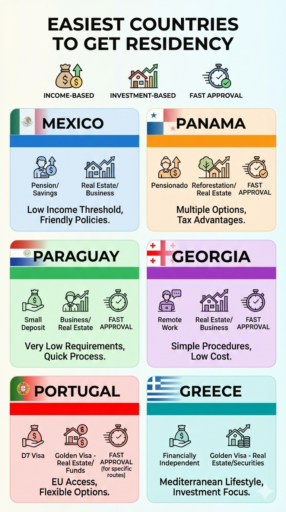
The easiest countries to get residency by investment include Portugal, Greece, and Spain, offering clear programs that exchange capital for legal residency, often with faster approval and predictable requirements.
Portugal (Golden Visa)
Despite changes, Portugal Golden Visa remains an attractive option.
- Investment still possible via funds
- Clear path to permanent residency and citizenship
- Strong EU mobility benefits
Greece (Golden Visa)
Greece offers one of Europe’s lowest property thresholds.
- Residency via real estate investment
- No minimum stay requirement
- Renewable long-term residency
Lithuania (Residence Permit for Business Investment)
Lithuania offers residency through business investment, not real estate purchases.
- Lower investment thresholds compared to Western Europe, starting with business capital tied to company establishment and employment
- Access to EU residency benefits and Schengen travel
- Pathway to permanent residency after several years, with citizenship through standard naturalization
Cyprus (Golden Visa)
Cyprus has a residency by investment scheme for non-EU citizens.
- Residency via real estate purchase or rental
- Fast processing, minimal stay requirement
- Low ongoing compliance
Malta (Malta Permanent Residence Program)
Malta residency is offered through contribution and property options.
- Residency by exception or investment routes
- EU mobility benefits
- Clear pathway to citizenship after long-term residency
Latvia (Golden Visa)
- Residency via property purchase or business investment
- Renewable temporary residence permits
- Low minimum stay for residency maintenance
Which Country Is the Cheapest to Obtain Residency?
Paraguay and Panama are among the cheapest countries to obtain residency, followed closely by Mexico, due to low income or bank balance requirements and minimal government fees.
Monthly Income Requirements
- Mexico:
Temporary residency requires demonstrating a regular income of around USD 4,100–4,400 per month (over the last 6–12 months) to meet the economic solvency test at many Mexican consulates. - Panama (Pensionado / Pensioner Visa):
The Pensionado visa requires at least USD 1,000 per month in lifetime pension income for the main applicant; this threshold can reduce to USD 750/month if the applicant purchases property worth at least USD 100,000. - Spain (Non-Lucrative Visa):
Applicants must show financial means equivalent to about €2,400 per month (4× the Spanish IPREM index) or corresponding savings (approx. €28,800 per year) for a single applicant. - Portugal (D7 Passive Income Visa):
Portugal’s passive income (D7) visa is tied to the Portuguese minimum wage; as of 2026 it’s approximately €920/month for the main applicant.
Bank Balance Requirements
- Paraguay:
Paraguay residency no longer requires a bank deposit. It completely eliminated the old ~$5,000 bank deposit option under its 2022 immigration reform (Law 6984), and standard temporary residency now requires no financial deposit at all. - Mexico (Temporary Residency – Economic Solvency):
Applicants typically must show a minimum average bank balance of approximately USD 70,000–73,000 in savings or investment accounts over the past 12 months to satisfy the consulate’s economic solvency requirement for a temporary resident visa. This amount is computed as a multiple of the Mexican minimum wage and generally updated annually by consulates. - Portugal (D7 Passive Income Visa):
In addition to proving a monthly passive income tied to the Portuguese minimum wage, D7 applicants generally must show savings equivalent to at least 12 months of minimum wage, which is about €11,040 for a single applicant as of 2026.
Investment Minimums
- Greece:
Residency by real estate investment starts at €250,000, making it one of the lowest minimums for a structured residency‑by‑investment program in Europe. - Latvia:
Latvia’s residency‑by‑investment program can start with about €50,000 invested into a local business (plus government fee) one of the lowest for an EU residency pathway. - Portugal:
The minimum investment to obtain residency ranges from about €200,000 ($291,900) for low-cost programs such as certain EU business or Caribbean options, up to €500,000 ($584,475) for Portugal’s fund-based route. - Dominica (Caribbean CBI → Residency step):
While it’s primarily a citizenship‑by‑investment (CBI) program, investors can qualify via real estate at around USD 200,000, among the most affordable globally for investment‑linked residence/citizenship.
Important Context on Lower Investment Thresholds Outside Europe
Many countries outside Europe have even lower investment thresholds.
There are investment requirements below €50,000 in some non-EU startup, business, or economic development visa schemes, particularly in parts of Latin America, Southeast Asia, and Central Asia.
However, these options often:
- Do not grant long-term residency immediately
- Require active business operations or employment creation
- Have less predictable renewal or permanent residency pathways
- Are more discretionary and less standardized than EU investment programs
As a result, while the upfront capital may be lower, these routes are not always easier or more secure than structured residency-by-investment programs.
Government Fees and Processing Costs
- Low-cost jurisdictions: Paraguay, Georgia, Mexico:typically hundreds to ~USD 2,000–2,500 including basic government fees and essential processing costs
- Southern Europe (EU): Southern Europe (EU): Portugal, Greece: typically €2,000–6,000+ in official government fees alone, excluding additional legal/professional costs
These figures are government/administrative fee ranges, not all-in totals. Applicants often also pay for translations, notarial/legal support, travel, and insurance.
Mexico’s government fees are rising in 2026 under new reforms, but even then remain within the hundreds to low-thousands (USD) range for core residency card charges.
Cost Summary
- Overall cheapest residency options: Paraguay and Panama (low income/bank balance requirements, minimal government fees)
- Lowest-cost EU residency via investment: Latvia (~€50,000 business investment) and Greece (€250,000 real estate)
- Moderate EU investment option: Portugal (€500,000 fund-based route)
- Lowest-cost Caribbean investment-linked residency/citizenship: Dominica (~USD 200,000 real estate)
Which Country Is the Fastest to Get Residency?
Paraguay, Panama, Georgia, and Mexico are among the fastest countries to obtain residency. Speed matters for tax planning and relocation:
- Paraguay: Often approved within months
- Panama: 2–6 months depending on route
- Georgia: Some statuses approved in weeks
- Mexico: Residency can be issued within a single consular cycle
Southern Europe generally takes longer due to EU compliance checks.
Which Country Is the Best for Tax Residency?
Panama, Georgia, and Paraguay are among the most practical countries for favorable tax residency because they combine low or territorial taxation with accessible, legally robust residency pathways, rather than the high-cost, hard-to-qualify structures typical of traditional tax havens.
- Panama: Territorial tax system; foreign-source income is not taxed, straightforward compliance.
- Georgia: Flat personal income tax (20%) with territorial tax elements; foreign income often exempt for new residents.
- Paraguay: Low personal income tax burden (~10%), simple reporting rules.
- Portugal & Spain: Strong treaty networks for double taxation relief, but higher tax exposure on worldwide income.
What Taxes Do You Have to Pay If You Live Abroad?
When you live abroad, you may be taxed on locally sourced income only or on your worldwide income.
The tax treatment is determined by the tax system of your country of tax residence, with countries such as Panama or Paraguay taxing only local income.
Meanwhile others, including Portugal and Spain, tax global income once residency thresholds are met.
Typical taxes you may encounter while living abroad include:
- Personal income tax: On wages, salaries, pensions, or self-employment income.
- Capital gains tax: On profits from selling assets such as stocks, real estate, or businesses.
- Dividend and interest tax: On investment income earned locally or abroad.
- Property tax / municipal tax: On property you own in your country of residence.
- Social security contributions: Sometimes required if your home country or host country has reciprocal agreements.
- Gift or inheritance tax: May apply depending on residency rules and local thresholds.
What Is the Difference Between Residency and Visa?
A visa allows temporary entry or stay in a country, often for a specific purpose, and can serve as a stepping stone toward residency.
Residency, in contrast, grants the legal right to live long-term, usually with options to renew and eventually obtain permanent status.
While a visa controls short-term access, residency enables tax planning, banking, work authorization, and long-term stability.
Which Country Is the Easiest to Get a Visa?
Some of the easiest countries to obtain long-stay visas, without pursuing full residency, include Georgia, Mexico, Malaysia, and Thailand.
These visas allow you to stay for extended periods, often several months to a year or more, making them popular with digital nomads, retirees, and long-term travelers.
While they provide flexibility to live abroad, they generally do not offer tax advantages, permanent residency, or guaranteed pathways to citizenship.
For individuals seeking long-term stability, banking access, or tax planning benefits, obtaining residency is typically necessary after holding a visa.
Which Residents Benefit Most from Each Country’s Residency Program?
Residency programs suit different residents: retirees often favor Mexico, tax planners and mobile entrepreneurs prefer Panama, digital nomads go to Georgia, and those seeking EU access or long-term stability choose Portugal.
- Mexico: Retirees, freelancers, and North Americans seeking flexible long-term stays.
- Panama: Tax planners, retirees, and mobile entrepreneurs looking for territorial taxation.
- Paraguay: Individuals seeking low-cost, low-maintenance residency with minimal bureaucracy.
- Georgia: Digital nomads, remote workers, and small business owners.
- Portugal: People seeking EU access, eventual citizenship, and long-term stability.
- Greece: Property investors aiming for affordable EU residency.
- Spain: Lifestyle movers with stable income who value quality of life and infrastructure.
Conclusion
The easiest residency programs are those that remove friction, letting individuals prioritize experiences, opportunity, and personal freedom rather than paperwork.
Residency is more than a legal status; it’s a gateway to shaping how and where you live, work, and manage your life globally.
In an increasingly mobile world, the smartest approach is to view residency as a strategic tool: a way to align your home base with your lifestyle, financial planning, and long-term goals, rather than a destination in itself.
FAQs
Which Country Has the Easiest Citizenship to Get?
Paraguay offers one of the fastest naturalization paths, granting citizenship after just 3 years of permanent residency.
Caribbean citizenship-by-investment programs, such as Dominica or St. Kitts & Nevis, can be even faster (1–6 months) but require significant investment.
What Are Common Reasons for Residency Denial?
Residency applications are commonly denied due to incomplete documentation, insufficient proof of income, a criminal record, or inconsistencies in previous immigration history.
Which Country PR Is Difficult to Get?
Permanent residency is especially hard to get in countries like Japan and Switzerland, due to long residence requirements, strict language and integration standards, and discretionary local approvals.
These high-barrier systems make PR far more challenging than in most other countries.
Pained by financial indecision?

Adam is an internationally recognised author on financial matters with over 830million answer views on Quora, a widely sold book on Amazon, and a contributor on Forbes.