Selling foreign property through a tax-friendly jurisdiction can minimize capital gains tax, but careful planning of ownership and residency is also required.
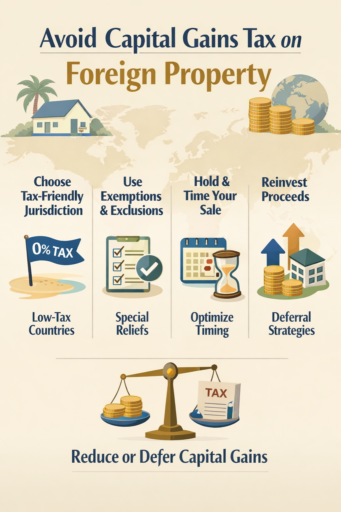
Legal strategies such as exemptions, timing, and reinvestment rules can help avoid capital gains tax on foreign property or significantly reduce and defer it.
This article covers:
- What is the meaning of capital gains tax?
- What is capital gains tax on overseas property?
- Is there any way to avoid paying capital gains tax?
- How to be exempted from capital gains tax?
Key Takeaways:
- Capital gains tax applies to profits from property sales, often in both foreign and home country.
- Using tax-friendly jurisdictions, primary residence exemptions, and proper holding structures can trim liability.
- Timing your residency and sale strategically can help defer or lower taxes.
- Low-tax countries like UAE, Georgia, and Portugal can significantly reduce property tax exposure.
My contact details are hello@adamfayed.com and WhatsApp +44-7393-450-837 if you have any questions.
The information in this article is not tax advice and may have changed since the time of writing. I can connect you with expert tax support for your specific situation.
What is the meaning of capital gains tax?
Capital gains tax (CGT) is the tax you pay on the profit when you sell an asset like property for more than you originally paid.
Simple formula:
Capital Gain = Selling Price − Purchase Price − Allowable Costs
Allowable costs may include:
- Legal fees
- Renovation costs
- Agent commissions
For foreign property, things get more complex because two countries may claim taxing rights:
- The country where the property is located
- Your country of tax residence
Do I have to pay capital gains tax on overseas property?
Capital gains tax must usually be paid both in the country where the property is located and in the country of tax residence.
Many countries have double taxation agreements (DTAs) that allow:
- Tax credits
- Exemptions
- Reduced rates
For example:
- A resident of the United Kingdom selling property in Spain may offset Spanish tax against UK liability
How much capital gains tax will I pay?
Capital gains tax on foreign property profits can be 0% in the UAE, about 6% in the Philippines, and roughly 18%–24% in the UK for residential property gains.
Rough ranges for major jurisdictions are:
- United States: 0%–20% federal tax on long‑term property gains (plus possible state taxes)
- United Kingdom: ~18%–24% for residential property gains
- Spain: ~19%–28% progressive rates
- Portugal: ~28% for non‑residents; residents include 50% of gain in taxable income
- Canada: 50% of gains added to taxable income at ordinary rates
- France: Up to ~36% (19% income tax + 17.2% social contributions) before exemptions; reductions apply after long-term ownership
- Japan: Effective tax on property gains can be high (often ~30–39% including local tax depending on holding period)
- China: ~20% personal income tax on net property gain (plus possible land appreciation tax)
- Singapore: No general capital gains tax on property gains (but short‑term sales may incur seller’s stamp duties that act like a CGT‑style levy)
- Hong Kong: No capital gains tax on property gains
Note that tax treaties between countries can prevent double taxation, but reporting the gain is usually still required.
How to avoid capital gains tax on overseas property?
Selling property through a tax-friendly jurisdiction can significantly reduce capital gains tax, though other legal strategies like exemptions, timing, and deductions are also essential.
You generally can’t avoid CGT entirely, but you can reduce or defer it legally:
1. Use tax-friendly jurisdictions
Selling property in countries with low or zero capital gains tax can significantly reduce liability. For example:
-United Arab Emirates has no personal CGT, making it attractive for high-value sales.
Some Caribbean jurisdictions offer similar zero-tax advantages.
-When using these jurisdictions, it’s essential to verify that residency rules and anti-avoidance laws are satisfied to ensure tax benefits apply.
2. Take advantage of primary residence exemptions
Many countries exempt gains on a property that qualifies as the main residence. Typical requirements include:
-Living in the property for a minimum period before sale.
-Using the property as the primary home rather than an investment.
This strategy can eliminate CGT entirely in countries like the UK, France, and Portugal for qualifying sales.
3. Time tax residency strategically
Changing residency before selling can lower capital gains tax if the new country has more favorable rates or exemptions.
Key points:
-Relocating to a lower-tax jurisdiction before disposal can reduce home-country CGT.
-Some countries impose exit taxes, so planning timing carefully is critical.
This strategy requires thorough knowledge of local tax residency definitions and reporting obligations.
4. Use holding structures
Owning property through legal entities like offshore companies or trusts can sometimes reduce CGT exposure.
Benefits may include:
-Deferring tax until profits are distributed.
-Benefiting from treaty protections between jurisdictions.
It’s important to ensure structures comply with anti-avoidance rules, or authorities may challenge the arrangement.
5. Offset gains with losses
Capital losses from other investments can be used to reduce taxable gains, effectively lowering overall CGT liability.
-Track investment performance across properties and other asset classes.
-Apply losses strategically in the same tax year or carry them forward if allowed.
6. Reinvestment strategies
Some countries allow CGT deferral if proceeds are reinvested in qualifying assets. For example:
-The United States offers like-kind exchanges for real estate, deferring tax until the replacement property is sold.
-Other countries may provide similar rollover relief for reinvestment in primary or commercial property.
7. Maximize deductible costs
Accurate record-keeping of all costs associated with the property can reduce taxable gains:
-Renovation and improvement expenses
-Legal and agent fees
-Taxes already paid abroad (for credit against home-country tax)
Every deductible cost reduces the net gain and therefore the CGT owed.
Where is the cheapest place to live for property taxes?
The cheapest places to live for property taxes include the United Arab Emirates, Georgia, Portugal, and Malta, due to their low or favorable capital gains tax regimes.
Top low-tax destinations:
- United Arab Emirates
The UAE has no capital gains tax or personal income tax, making it one of the most tax-efficient jurisdictions for property ownership and sales. - Georgia
Georgia allows individuals to sell property tax-free after meeting a minimum holding period, which can eliminate capital gains tax entirely. - Portugal
Portugal offers favorable tax treatment for certain residents, including partial exemptions and structured regimes that can reduce overall tax liability. - Malta
Malta uses a remittance-based system, meaning foreign income and gains are often only taxed if brought into the country.
The cheapest country for property taxes is determined by factors such as residency status, how long the property is held, and whether it is used for personal living or rental income.
Integrating Capital Gains Tax Planning with Estate and Inheritance Strategy
Foreign property planning should consider not just the sale but also how ownership impacts estate and inheritance taxes.
Proper integration of CGT planning with succession strategies can preserve wealth across generations.
- Holding structures affect inheritance outcomes: Using trusts, companies, or joint ownership can change how capital gains are calculated at death and whether heirs face additional taxes.
- Exemptions and rollover relief: Some countries allow the step-up of cost basis for heirs or defer CGT on inherited property, which can dramatically reduce tax liability.
- Residency and domicile considerations: Where the owner and heirs are tax residents determines which countries can levy inheritance tax and how foreign gains are treated.
- Coordinating with estate planning: Aligning property ownership with wills, succession plans, and trusts ensures gains and future transfers are managed efficiently, avoiding double taxation and preserving maximum value for beneficiaries.
By planning CGT alongside estate and inheritance considerations, investors can minimize tax exposure both during ownership and for heirs, turning what is often a compliance burden into a strategic wealth-preservation tool.
Conclusion
Minimizing capital gains tax on foreign property starts long before the sale. It begins with how the investment is structured from day one.
The choice of jurisdiction, ownership setup, and intended holding period all shape the eventual tax outcome more than any last-minute adjustments.
Well-planned investors treat tax as part of the investment strategy, not an afterthought.
By aligning location, residency, and exit timing early, it becomes possible to preserve more of the gain without relying on aggressive or risky approaches.
In the end, the goal is not to avoid tax entirely, but to manage it intelligently so that the overall return on investment remains strong across borders.
FAQs
Where should I put money to avoid capital gains tax?
Money is best placed in jurisdictions with no capital gains tax, such as the United Arab Emirates, or in tax-advantaged accounts where available.
Holding investments long term can also reduce or eliminate capital gains tax through exemptions in many countries.
Where is the best place to live for tax purposes?
The best place to live for tax purposes is typically a jurisdiction with low or zero income tax or favorable tax regimes, such as Portugal, or Singapore, or the United Arab Emirates.
The optimal choice depends on how income is earned and whether foreign income is taxed locally.
What are the most common tax loopholes?
Common tax loopholes are actually legal strategies such as primary residence exemptions, tax loss harvesting, residency arbitrage, and using double taxation treaty relief.
These approaches reduce tax liability within the rules rather than bypassing them.
What is the 6 year rule for capital gains tax?
The 6-year rule in Australia allows a former main residence to continue being treated as a primary home for up to six years after moving out.
This can eliminate capital gains tax if the property is sold within that period, subject to specific conditions.
Pained by financial indecision?

Adam is an internationally recognised author on financial matters with over 830million answer views on Quora, a widely sold book on Amazon, and a contributor on Forbes.