A second passport for Pakistan citizens typically involves a choice between Pakistan-compatible countries like the United Kingdom, Canada, and Australia, or faster options such as Turkey and Caribbean programs like St. Kitts and Nevis, which may require giving up Pakistani citizenship.
The right path is based on whether you prioritize legal dual citizenship or faster access to global mobility.
This article covers:
- What was the cause of migration movement in Pakistan?
- Which 22 countries have dual citizenship with Pakistan?
- Which country gives easy citizenship for Pakistanis?
- What are the benefits of having a dual citizenship?
- What is the problem of double citizenship?
Key Takeaways:
- Pakistan allows dual citizenship only with specific countries.
- UK, Canada, and Australia are the most reliable long-term dual citizenship routes for Pakistani nationals.
- Turkey and Caribbean passports are faster but are generally not compatible with Pakistan’s dual nationality rules.
- The key decision is balancing fast global mobility vs retaining Pakistani citizenship legally and permanently.
My contact details are hello@adamfayed.com and WhatsApp +44-7393-450-837 if you have any questions.
For digital nomad or residence visas that require income, assets, or qualifying investments, we can help structure suitable investment solutions that may align with those requirements, depending on your circumstances.
The information in this article is for general guidance only, does not constitute financial, legal, or tax advice, and may have changed since the time of writing.

Can Pakistanis have two passports?
Yes, Pakistan allows dual citizenship, but only with specific countries approved by the Government of Pakistan.
This means you can legally hold two passports only if your second nationality is from one of these recognized countries.
If you acquire citizenship in a country not on the approved list, you may be required to renounce your Pakistani citizenship under Pakistani law.
Additionally, dual nationals may face restrictions on holding certain public offices or sensitive government positions within Pakistan.
Which countries allow dual citizenship with Pakistan?
Pakistan allows dual citizenship with countries such as the United Kingdom, United States, Canada, Australia, and the New Zealand, along with other officially recognized countries under the Pakistan Citizenship Act, 1951, as implemented by the government.
The remaining of the 22 approved countries include several European and Middle Eastern states:
- France
- Germany
- Italy
- Belgium
- Netherlands
- Sweden
- Switzerland
- Ireland
- Denmark
- Norway
- Finland
- Iceland
- Luxembourg
- Egypt
- Jordan
- Syria
- Bahrain
This framework is managed through official government notifications to regulate dual nationality, ensure legal clarity, and maintain reciprocity with selected partner states.
Why are so many Pakistanis leaving Pakistan?
Many Pakistanis are leaving Pakistan primarily due to economic pressure, limited global mobility from a weaker passport, and stronger long-term opportunities for income, education, and residency abroad.
- Economic instability and inflation – Rising living costs, currency depreciation, and limited wage growth push many skilled workers to seek higher-earning opportunities abroad, especially in Gulf and Western labor markets.
- Limited global mobility due to passport strength – The Pakistani passport provides relatively limited visa-free access compared to stronger passports, making relocation or international travel more difficult without long-term visas.
- Education and career opportunities abroad – Countries like Canada and United Kingdom offer structured immigration pathways for students and skilled workers, along with higher salaries and globally recognized qualifications.
- Political and security concerns – Some individuals cite governance uncertainty and security perceptions as additional factors influencing long-term migration decisions, especially among professionals and students.
What is the best country to get a second passport?
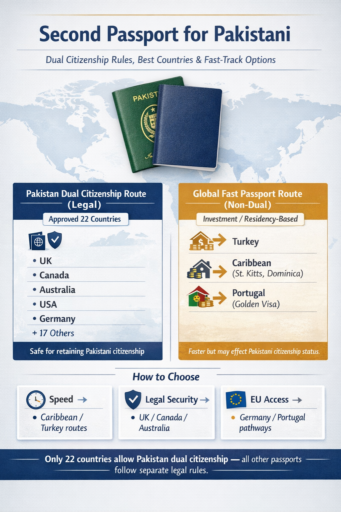
The best second passports for Pakistan citizens include the United Kingdom, Canada, Australia, United States, and Germany, as they offer a strong mix of immigration pathways, job opportunities, and long-term settlement options.
These countries are also part of Pakistan’s officially recognized dual nationality framework, which includes 22 countries approved by the Government of Pakistan.
Tier 1: Best overall second passport countries for Pakistanis
UNITED KINGDOM
The United Kingdom is the most established destination for Pakistani migrants.
Best pathway: Skilled Worker visa → Indefinite Leave to Remain → UK Citizenship
Key requirements:
- Job offer from a licensed UK employer
- Salary threshold (varies by occupation)
- Continuous residence (usually 5–6 years total pathway)
- English language requirement
Strong advantage: Large Pakistani diaspora and stable settlement routes
CANADA
Canada is one of the most accessible structured immigration systems.
Best pathway: Express Entry (skilled migration) → PR → Canadian Citizenship
Key requirements:
- Points-based eligibility (age, education, work experience, language)
- IELTS/English or French proficiency
- Proof of funds (for most streams)
- Physical presence requirement for citizenship
Strong advantage: Transparent system + relatively high approval rates for skilled workers
AUSTRALIA
Australia offers a strong skilled migration system and high living standards.
Best pathway: Skilled Independent visa → Permanent Residency → Australian Citizenship
Key requirements:
- Occupation must be on Skilled Occupation List
- Points test (age, education, experience, English level)
- Skills assessment from relevant authority
- Residency requirement before citizenship
Strong advantage: High quality of life and strong labor demand
UNITED STATES
The United States offers the highest income potential but is the most competitive.
Best pathway: Employer sponsorship (H-1B) or family-based immigration → Green Card → US Citizenship
Key requirements:
- Employer sponsorship or lottery-based visa system
- Long processing timelines
- Permanent residency (Green Card) first
- Physical presence and residency requirements for citizenship
Strong advantage: Career and income opportunities in global industries
GERMANY
Germany is the strongest EU option for skilled professionals.
Best pathway: EU Blue Card or Skilled Worker Visa → Residency → German Citizenship
Key requirements:
- Recognized qualification or job offer
- Minimum salary threshold (for Blue Card route)
- German language proficiency (for citizenship stage)
- Several years of continuous residence
Strong advantage: Strong economy + expanding skilled labor demand
Tier 2: Alternative second passports but less common pathways
These countries are part of Pakistan’s 22 dual citizenship list but have more limited or niche migration routes.
FRANCE
France offers structured residency pathways.
Best pathway: Work/study → long-term residency → French citizenship
Key requirements:
- French language proficiency
- Several years of legal residence
- Stable employment or integration proof
ITALY
Italy is often used for family-linked migration.
Best pathway: Work permit or family reunification → residency → Italian citizenship
Key requirements:
- Proof of residence
- Language requirement (basic Italian for citizenship)
- Longer naturalization timeline
NETHERLANDS / BELGIUM / SWEDEN
These countries offer high living standards but competitive immigration systems.
Best pathway: Skilled work visa → residency → citizenship
Key requirements:
- Job offer in high-demand sector
- Integration requirements (language + civic knowledge)
- Continuous residence period
SWITZERLAND
Switzerland is high-income but highly restrictive.
Best pathway: Specialized work permit → long-term residency
Key requirements:
- Highly skilled profession or employer sponsorship
- Very limited immigration quotas
- Long residence requirement before citizenship
For high-net-worth Pakistani individuals, second citizenship strategies often extend beyond skilled migration routes and may include investment-based residency or citizenship programs in regions such as the Caribbean or parts of Europe.
However, eligibility for dual citizenship depends on Pakistan’s bilateral agreements and the legal implications of acquiring another nationality.
For investors, the key decision is strategic rather than purely legal:
- If the priority is retaining Pakistani citizenship, focus remains on traditional Tier 1 countries like the UK, Canada, Australia, the US, and Germany
- If the priority is speed, visa-free access, and portfolio diversification, investment migration routes may offer faster results but with legal trade-offs
Which country gives Pakistani citizenship easily?
Some of the most accessible citizenship pathways involve structured investment or residency programs from Turkey, Dominica, and Paraguay.
These are often considered faster citizenship routes globally, but they may not preserve Pakistani citizenship under current rules.
- Turkey – Citizenship by investment in Turkey via real estate or capital investment. Offers relatively fast processing once investment requirements are met, but it is not part of Pakistan’s dual citizenship list.
- Dominica – Citizenship by investment in Dominica program, with donation or real estate options. Fast-track approval but typically not tied to long-term residency.
- Paraguay – Residency-first system where applicants obtain permanent residency and may apply for citizenship after meeting long-term stay requirements.
Which countries have banned Pakistani?
No country has a universal formal passport ban on Pakistani citizens, but countries like India, Israel, Libya, Sudan, and the United Arab Emirates currently impose severe visa restrictions that, in practice, can function as entry bans for most Pakistani passport holders.
These restrictions are usually driven by security, diplomatic, or immigration policy factors:
- India has suspended visa services for Pakistani nationals, cancelling previously issued visas and stopping new applications for most categories (tourist, business, and medical), effectively blocking normal entry channels.
- Israel does not allow entry for ordinary Pakistani passport holders, with visas only possible in rare, exceptional cases requiring special authorization.
- Libya has extremely limited or near-zero visa issuance for Pakistani citizens due to ongoing instability and security conditions, making entry highly unlikely in practice.
- Sudan imposes very high rejection rates and restrictive processing, which results in most applications being denied or not processed under current conditions.
- The United Arab Emirates has periodically tightened or frozen visa issuance for certain Pakistani applicants, particularly in tourist and work categories, due to immigration compliance and security-related concerns.
Is a Pakistani passport powerful?
No, the Pakistani passport is weak and not considered a powerful passport globally, as it ranks in the lower tier on major passport indices with around 30-40 visa-free or visa-on-arrival destinations.
| Passport Index | Ranking (Latest Available Tier) | Notes |
| Henley Passport Index | 98th | One of the weakest rankings globally; reflects limited mobility |
| Arton Capital Passport Index | 91st | Slight variation due to different scoring methodology |
| Nomad Capitalist Passport Index | 194th | Factors in taxation, perception, dual citizenship, and freedom score |
Are there any benefits of dual citizenship?
Yes, dual citizenship for Pakistani provides greater global mobility, access to stronger education and healthcare systems, improved business opportunities, and a backup option during political or economic uncertainty.
- Global mobility – More visa-free travel and less reliance on a weak passport like the Pakistani passport
- Education & healthcare – Access to higher-quality public services in countries like Canada or the United Kingdom
- Business access – Easier cross-border investment and financial flexibility
- Security fallback – A second residency or citizenship during instability or uncertainty
What are the negatives of dual citizenship?
Dual citizenship can create tax complications, legal and compliance burdens, restrictions on public office in Pakistan, and potential obligations in the second country such as military or civic duties.
- Tax obligations – Possible reporting or taxation requirements in more than one country depending on residency and tax laws
- Legal complexity – More paperwork, compliance rules, and administrative responsibilities across two jurisdictions
- Public office limits – Restrictions on holding certain government or sensitive positions in Pakistan
- Foreign obligations – Possible military service or civic duties depending on the laws of the second country
Pakistan’s Growing Global Diplomatic Role and Its Impact on Mobility
Pakistan’s increasing involvement in international diplomacy is gradually influencing how its citizens are perceived in global mobility discussions, including visa policies and long-term migration considerations tied to second citizenship strategies.
In recent developments, Pakistan has played a more visible role in regional and international diplomacy, including involvement in mediation efforts in Middle Eastern tensions such as the reported US–Iran ceasefire discussions in 2026.
At the same time, Pakistan continues to maintain active engagement with global partners on security, economic cooperation, and regional stability.
While these developments do not directly change passport strength or visa rules under the Pakistani passport, they can indirectly influence how countries perceive diplomatic relations, security cooperation, and travel risk assessments over time.
Conclusion
For Pakistani citizens, a second passport is more about risk management and long-term global positioning in a world where mobility is increasingly selective.
The real decision is not simply which country is best, but whether you prioritize speed of access, legal security of retaining Pakistani citizenship, or long-term settlement quality.
Most effective outcomes still come from structured immigration systems in a few stable destinations, while faster routes often introduce legal and residency trade-offs that are easy to underestimate.
Ultimately, a second passport is best viewed as a long-term diversification strategy for mobility, opportunity, and geopolitical flexibility, rather than a quick relocation solution.
FAQs
Which country is not accepted by Pakistan?
Pakistan does not allow dual citizenship with any country that is not on its official list of 22 government-approved countries.
This includes countries like Turkey, Portugal, and most Caribbean citizenship-by-investment destinations.
Is a Germany visa free for Pakistanis?
No, Germany requires Pakistani citizens to obtain a visa before travel.
Is it hard to get Pakistani citizenship?
Yes, Pakistan has strict naturalization rules, typically requiring long-term residency and government approval.
Can you have dual citizenship with Pakistan and the US?
Yes, Pakistan allows dual citizenship with the United States, making it one of the most common combinations.
Pained by financial indecision?

Adam is an internationally recognised author on financial matters with over 830million answer views on Quora, a widely sold book on Amazon, and a contributor on Forbes.