Accumulating and distributing ETFs differ mainly in what happens to the income generated by the fund. Accumulating ETFs reinvest it automatically, while distributing ETFs pay it to investors.
The distinction can affect how efficiently an ETF compounds, how much cash an investor receives, and when tax may arise.
Key Takeaways
- Accumulating ETFs automatically reinvest income rather than paying it out.
- Distributing ETFs provide cash income but may create more frequent tax and reinvestment considerations.
- An accumulating ETF is not automatically tax-free simply because no cash dividend reaches the investor.
- ETF domicile can have a greater tax impact than whether the ETF accumulates or distributes income.
My contact details are hello@adamfayed.com and WhatsApp +44-7393-450-837 if you have any questions.
The information in this article is for general guidance only. It does not constitute financial, legal, or tax advice, and is not a recommendation or solicitation to invest. Some facts may have changed since the time of writing.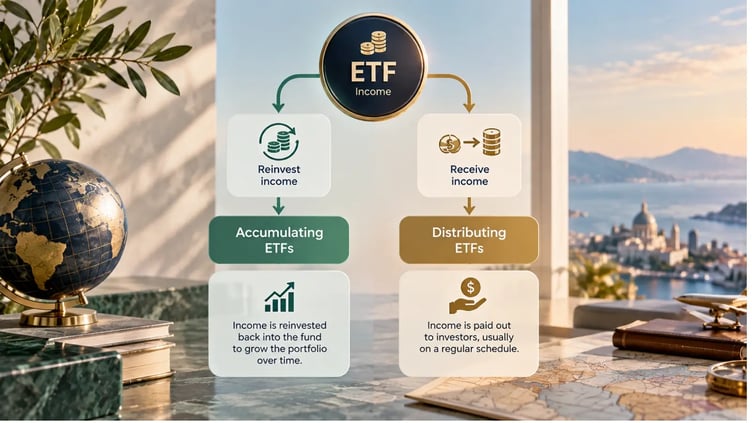
What are accumulating and distributing ETFs
Accumulating and distributing ETFs are two types of exchange-traded funds classified by how they handle income generated by their underlying investments.
An accumulating ETF is an ETF that retains and reinvests income within the fund.
A distributing ETF is an ETF that pays income from the fund to investors.
What is the difference between accumulating and distributing ETFs?
The main difference is what happens to the income generated by the ETF: accumulating ETFs automatically reinvest it, while distributing ETFs pay it to investors as cash.
This creates several practical differences for investors:
|
Feature |
Accumulating ETFs |
Distributing ETFs |
|
Income |
Reinvested within the fund |
Paid to the investor |
|
Reinvestment |
Automatic |
Usually manual |
|
Cash flow |
No regular cash distribution |
Provides cash distributions |
|
Compounding |
Income is automatically reinvested |
Requires reinvestment to maintain compounding |
|
Portfolio management |
Less ongoing intervention |
More active management may be required |
Are accumulating ETFs better than distributing ETFs?
Accumulating ETFs are not universally better than distributing ETFs.
The more suitable structure is based largely on whether the investor is building wealth or drawing income, as well as the tax rules applying to the investor.
Accumulating ETFs can be attractive during the wealth-building stage because income is automatically reinvested.
There is no need to receive a dividend and place a separate reinvestment order.
This can make accumulating ETFs particularly convenient for expats who:
- Are still working and do not need portfolio income
- Want to maximize long-term compounding
- Move between countries during their careers
- Prefer a lower-maintenance investment structure
- Intend to reinvest portfolio income rather than spend it
Distributing ETFs can make more sense when portfolio income is actually required.
For example, a retired expat may prefer regular distributions to help fund living expenses rather than selling ETF units periodically.
However, distributions are not necessarily a tax advantage.
Receiving cash does not automatically produce a better after-tax outcome than allowing income to accumulate inside the fund.
When comparing accumulating and distributing ETFs, consider how the income is taxed, where the fund is domiciled and whether the investor needs regular cash payments.
How are accumulating ETFs taxed for expats?
Accumulating ETFs can be taxed on the income they retain and reinvest, even when no cash is paid to the investor.
The tax treatment depends primarily on the investor’s country of tax residence.
Some jurisdictions tax accumulated investment income as it arises, while others may defer taxation until the ETF is sold.
Certain countries also apply specific rules to foreign or offshore funds.
UK investors in qualifying reporting funds can be taxed on excess reported income, including amounts that have not been distributed in cash.
Expats should check whether their country of tax residence taxes reinvested ETF income during the holding period or defers taxation until the investment is sold.
A change in tax residence can also change this treatment.
An accumulating ETF that receives one tax treatment before a move may be subject to different rules after becoming resident in another country.
How does ETF distribution taxation work?
ETF distribution taxation generally involves two separate layers: taxation within the investment structure and taxation of income received by the investor.
A distributing ETF may receive dividends from companies in its portfolio. Withholding tax can arise before the income reaches the ETF.
The ETF may then distribute income to its investors, who may face additional taxation in their country of residence.
The exact outcome varies by jurisdiction and fund structure.
US-source dividends paid to a nonresident alien are generally subject to 30% US withholding unless a lower treaty rate applies.
This illustrates why the headline dividend yield of an ETF is not necessarily the amount that an expat ultimately receives.
An investor should consider how dividends are taxed at each stage, from receipt by the ETF to distribution to the investor and taxation in their country of residence.
Tax treaties and foreign tax credits can sometimes reduce or offset parts of this tax burden, but they do not work identically in every country.
Distributing ETFs can also create additional record-keeping because the investor receives actual payments that may need to be reported as investment income.
Does ETF domicile matter more than accumulating or distributing?
For expats, the ETF’s domicile can matter more than whether the fund accumulates or distributes income because it determines the legal and tax framework surrounding the investment.
An ETF’s domicile is the jurisdiction where the fund is legally established, which may differ from both the investor’s country of residence and the exchange where the ETF trades.
This means two ETFs tracking the same index can have different tax and reporting outcomes despite having similar portfolios.
The accumulating or distributing structure is only one part of the decision; the fund’s domicile can determine how that structure is treated.
Ireland-domiciled UCITS ETFs, for example, are widely used by international investors because of their regulatory framework and access to tax treaties.
However, suitability still depends on the investor’s tax residence and circumstances.
Conclusion
ETF selection should also account for what happens when circumstances change for expats.
A fund that works well while living in one country may become less attractive after a move, a change in employment, or the start of retirement.
Selling and replacing an ETF can create transaction costs, tax consequences and unnecessary portfolio disruption.
This makes future flexibility an important part of ETF selection.
A suitable structure is not simply one that works today, but one that is unlikely to create problems when tax residence, cash flow needs or investment goals change.
FAQs
How to avoid tax on ETFs?
ETF taxes can sometimes be reduced legally through tax-advantaged accounts, favorable fund structures or jurisdictions with lower investment taxes.
For expats, avoiding tax generally means using legally available exemptions, allowances or tax-efficient structures, not concealing investment income or gains.
Is there an ETF that does not pay dividends?
Yes. Accumulating ETFs do not pay dividends directly to investors because income generated by the underlying holdings is retained and reinvested within the fund.
What is the 7% rule in ETF?
The 7% rule is a risk management guideline suggesting that an investor consider selling an ETF or stock if its price falls about 7% to 8% below the purchase price.
It is not a guaranteed loss limit or a universal ETF rule, and it is generally associated with active trading rather than long-term investing.
Do I have to pay taxes on ETFs if I don't sell?
Not necessarily, but holding an ETF without selling it does not automatically eliminate tax.
Some countries tax dividends, distributions or accumulated income during the holding period even when no ETF units are sold.
Related Articles
- Can I invest in ETFs if I live abroad?
- Expat Investment Advice for International Tax Planning: A Guide to Tax-Efficient Global Investing
- Tax on Investment Income Abroad: Is Overseas Investment Taxable?
- Expat Investment Income Strategies: How to Build Wealth Across Borders
- Best Equity Income ETFs
- How Does a Cross-Border Financial Planner Help?