For UK nationals living in Hong Kong, the strongest investment strategy is often a diversified portfolio of global ETFs, equity funds, bonds, real estate, and retirement-focused investments that balances Hong Kong's tax advantages with long-term financial goals.
Hong Kong's position as a leading international financial center provides access to various investment opportunities, but choosing the right portfolio also requires careful planning around taxes, currency exposure, and long-term goals.
Key Takeaways
- Hong Kong offers a tax-efficient environment with no general capital gains tax and no dividend tax.
- British expats should consider both Hong Kong and UK tax rules before making investment decisions.
- A diversified portfolio that combines global equities, fixed income, and alternative assets can help manage risk.
- Retirement planning should include both Hong Kong and UK pension arrangements where applicable.
Request an international portfolio review. My contact details are hello@adamfayed.com and WhatsApp +44-7393-450-837 if you have any questions.
The information in this article is for general guidance only. It does not constitute financial, legal, or tax advice, and is not a recommendation or solicitation to invest. Some facts may have changed since the time of writing.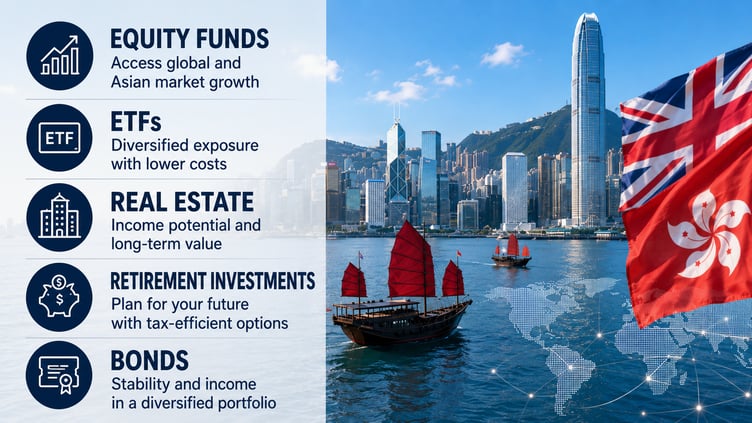
Is Hong Kong a good place to invest?
Yes, Hong Kong remains one of Asia's leading financial hubs and offers several advantages for long-term investors.
Its open economy, well-regulated financial system, and broad access to international investment products make it attractive for British expats seeking global diversification.
Some of Hong Kong's biggest investment advantages include:
- No general capital gains tax on investment gains
- No tax on most dividend income
- A territorial tax system that generally taxes income sourced in Hong Kong
- Access to international banks and brokerages
- Deep, liquid stock markets
- Easy access to investments across Asia, the United States, and Europe
- A freely convertible currency that is linked to the US dollar through a currency peg
What British expats should consider before investing in Hong Kong
Choosing suitable investments in Hong Kong for British expats requires considering tax residency, investment goals, currency exposure, retirement arrangements, and whether the investor expects to remain in Hong Kong, return to Britain, or relocate elsewhere.
Tax residency
Depending on your circumstances, you may still have reporting or tax obligations in the UK even while residing in Hong Kong.
Future plans
Ask yourself whether you intend to:
- Remain in Hong Kong permanently
- Return to the UK
- Relocate to another country
Your future residence may influence which accounts, pensions, and investment vehicles are most suitable.
Currency exposure
Many British expats continue to have financial commitments in pounds sterling while earning income in Hong Kong dollars.
Diversifying across HKD, GBP, and other major currencies can reduce exchange rate risk.
Investment objectives
Different goals require different investment strategies.
For example:
- Retirement investing
- Wealth preservation
- Children's education
- Property purchases
- Income generation
Diversification
Avoid concentrating investments in a single country or asset class. Holding global investments can help reduce portfolio volatility over the long term.
What are the best investments for UK expats in Hong Kong?
The best investments in Hong Kong for UK expats generally include globally diversified ETFs, global equity funds, Hong Kong and Asia-Pacific stocks, UK investments, bonds, multi-currency savings accounts, real estate, and alternative assets.
British residents of Hong Kong can consider many of the same investment options available to expats, but UK tax connections, Hong Kong regulations, and future relocation plans can affect their suitability.
The top investments are not necessarily limited to Hong Kong-based assets. Internationally portable funds, multi-currency accounts, UK investments, and global portfolios may be particularly useful for those who could move countries again.
Together, these investments can help British expats benefit from Hong Kong's tax-efficient investment environment while maintaining diversification across regions, currencies, and asset classes.
Exchange-Traded Funds (ETFs)
ETFs are one of the most practical investment options for British expats in Hong Kong because they provide low-cost exposure to global markets without relying solely on either UK or Hong Kong equities.
Many investors use globally diversified ETFs to spread investments across North America, Europe, and Asia while taking advantage of Hong Kong's broad access to international investment platforms.
Examples include ETFs tracking:
- Global stock markets
- US equities
- Developed markets
- Emerging markets
- Global bonds
Rather than selecting individual companies, investors gain exposure to hundreds or even thousands of securities through a single fund, making ETFs an efficient foundation for a diversified portfolio.
Global Equity Funds
Global equity funds allow British expats to build long-term wealth without concentrating investments in either the UK or Hong Kong.
This can be particularly valuable for those who may relocate again or eventually return to the UK, as diversified global exposure reduces reliance on the performance of a single economy.
Hong Kong and Asia-Pacific Stocks
Living in Hong Kong provides British expats with easier access to companies across Greater China and the wider Asia-Pacific region, markets that many UK-focused portfolios may underrepresent.
Sectors commonly considered by investors include:
- Technology
- Healthcare
- Consumer goods
- Infrastructure
- Financial services
While Asia-Pacific investments can offer attractive growth potential, they should generally complement rather than replace broader global investments.
UK Investments While Living Abroad
Moving to Hong Kong does not necessarily mean abandoning UK investments.
Many British expats continue holding UK-listed shares, investment trusts, gilts, and mutual funds to maintain exposure to sterling-denominated assets and preserve long-term financial ties with the UK.
Many investors continue holding:
- UK-listed shares
- Investment trusts
- Gilts
- Mutual funds
- Existing Individual Savings Accounts (ISAs)
Existing ISA investments can generally remain invested after moving abroad.
However, British expats who become non-UK residents are generally unable to make new ISA subscriptions unless they meet specific eligibility requirements.
Bonds and Fixed Income
Bonds can provide stability for British expats whose portfolios are heavily invested in equities or exposed to multiple currencies.
Government bonds and high-quality corporate bonds may help reduce overall portfolio volatility while providing more predictable income, particularly for investors approaching retirement.
Multi-Currency Savings Accounts
Multi-currency savings accounts can simplify managing cash across different currencies while reducing foreign exchange costs.
Real Estate Investments
Common real estate investment options include:
- Hong Kong residential property
- Commercial property
- Real estate investment trusts (REITs)
While purchasing property requires significant capital and comes with ongoing ownership costs, REITs provide a more accessible way to gain exposure to Hong Kong's property market.
Gold and Alternative Assets
As a major international financial and precious metals trading center, Hong Kong offers convenient access to physical gold, gold ETFs, and other alternative investment products, making it easier for investors to incorporate these assets into a diversified portfolio.
Private Equity
Hong Kong provides access to private equity opportunities that may not be as readily available through traditional retail investing in the UK.
Because these investments are typically illiquid and involve greater risk, they are generally suitable for experienced investors with longer investment horizons and the financial capacity to hold assets for several years.
Best retirement investments for UK expats in Hong Kong
The best retirement investments for British expats in Hong Kong typically include the Mandatory Provident Fund (MPF), UK pensions, Self-Invested Personal Pensions (SIPPs), and a globally diversified retirement portfolio.
Mandatory Provident Fund (MPF)
Most employees in Hong Kong are required to participate in the Mandatory Provident Fund (MPF), with contributions made by both employers and employees, subject to applicable rules and limits.
Many British expats continue to hold workplace or personal pensions in the UK after relocating to Hong Kong.
Rather than transferring or withdrawing these assets immediately, review how they fit into your overall retirement strategy and future plans.
Self-Invested Personal Pension (SIPP)
A Self-Invested Personal Pension (SIPP) can provide greater control over retirement investments for eligible individuals.
However, contribution eligibility and tax treatment may change after becoming non-UK resident, so it's important to understand the applicable rules before making contributions or altering existing arrangements.
Is investing in Hong Kong tax-free for British expats?
Investing in Hong Kong can be highly tax-efficient for British expats, but it is not automatically tax-free.
Hong Kong generally does not impose capital gains tax, dividend tax, VAT, or GST, making it one of the world's most attractive jurisdictions for investors.
In addition, the UK and Hong Kong have a Comprehensive Double Taxation Agreement (CDTA) that helps prevent the same income from being taxed twice, although it does not exempt all income from tax.
Investing in Hong Kong vs other popular investment destinations for British expats
Aside from Hong Kong, Singapore, the United Arab Emirates, Switzerland, the United Kingdom, and Australia are also popular investment destinations for British expats, each offering unique advantages based on investment objectives, tax considerations, and long-term financial plans.
|
Destination |
Why Consider It |
Compared with Hong Kong |
|
Singapore |
Political stability, wealth management, regional hub |
Similar tax efficiency; Singapore may appeal for Southeast Asia exposure |
|
United Arab Emirates |
No personal income tax, growing financial sector |
Strong for Middle East investments, but Hong Kong offers broader access to China and Asian markets |
|
United Kingdom |
Familiar market and pension system |
Hong Kong generally offers greater tax efficiency for investments |
|
Switzerland |
Wealth preservation, private banking |
Stronger private banking tradition, while Hong Kong offers better access to Asian growth |
|
Australia |
Stable economy and dividend-paying companies |
Attractive income investments, but generally higher taxes than Hong Kong |
Conclusion
For British expats, the biggest investment advantage of living in Hong Kong is not necessarily access to more products; it's access to more choices.
The most suitable British expat investments in Hong Kong depend on where the investor expects to live, spend money, and retire.
Access to local and international markets creates opportunities, but not every available investment will suit an individual’s objectives, tax position, or future plans.
The goal is to build a portable investment strategy that can adapt to changing markets, tax rules, and countries of residence without relying too heavily on any one jurisdiction.
FAQs
What are Hong Kong's unique advantages?
Hong Kong's key advantages include its territorial tax system, absence of general capital gains tax, internationally recognized financial sector, strategic location in Asia, freely convertible currency, and broad access to global investment products.
What is the best passive income in Hong Kong?
Dividend-paying ETFs and REITs are among the most practical passive-income investments in Hong Kong because they provide diversified exposure without requiring investors to manage individual properties or businesses.
The best option depends on the UK investor’s risk tolerance, income needs, currency exposure, tax position, and investment horizon.
Does Hong Kong have a tax treaty with the UK?
Yes. Hong Kong and the United Kingdom have a Comprehensive Double Taxation Agreement (CDTA) that helps reduce double taxation on certain types of income and provides rules for allocating taxing rights between the two jurisdictions.
Is Japan or Hong Kong better?
Hong Kong is generally better for British expats seeking tax efficiency and access to international financial markets, while Japan is better suited to investors focused on its mature domestic economy and companies.
Related Articles
- Best Investment Options for UK Expats
-
Cross-Border Investing for Expats: How to Invest Across Multiple Countries
- Financial Planning for Cross-Border Wealth for Expats
- Why Wealthy Expats Struggle to Trust Investments Abroad
- Hong Kong External Asset Managers
- Do expats pay tax on UK pensions?
- UK Expat Taxes: A 2025 Guide