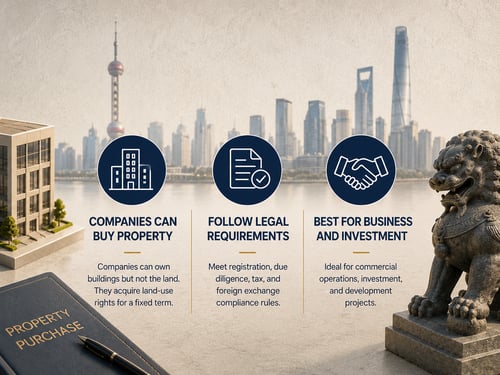
Companies can generally buy property in China, but they acquire land-use rights rather than ownership of the land, and the rules differ significantly for Chinese companies and foreign companies.
Buying property through a company can be advantageous for commercial operations and investment, but foreign investors must also navigate foreign investment rules, foreign exchange controls, and ongoing corporate compliance obligations.
This article covers:
- Are foreign companies allowed to purchase property in China?
- What taxes to pay when buying property in China?
- Can corporations own land in China?
- What are the requirements when buying land?
- What are the advantages and disadvantages of a company buying property or land?
Key Takeaways:
- Chinese companies generally face fewer acquisition restrictions, while foreign companies must meet more regulatory requirements.
- Companies cannot own land outright and instead acquire fixed-term land-use rights.
- Buying through a company generally suits commercial property, investment, and development projects better than personal residences.
- Foreign exchange controls require cross-border property transactions to meet approval and reporting requirements.
My contact details are hello@adamfayed.com and WhatsApp +44-7393-450-837 if you have any questions.
The information in this article is for general guidance only. It does not constitute financial, legal, or tax advice, and is not a recommendation or solicitation to invest. Some facts may have changed since the time of writing.
Can foreign companies own property in China?
Yes, foreign companies can own certain types of property in China, but they are generally subject to stricter rules than Chinese companies.
China has tightened foreign investment in real estate since 2006, when measures were introduced to curb speculative overseas investment in the property market.
As a result, foreign companies are generally expected to acquire property for legitimate business operations or approved investment activities rather than purely speculative purposes.
Unlike some countries that allow unrestricted foreign corporate ownership, China regulates foreign real estate acquisitions through its foreign investment framework, land administration rules, and foreign exchange regulations.
In many cases, a foreign company must first establish a legal presence in China, typically as a Foreign-Invested Enterprise (FIE), before acquiring property for business operations or other permitted purposes.
A foreign company may be able to purchase:
- Office premises
- Commercial buildings
- Industrial property
- Warehouses
- Certain development projects, subject to applicable approvals
Purchases must generally relate to the company's business activities, and additional restrictions may apply depending on the property's intended use, location, and the industry involved.
By contrast, a locally incorporated Chinese company can generally acquire property more easily, provided it complies with applicable planning, registration, financing, and taxation requirements.
Domestic companies also tend to have broader access to local financing and fewer regulatory hurdles than foreign-owned entities.
How does buying property work in China as a business?
Buying property through a company in China generally involves verifying the company's eligibility, conducting due diligence, completing the purchase, and registering the property or land-use rights with the relevant authorities.
- Confirm eligibility. The company must be eligible to acquire the property under Chinese law. Foreign companies generally need an established legal presence in China and may be subject to foreign investment regulations.
- Conduct legal due diligence. Verify the seller's ownership, review the property's land-use rights, confirm zoning and permitted use, and check for mortgages, liens, or other encumbrances.
- Sign the sale and purchase agreement. Once due diligence is complete, the parties execute the purchase agreement and complete the payment of the purchase price, taxes, and government fees.
- Register the transfer. The transfer is registered with the relevant real estate registration authority, and the company receives the updated property ownership certificate or land-use rights registration.
- Complete regulatory requirements. Foreign-invested companies may also need to satisfy foreign investment and foreign exchange registration or reporting requirements before overseas funds can be remitted into China.
How much money do companies need to buy a house in China?
There is no minimum amount required to buy a house in China for businesses, but prices can range from under CNY 1 million in some smaller cities to CNY 10 million or more for comparable properties in major cities such as Beijing, Shanghai, Shenzhen, and Guangzhou.
The total cost is based on the property's location, size, intended use, and prevailing market conditions.
Companies should also budget for additional acquisition costs, including:
- Purchase taxes
- Registration fees
- Legal and professional fees
- Due diligence costs
- Financing expenses, where applicable
If financing is used, lenders typically require a substantial down payment, with the exact amount depending on the borrower's financial position, the property, and the lender's credit policies.
What is the most common method used to finance the purchase of real estate in China?
Corporate bank lending is the most common method used to finance commercial real estate purchases in China.
Chinese companies frequently obtain loans from domestic banks by providing financial statements, business information, and suitable collateral.
The availability and terms of financing depend on the company's financial position, creditworthiness, and the intended use of the property.
Foreign-invested enterprises may also access domestic financing, although lenders often apply additional due diligence and regulatory requirements.
Some companies instead finance acquisitions through shareholder capital contributions or retained earnings rather than external borrowing.
Cross-border financing is generally subject to China's foreign exchange and capital control rules.
As a result, overseas funding often requires additional regulatory compliance before it can be used to purchase property in China.
Is it better to buy property as a company or individual in China?
Buying property through a Chinese company or eligible foreign-invested enterprise is generally better for commercial and investment purposes, while individual ownership is usually better for an owner-occupied home.
In China, companies commonly purchase offices, factories, warehouses, hotels, and other commercial property needed for their operations.
Corporate ownership may also be preferable for businesses managing multiple investment properties or undertaking real estate development, particularly where the property forms part of the company's commercial activities.
However, foreign companies cannot simply purchase property in China in the same way they might in some other jurisdictions.
By comparison, purchasing as an individual is generally simpler for those acquiring a home for their own use, although foreign individuals are also subject to eligibility requirements and restrictions designed to discourage speculative property investment.
Do companies pay property taxes in China?
Yes. Companies purchasing property in China may be liable for several taxes during acquisition, ownership, and disposal.
At the time of purchase, buyers commonly pay Deed Tax, with the applicable rate depending on the nature of the property and the transaction.
Companies that own property may also be subject to Urban Land Use Tax, which is generally imposed on entities using urban land.
In addition, businesses owning commercial property may pay Property Tax, although the rules differ depending on the property's use and location.
Rental income generated from the property is generally subject to the applicable corporate tax rules, while the sale of property may give rise to Corporate Income Tax, Value-Added Tax (VAT) where applicable, and other transaction-related taxes.
Because several taxes can apply at different stages of ownership, companies should evaluate the total tax cost of acquiring, holding, leasing, and eventually disposing of the property before completing the purchase.
What is the most tax-efficient way to buy property in China as a company?
Buying commercial property through a Chinese company or a properly structured foreign-invested enterprise is often more tax-efficient than individual ownership when the property will be used for business operations.
However, there is no single ownership structure that is the most tax-efficient for every purchase, as the optimal approach depends on the property's intended use, the buyer's tax status, and the applicable tax and foreign investment rules.
Corporate ownership also creates ongoing compliance obligations and may result in taxes that would not apply to some individual buyers.
Businesses should also consider the impact of Corporate Income Tax, VAT, Property Tax, Urban Land Use Tax, financing arrangements, and any applicable tax treaty benefits before selecting an ownership structure.
Given China's complex tax and foreign investment rules, obtaining professional legal and tax advice before acquiring property is generally the most effective way to structure the purchase efficiently while remaining compliant.
Can companies own land in China?
No. Companies cannot own land outright in China because private land ownership is not permitted.
Under China's legal system, urban land is owned by the state, while rural and agricultural land is generally owned collectively by rural communities.
Rather than purchasing freehold land, companies obtain land-use rights that allow them to develop, occupy, lease, or transfer the land during the applicable term.
Land-use rights are typically granted for fixed periods depending on the approved use of the land.
Common terms include:
- Up to 70 years for residential use
- Up to 50 years for industrial use
- Up to 40 years for commercial, tourism, and entertainment use
These rights are commonly obtained through government tender, auction, listing, or allocation procedures, depending on the nature of the project.
Both Chinese companies and eligible foreign-invested enterprises may acquire land-use rights, although foreign-invested companies are generally subject to additional approval requirements and foreign investment regulations.
Before acquiring land-use rights, companies should also verify zoning restrictions, permitted land use, development obligations, environmental requirements, and the remaining term of the existing land-use rights where applicable.
These factors can significantly affect the value and future use of the property.
What are the documents needed when buying Chinese land?
Companies acquiring land-use rights in China generally need corporate registration documents, identification for authorized representatives, and documents relating to the land-use rights being transferred.
Common documents include:
- Business license
- Articles of Association
- Identification of the legal representative or authorized signatory
- Board resolution approving the acquisition
- Company chop (official seal), where required
- Tax registration documents
- Proof of funds or financing arrangements
The seller typically provides documents relating to the land-use rights, including the land-use rights certificate, property ownership registration where applicable, planning approvals, and evidence that the land-use rights are free from undisclosed mortgages, liens, or other encumbrances.
Foreign-invested companies may also need to provide additional foreign investment or foreign exchange documentation, depending on the nature of the transaction and the source of the purchase funds.
How much does it cost to buy land in China?
The land grant premium is determined through the Chinese government's tender, auction, or listing process and can range from several million yuan for smaller industrial sites to billions of yuan for prime commercial land in major cities.
There is no fixed or minimum amount to acquire land-use rights in China.
The total cost depends on the land's location, permitted use, size, remaining land-use term, and prevailing market conditions.
Prime commercial districts in Tier 1 cities generally command substantially higher land grant premiums than comparable sites in lower-tier cities.
Companies should also budget for additional acquisition costs, including:
- Land grant premium, where applicable
- Deed Tax
- Registration fees
- Legal and professional fees
- Due diligence costs
Commercial and industrial land in major cities such as Beijing, Shanghai, Shenzhen, and Guangzhou generally commands significantly higher prices than comparable land in smaller cities or less-developed regions.
Does owning Chinese land have taxes?
Yes. Companies holding land-use rights in China may be required to pay several ongoing taxes.
One of the main recurring taxes is Urban Land Use Tax, which generally applies to entities using urban land.
Businesses owning commercial buildings may also be subject to Property Tax, depending on the property's use and location.
If the land generates rental income or is later sold, additional taxes such as Corporate Income Tax, VAT where applicable, and other transaction taxes may also arise.
What are the advantages of buying property or land under company name in China?
Buying property or acquiring land-use rights under a company name in China can make it easier to own business assets, manage commercial property, access corporate financing, and separate business assets from personal assets.
These advantages include:
- Separating business assets from personal assets
- Facilitating the ownership and management of multiple properties
- Supporting commercial operations through corporate ownership
- Potentially improving access to domestic business financing
- Simplifying ownership where there are multiple investors or shareholders
- Aligning property ownership with the company's accounting and tax records
For businesses acquiring offices, factories, warehouses, hotels, or investment property, corporate ownership may provide a more appropriate legal structure than individual ownership.
What are the disadvantages in buying property or land through a company in China?
Purchasing property or acquiring land-use rights through a company in China generally involves higher compliance costs, greater regulatory requirements, and more administrative obligations than buying as an individual.
These disadvantages may include:
- Higher accounting and administrative costs
- Ongoing corporate compliance and reporting obligations
- Corporate taxation on income and gains
- Additional regulatory requirements for foreign-invested enterprises
- Foreign exchange restrictions affecting cross-border funding
- More complex acquisition and approval procedures than individual purchases
For businesses purchasing only a single property for limited use, these additional obligations may outweigh the benefits of corporate ownership.
How do foreign exchange regulations affect property purchases in China?
China's foreign exchange and capital controls require foreign companies to comply with approval, registration, and reporting requirements when bringing funds into China to acquire property or remitting proceeds overseas.
Cross-border payments for property acquisitions are regulated by the State Administration of Foreign Exchange (SAFE) and other relevant authorities.
Overseas funds used to purchase property generally must comply with foreign exchange regulations and may require supporting documentation before they can be converted into Renminbi (RMB) and transferred into China.
Similarly, companies seeking to repatriate rental income, dividends, or sale proceeds overseas must satisfy the applicable tax, reporting, and foreign exchange requirements before funds can be remitted abroad.
Because these controls can affect both the timing and structure of a transaction, foreign investors should consider foreign exchange compliance at an early stage of the acquisition process.
Conclusion
Companies can acquire commercial, industrial, and other eligible property interests in China, but ownership is fundamentally different from jurisdictions that permit private land ownership.
Businesses obtain land-use rights rather than ownership of the underlying land, making due diligence on the property's remaining land-use term, regulatory restrictions, financing, taxation, and foreign exchange requirements essential.
For foreign investors, structuring the acquisition correctly from the outset can help reduce regulatory complications and support long-term business objectives.
FAQs
Is it possible to buy property in China as an individual foreigner?
Yes, foreigners can buy property in China, but strict restrictions apply.
Eligible foreign individuals are generally limited to purchasing one residential property for their own use, while foreign companies must typically have an approved business presence in China and comply with foreign investment and foreign exchange regulations before acquiring property.
How many years can you own property in China?
You generally hold land-use rights for up to 70 years for residential property, 50 years for industrial property, and 40 years for commercial, tourism, and entertainment property.
Companies and individuals do not own the land itself; they acquire land-use rights for these fixed terms.
Is it true that 90% of people in China own their homes?
Homeownership in China is widely estimated to exceed 90%, although the exact percentage varies depending on the survey and methodology used.
This high ownership rate reflects decades of housing reforms and strong cultural preferences for homeownership.
Why do Chinese people invest in real estate?
Many Chinese investors view real estate as a long-term store of wealth, a source of rental income, and a way to preserve capital.
Property has also traditionally been regarded as an important component of family wealth and financial security, although investment decisions have become more cautious in recent years due to changes in the property market.
Can Chinese companies purchase properties outside of China?
Yes. Chinese companies can generally purchase overseas property, subject to the laws of the destination country and China's outbound investment and foreign exchange regulations.
Larger overseas acquisitions may also require additional approvals or filings with the relevant Chinese authorities.
Related Articles:
- Can You Buy Property and Land in the Philippines through a Company?
- Can Foreigners Buy Property and Land in Indonesia Through a Company?
- Buying Property and Land in South Africa Through a Company
- Should you buy a UK property through a company?
- Which is the Best Country to Buy Property in 2025?
- 10 Best Real Estate Developers in China