Buying property and land in Italy through a company is a common strategy used by investors seeking liability protection, portfolio management flexibility, and long-term asset ownership.
Both Italian and foreign companies can generally acquire property in Italy, but the ownership structure can affect taxation, financing, compliance requirements, and long-term investment flexibility.
This article covers:
- Are foreign companies allowed to own property in Italy?
- What are the rules for foreign companies buying property in Italy?
- What is needed to buy property in Italy?
- Is it better to buy property through a company?
- Can a company buy land in Italy?
- What are the taxes in Italy for property and land?
- How to purchase land in Italy?
Key Takeaways:
- Foreign and Italian companies can generally acquire property and land in Italy.
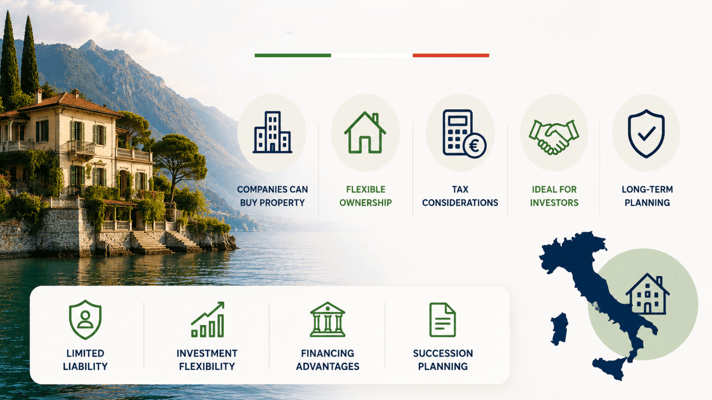
- Company ownership may offer liability, investment, and succession planning benefits.
- Corporate buyers may face different tax treatment than individual purchasers.
- Land acquisitions require careful review of zoning and development restrictions.
My contact details are hello@adamfayed.com and WhatsApp +44-7393-450-837 if you have any questions.
The information in this article is for general guidance only. It does not constitute financial, legal, or tax advice, and is not a recommendation or solicitation to invest. Some facts may have changed since the time of writing.

What are the rules for buying a property in Italy for companies?
Italy generally allows both Italian and foreign companies to buy residential, commercial, and investment property.
Certain non-EU companies may be subject to Italy's reciprocity principle, which considers whether Italian individuals or companies enjoy equivalent property ownership rights in the buyer's home jurisdiction.
Corporate buyers generally follow the same acquisition process as individual purchasers, including legal due diligence, contract negotiation, notarial review, execution of the deed of sale, and registration with the relevant Italian authorities.
While the acquisition process is broadly similar, companies should also consider corporate tax, financing, and ongoing compliance requirements before completing a purchase.
Foreign Company vs Italian Company
Both foreign and Italian companies can buy property in Italy, but an Italian company—most commonly an Italian SRL (Società a Responsabilità Limitata)—may provide greater operational flexibility for long-term investment activities.
An Italian SRL is Italy's equivalent of a limited liability company (LLC) and is one of the most common business structures used to own and manage Italian real estate.
Compared with a foreign company, an Italian SRL may offer easier access to local banking and financing, a stronger operational presence in Italy, simplified management of rental activities, and greater flexibility for future expansion.
| Factor | Foreign Company | Italian Company |
| Property ownership | Yes | Yes |
| Local administration | More complex | Generally simpler |
| Financing access | May be more limited | Often easier |
| Tax filings | Cross-border considerations | Domestic compliance |
| Development projects | Possible | Often more practical |
| Ongoing management | International coordination | Local management structure |
Many investors use foreign companies for passive property holdings or as part of a broader international investment structure, while Italian SRLs are commonly used for active rental portfolios, commercial operations, and property development within Italy.
The most appropriate ownership structure is based on the scale of the investment, financing requirements, tax considerations, operational needs, and long-term ownership objectives.
Purchasing Property in Italy Through a Company vs Buying Personally
Buying personally is often more suitable for individuals purchasing a primary residence, holiday home, or a single investment property due to its simpler administration and lower ongoing compliance.
Buying through a company is generally better suited to investors acquiring multiple properties, operating rental or hospitality businesses, developing real estate, or seeking liability protection and long-term succession planning.
For example, an individual buying a villa in Tuscany for personal use may prefer direct ownership, while an investor purchasing several rental apartments in Milan or a hospitality property in Sicily may benefit from a company structure.
The most appropriate ownership structure depends on the property's intended use, investment scale, financing strategy, and long-term tax and estate planning objectives.
What Are the Requirements to Buy Property in Italy?
Companies purchasing property in Italy generally need corporate formation documents, tax registrations, and evidence of authority to complete the transaction.
Typical requirements include:
- Certificate of incorporation
- Articles of association
- Company registry extract
- Director and shareholder information
- Tax identification documentation
- Corporate resolution authorizing the purchase
- Power of attorney where applicable
- Anti-money laundering documentation
- Proof of funds
Foreign corporate documents may need translation, notarization, or apostille certification depending on the jurisdiction involved.
Professional legal and tax advice is commonly obtained before completing the acquisition.
What Taxes Do You Pay When Buying a Property in Italy?
Companies buying property in Italy may pay registration tax, VAT (in certain transactions), mortgage tax, and cadastral tax, based on the type of property being acquired and the transaction structure.
Common acquisition taxes include:
- Registration Tax – Typically applies to property transfer transactions.
- VAT – May apply when purchasing certain new-build properties or commercial real estate.
- Mortgage Tax – Associated with registering property rights and certain transactions.
- Cadastral Tax – Relates to registration within Italy's land and property records.
After acquisition, companies may also face:
- Municipal property taxes, including IMU where applicable
- Corporate taxation on rental income
- Capital gains taxation upon sale
- Accounting and reporting obligations
For larger investments, tax treaty considerations and corporate tax planning may also affect the total tax burden.
What to Know Before Buying Property in Italy?
Anyone buying property in Italy as a company should assess legal, tax, financing, and operational considerations before purchasing Italian property.
Key areas of due diligence include:
Title Verification
Confirm legal ownership and identify any encumbrances, easements, or restrictions affecting the property.
Planning and Zoning Restrictions
Review municipal regulations governing future use, development, and renovation activities.
Historic Property Regulations
Many properties in Italy are subject to cultural heritage protections that may restrict modifications.
Financing Availability
Mortgage financing may differ significantly for foreign companies compared to domestic entities.
Ongoing Compliance
Corporate ownership typically creates additional accounting, reporting, and tax obligations.
Understanding these factors before purchase can help reduce unexpected costs and administrative challenges.
Where are the Best Places to Buy Investment Property in Italy?
Milan is often considered the best location for companies seeking long-term rental income and commercial property investments, while Rome, Florence, Bologna, Turin, Puglia, and Sicily offer opportunities for hospitality, development, and tourism-focused projects.
- Milan: Italy's financial center offers strong rental demand, corporate tenants, office opportunities, and a mature investment market.
- Rome: The capital attracts long-term residents, professionals, diplomats, and tourists, supporting both residential and hospitality investments.
- Florence: A popular location for luxury real estate, boutique hospitality, and tourism-focused property businesses.
- Bologna: Strong demand from students, professionals, and academic institutions supports long-term rental strategies.
- Turin: Often provides lower entry prices than Milan while maintaining a diversified economy and stable rental demand.
- Puglia and Sicily: Popular destinations for companies investing in holiday rentals, hospitality assets, and lifestyle-oriented developments.
Can You Purchase Land in Italy as a Company?
Yes. Companies can generally purchase land in Italy, including development land, commercial land, and agricultural land.
Land acquisitions often require additional due diligence because development rights vary significantly between regions and municipalities.
Important considerations include:
- Zoning classification
- Building restrictions
- Environmental regulations
- Infrastructure access
- Utility availability
- Agricultural use limitations
Land investors should verify permitted uses before completing a purchase.
How much does 1 acre of land cost in Italy?
As a broad guide, agricultural land in Italy averages around €9,000 per acre, although prices vary significantly based on the region, land quality, and permitted use.
Development land near major cities and tourist destinations can cost substantially more.
Development land near major cities, tourist destinations, or commercially attractive locations can cost well over €100,000 per acre, particularly where planning permission and infrastructure significantly increase its value.
For companies, the purchase price is only one factor.
Do You Pay Tax on Land in Italy?
Yes. Companies that own land in Italy may be subject to acquisition taxes when purchasing the land, annual municipal property taxes (IMU), and taxes on any gains realized when the land is sold.
The tax treatment depends on factors such as:
- Land classification
- Agricultural versus development use
- Ownership structure
- Commercial activities conducted on the land
- Future sale arrangements
For ongoing ownership, land may be subject to IMU (Imposta Municipale Unica), Italy's municipal property tax.
Agricultural land is commonly subject to IMU rates that are often around 0.76% of the taxable value, although municipalities can apply different rates and exemptions depending on the location and classification of the land.
Development land may also be subject to IMU, often at rates determined by the local municipality.
Development land, commercial land, and income-producing land may face different tax consequences than passive agricultural holdings.
Companies should therefore review both acquisition taxes and ongoing municipal tax obligations before purchasing land in Italy.
How to Buy Land in Italy as a Company?
Italian and foreign companies can generally buy land in Italy by selecting an appropriate ownership structure, completing legal due diligence, executing the purchase before an Italian notary, and registering the transaction with the relevant authorities.
The process typically involves:
- Choose the company structure. Purchase the land through an existing Italian company, such as an SRL, or an eligible foreign company, depending on your investment objectives, tax planning, and operational needs.
- Confirm eligibility. Foreign companies should verify whether Italy's reciprocity principle applies, while Italian companies should ensure they meet the relevant corporate and regulatory requirements.
- Review the land carefully. Verify the title, zoning classification, permitted use, boundaries, easements, environmental restrictions, and any planning or development limitations.
- Conduct legal due diligence. Engage an Italian lawyer or notary to confirm ownership, identify encumbrances, and ensure the land can legally be used for its intended purpose.
- Sign the purchase agreement. Execute the preliminary contract, followed by the final deed of sale before an Italian notary.
- Pay the applicable taxes and fees. Settle any registration tax, VAT (where applicable), mortgage tax, cadastral tax, and notarial fees associated with the acquisition.
- Register the ownership. Register the transfer with the relevant Italian land and property authorities so the company becomes the legal owner.
Companies purchasing agricultural or development land should also confirm that local planning regulations and zoning rules permit their intended commercial use before completing the transaction.
Conclusion
Buying property in Italy through a company can provide a structured approach to managing real estate investments, particularly for investors building portfolios, acquiring commercial assets, or planning for long-term succession.
The decision is often not simply about purchasing property but about selecting an ownership structure that aligns with future investment, financing, and estate planning objectives.
For many investors, the greatest benefits of corporate ownership emerge over time through portfolio growth, operational efficiency, and succession planning rather than at the point of acquisition itself.
FAQs
Does Owning Property in Italy Make You a Tax Resident?
No. Owning property in Italy does not automatically make you an Italian tax resident.
Tax residency is generally determined by factors such as physical presence, habitual residence, and personal or economic connections to Italy.
Can an UK Company Buy Property in Italy?
Yes. A UK company can generally buy property in Italy, subject to Italian legal requirements, reciprocity rules, and applicable tax obligations.
What Are the Pitfalls of Buying a Property in Italy?
The most common pitfalls include title defects, zoning restrictions, historic building protections that limit renovations, unexpected refurbishment costs, tax complexity, and underestimating ongoing maintenance and compliance expenses.
Investors may also encounter financing challenges and delays when acquiring older or highly regulated properties.
Can You Build on Agricultural Land in Italy?
Usually not. Agricultural land in Italy is primarily designated for farming, and new construction is generally restricted unless specifically permitted under local zoning and planning regulations.
Related Articles