France, Singapore, and the United Arab Emirates are among the countries that can grant citizenship in exceptional cases based on an individual's outstanding achievements, contributions, or value to the country.
Unlike citizenship by investment or ordinary naturalization, these pathways are typically highly discretionary, rare, and reserved for individuals whose exceptional talent, achievements, or contributions are considered to serve the national interest.
Key Takeaways
- Citizenship by merit is limited to a small number of countries and exceptional cases.
- Most routes are discretionary, with no guaranteed eligibility.
- Merit can include business, science, sports, arts, philanthropy, and other national contributions.
- Wealth alone does not normally qualify someone for citizenship by merit.
For second residencies that require income, assets, or qualifying investments, we can help structure suitable investment solutions that may align with those requirements, depending on your circumstances.
My contact details are hello@adamfayed.com and WhatsApp +44-7393-450-837 if you have any questions.
The information in this article is for general guidance only, does not constitute financial, legal, or tax advice, and may have changed since the time of writing.

What does citizenship by merit mean?
Citizenship by merit refers to the discretionary granting of citizenship to individuals who have made exceptional contributions to a country or whose achievements are considered beneficial to the national interest.
Unlike traditional immigration routes, citizenship by merit is generally not based on years of residence, family ties, or a fixed financial investment.
Instead, governments evaluate each case individually and determine whether granting citizenship serves the country's economic, scientific, cultural, sporting, or strategic objectives.
Citizenship by merit can overlap with citizenship by exception, but the terms are not always interchangeable.
Citizenship by exception is broader and can cover special grants outside ordinary naturalization rules for reasons other than exceptional merit or achievement.
Most citizenship by merit pathways are not open to public applications.
In many cases, candidates are nominated by government authorities or approved through a cabinet decision, presidential decree, or other exceptional legal process.
Because these decisions are discretionary, eligibility requirements differ significantly from one country to another.
Countries with citizenship by merit
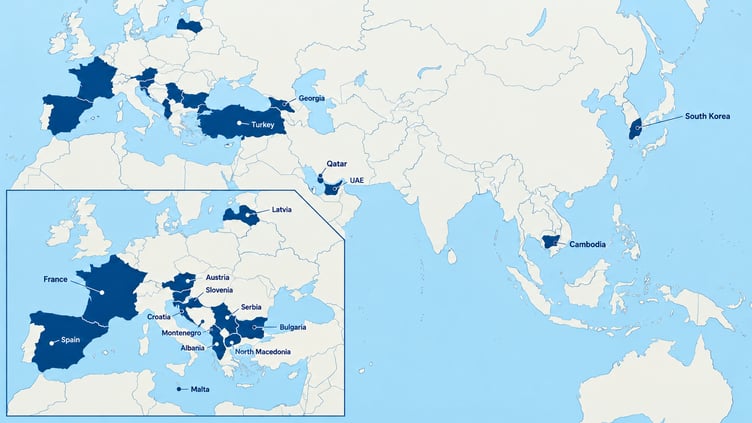
Austria, France, Turkey, South Korea, Georgia, Cambodia, Malta, and the United Arab Emirates are among the countries that provide exceptional pathways to citizenship based on outstanding services, achievements, talent, or contributions to the national interest.
Legal basis: Article 10(9) of Malta's Citizenship Act, together with the Granting of Citizenship by Naturalization on the Basis of Merit Regulations (S.L. 188.06), allows citizenship to be granted to a person who renders exceptional services, makes an exceptional contribution, including through job creation, or is of exceptional interest to Malta.
The framework covers exceptional contributions in areas including science and research, technology, sport, entrepreneurship, culture and the arts, and philanthropy.
Residence requirement: At least eight months. Following approval in principle, the applicant must complete the formal naturalization process after establishing at least eight months of residence in Malta and holding adequate residential property there.
Investment requirement: None. Malta's merit framework does not establish a fixed investment amount or operate as a citizenship-by-investment program.
2. Austria
Legal basis: Section 10(6) of the Austrian Citizenship Act allows citizenship to be granted where the Austrian Government confirms that naturalization is in the special interest of the Republic because of extraordinary services already rendered or expected from the foreigner.
This can cover individuals with exceptional achievements in areas such as science, research, economics, sport, or the arts.
Residence requirement: None. The special provision allows citizenship without the ordinary residence requirement.
Investment requirement: None. There is no fixed investment threshold, although economic contributions may be relevant when assessing the applicant's extraordinary services.
3. France
Legal basis: Article 21-19 of the French Civil Code allows naturalization without the ordinary residence period for individuals who have rendered exceptional services to France or whose naturalization is considered to be of exceptional interest to France.
A reasoned ministerial report and opinion from the Conseil d'État are required.
Residence requirement: None. The ordinary residence requirement can be waived under this provision.
Investment requirement: None. The provision does not establish a minimum investment requirement.
4. Turkey
Legal basis: Article 12 of the Turkish Citizenship Law allows foreigners who have rendered or are expected to render outstanding services in scientific, technological, economic, social, sporting, cultural, or artistic fields to acquire citizenship by Presidential decision, following a reasoned proposal from the relevant ministry.
Residence requirement: None. The exceptional route does not require the ordinary naturalization conditions.
Investment requirement: None. The merit-based route has no fixed investment requirement and is separate from Türkiye's citizenship-by-investment program.
5. South Korea
Legal basis: Article 7 of South Korea's Nationality Act allows special naturalization for foreigners who have made a major contribution to South Korea or possess outstanding ability in fields such as science, economics, culture, or sport and are considered likely to contribute to the national interest.
The implementing regulations further cover areas including national security, society, education, and culture.
Residence requirement: None. Special naturalization waives the ordinary residence requirement.
Investment requirement: None. The special naturalization route does not require a minimum investment.
6. Georgia
Legal basis: Article 17 of Georgia's Organic Law on Citizenship allows the President to grant citizenship by exception to a foreigner who has made an exceptional contribution to Georgia or where granting citizenship is justified by state interests.
The assessment may consider substantial investment contributing to economic development and achievements in sport, science, or the arts.
Residence requirement: None. Citizenship by exception is separate from ordinary residence-based naturalization.
Investment requirement: No fixed amount. Substantial investment may be considered as a factor in determining whether granting citizenship serves Georgia's state interests.
7. Cambodia
Legal basis: Article 13 of Cambodia's Law on Nationality allows a foreigner who has made a special merit or achievement for the interests of Cambodia to acquire Cambodian nationality without meeting certain ordinary naturalization conditions.
Residence requirement: Not specifically required under the special merit provision. Article 13 provides an exception to the ordinary naturalization conditions.
Investment requirement: No fixed investment threshold applies to the special merit provision.
Cambodia separately provides for nationality based on substantial contributions to the national budget, which is distinct from the special merit route.
8. United Arab Emirates
Legal basis: The UAE's citizenship framework is based on Federal Law No. 17 of 1972 Concerning Nationality and Passports, as amended by Federal Decree-Law No. 16 of 2017.
Amendments to its Executive Regulation in January 2021 introduced a nomination framework for selected foreign investors, professionals, and exceptional talents.
Who may qualify: Eligible categories include investors, doctors, specialists, scientists, inventors, intellectuals, artists, and people with exceptional or creative talents.
Investment requirement: Varies by category. Investors must meet specific property ownership requirements, while professionals and exceptional talents must satisfy relevant qualification or achievement criteria.
Decision process: There is no ordinary public application process.
Candidates are nominated by designated government entities, Rulers' and Crown Princes' Courts, Executive Councils, or the Cabinet.
9. Qatar
Legal basis: Article 6 of Qatar's Nationality Law allows Qatari nationality to be granted by Emiri decision to foreigners who have rendered great service to Qatar, possess skills the country needs, or have demonstrated promising scientific ability.
Residence requirement: None. Article 6 provides an exception to the ordinary nationality requirements.
Investment requirement: None. The provision does not establish a minimum investment requirement.
10. Montenegro
Legal basis: Article 12 of the Law on Montenegrin Citizenship allows a foreigner to exceptionally acquire citizenship when this is of special importance to Montenegro's state, scientific, economic, cultural, sporting, or other interests.
The decision is made by the Ministry of Interior based on a proposal from the President, Parliament Speaker, or Prime Minister.
Residence requirement: None. The special interest provision allows citizenship without meeting the ordinary admission conditions.
Investment requirement: None. Article 12 does not establish a fixed investment threshold.
Montenegro's separate citizenship-by-investment program ended on December 31, 2022.
11. North Macedonia
Legal basis: Article 11 of the Law on Citizenship of the Republic of North Macedonia allows a foreigner to acquire citizenship by naturalization when this is of special scientific, economic, cultural, sporting, or other national interest.
A government decree establishes the criteria for determining such interest.
Residence requirement: None. The special interest route provides an exception to the ordinary naturalization requirements.
Investment requirement: None. The provision does not establish a universal minimum investment amount.
12. Serbia
Legal basis: Article 19 of Serbia's Citizenship Law allows a foreigner to acquire Serbian citizenship when this is in the interest of the Republic of Serbia, without meeting certain ordinary naturalization requirements.
Residence requirement: None. Article 19 does not impose the ordinary residence requirement.
Investment requirement: None. The provision does not establish a minimum investment amount and is separate from any investment-based immigration route.
13. Spain
Legal basis: Article 21 of the Spanish Civil Code allows Spanish nationality to be acquired through carta de naturaleza when exceptional circumstances exist.
The grant is discretionary and made by Royal Decree.
Residence requirement: None. The carta de naturaleza route does not require a minimum period of residence in Spain.
Investment requirement: None. The law does not establish a minimum investment requirement.
14. Albania
Legal basis: Article 9 of Law No. 113/2020 on Citizenship, as amended, allows a foreigner to acquire citizenship when granting it is in Albania's national interest, including for reasons related to education, science, art, culture, economics, or sport.
Residence requirement: None. The special interest route can waive the ordinary residence and language/history requirements.
Investment requirement: None. The provision does not establish a minimum investment threshold.
15. Bulgaria
Legal basis: Article 16 of the Bulgarian Citizenship Act allows a foreigner to acquire citizenship without meeting the ordinary naturalization conditions if Bulgaria has an interest in their naturalization or they have special merits in the public or economic sphere, science, technology, culture, or sport.
Residence requirement: None. Article 16 allows citizenship without the ordinary naturalization conditions.
Investment requirement: None. The provision does not establish a minimum investment requirement, although economic contributions may be considered when assessing an applicant's merits.
16. Latvia
Legal basis: Section 13 of Latvia's Citizenship Law allows a person who has rendered special meritorious service for the benefit of Latvia to be admitted to Latvian citizenship by a decision of the Saeima (Parliament).
Residence requirement: None. The ordinary five-year residence requirement does not apply to this special merit route.
Investment requirement: None.
17. Croatia
Legal basis: Article 12 of the Croatian Citizenship Act allows a foreigner to acquire Croatian citizenship by naturalization when their admission is in the interest of the Republic of Croatia, without meeting the ordinary naturalization requirements.
The Ministry of the Interior confirms that this provision allows citizenship to be acquired without regulated residence in Croatia.
Residence requirement: None. Article 12 provides an exception to the ordinary residence requirement.
Investment requirement: None. Article 12 does not prescribe a minimum investment amount.
18. Slovenia
Legal basis: Article 13 of the Citizenship of the Republic of Slovenia Act allows citizenship through extraordinary naturalization when granting citizenship is in Slovenia's interest for scientific, economic, cultural, national, or similar reasons.
Government regulations set criteria for determining the relevant national interest, including an exceptional contribution to Slovenia's development or international reputation.
Residence requirement: Usually one year of continuous residence, but this can be waived in exceptional cases where the applicant has made an exceptional contribution to Slovenia's development or international reputation.
Investment requirement: None. The law does not prescribe a minimum investment for extraordinary naturalization.
Countries with honorary or exceptional citizenship powers
Ireland, the United States, Canada, and Paraguay have legal mechanisms that allow citizenship or nationality to be conferred as an honorary or exceptional recognition for extraordinary service or achievements.
These mechanisms differ from citizenship-by-merit pathways because they are generally symbolic honors rather than ordinary routes that foreigners can apply for to obtain a second passport.
1. Ireland
Legal basis: Section 12 of the Irish Nationality and Citizenship Act 1956 allows the President to grant Irish citizenship as a token of honor to a person, or their child or grandchild, who has done signal honor or rendered distinguished service to Ireland.
Who can receive it: Individuals who have brought exceptional honor to Ireland or rendered distinguished service to the country.
How it is conferred: The President grants citizenship on the advice of the Government.
The Irish Government has stated that individuals cannot submit ordinary applications for this status; a Government member must put forward a memorandum recommending the grant.
Does it provide citizenship rights? Yes, legally. Unlike honorary citizenship in some other countries, Ireland's law expressly provides for the grant of Irish citizenship.
2. United States
Legal basis: Honorary US citizenship is conferred through individual Acts of Congress, rather than a general citizenship provision in the US Code.
The President has signed such legislation granting honorary citizenship to a small number of exceptional foreign nationals, including Winston Churchill, Mother Teresa, and Marquis de Lafayette.
Who can receive it: Individuals who have rendered extraordinary service or made exceptional contributions recognized by the United States.
How it is conferred: Congress must enact legislation conferring honorary citizenship, with presidential approval.
Does it provide citizenship rights? No. Honorary US citizenship does not provide the rights and privileges of ordinary US citizenship, including a US passport, voting rights, or immigration benefits.
3. Canada
Legal basis: Honorary Canadian citizenship is conferred through Parliamentary action, rather than through the ordinary citizenship application process.
It is considered an exceptional national honor.
Who can receive it: Individuals of exceptional international stature whose achievements or contributions are considered worthy of recognition by Canada.
How it is conferred: The honor is conferred through Parliamentary action, generally following a government recommendation.
Past recipients have included Nelson Mandela, the Dalai Lama, Aung San Suu Kyi, and the Aga Khan.
Does it provide citizenship rights? No. Honorary Canadian citizenship does not provide the rights, benefits, or privileges of ordinary Canadian citizenship, including a Canadian passport or voting rights.
4. Paraguay
Legal basis: Article 151 of the Constitution of Paraguay provides that foreigners who have rendered eminent services to the Republic may be distinguished with honorary nationality by an Act of Congress.
Who can receive it: Foreigners who have rendered eminent services to Paraguay.
How it is conferred: Honorary nationality must be conferred by an Act of Congress.
Does it provide citizenship rights? No. Honorary nationality does not make the recipient a Paraguayan citizen.
Can citizenship by merit be used as a second passport strategy?
Yes, but only where the merit route grants full citizenship rather than an honorary status.
However, the practical value depends on the country's dual citizenship rules and the applicant's existing nationality.
Merit Citizenship Can Provide a Full Second Nationality
This is different from honorary citizenship or honorary nationality, which may recognize an individual's achievements without creating the full legal rights of citizenship.
The distinction is particularly important when comparing countries that offer honorary recognition with those that provide actual naturalization.
Dual Citizenship Must Be Checked Separately
Obtaining a second citizenship does not automatically mean an applicant can keep their original one.
Some countries permit dual citizenship, while others may require a person to renounce their existing nationality or impose restrictions on holding another citizenship.
A Merit Passport Is Not Necessarily a Tax Strategy
Acquiring citizenship through merit does not automatically make a person tax resident in that country, nor does it necessarily change where their existing income is taxed.
For HNWIs and internationally mobile individuals, the tax consequences should be assessed separately from the passport benefits.
The Route Is Not a Guaranteed Shortcut
Even when a country legally permits citizenship based on exceptional merit, approval is usually discretionary.
Applicants may need to demonstrate achievements that genuinely meet the country's national interest standard, obtain government nominations or recommendations, and pass security and due diligence checks.
As a result, citizenship by merit can be an attractive second passport strategy for an exceptionally qualified individual, but it is not a substitute for a conventional citizenship-by-investment program where eligibility is based on meeting defined financial criteria.
Conclusion
The countries on this list demonstrate that exceptional talent, achievement or contribution can provide a route to citizenship, but the existence of such a provision does not mean there is a predictable application process or a right to qualify.
For expats and investors, that limits how much citizenship by merit should factor into long-term migration planning.
Someone choosing where to live, invest or establish a business should not assume that economic success or a significant contribution will eventually result in citizenship where the decision remains discretionary.
Citizenship by merit may become relevant when an individual's achievements or contributions reach the level recognized by a government, but it is generally a potential opportunity, not a citizenship route that can be planned around from the outset.
FAQs
Which country gives the most citizenship?
The United States grants the most new citizenships each year, followed by other countries with large naturalization programs such as Germany, France, Canada, and the United Kingdom.
Which is better, permanent residency or citizenship?
Permanent residency is preferable for those who want to live and work in a country while keeping their existing citizenship.
Citizenship provides broader rights, including voting, a national passport, and unrestricted residence, but may also bring additional legal obligations.
Can I get citizenship for free?
Yes, citizenship by naturalization can be obtained without making an investment, usually after meeting a country's residence and other eligibility requirements.
However, applicants still pay government fees and other costs, while citizenship by merit requires exceptional achievements or contributions rather than a fixed payment.
Which countries have fast track citizenship?
Dominica, St Kitts and Nevis, Antigua and Barbuda, Grenada, and Saint Lucia offer citizenship by investment, with processing often taking around 3–6 months.
Citizenship by merit can bypass ordinary residence requirements in some countries, but it is not a predictable fast-track option because approval is highly selective and discretionary.
Related Articles
- Citizenship by Merit vs Citizenship by Investment: A Comparison Guide
- Caribbean Second Passport: Which Citizenship Is Fastest to Get?
- Residency By Merit Explained: Immigration Alternatives for Exceptional Individuals
- Residency by Merit Countries: Where Achievement and Recognition Can Secure a Visa
- Weakest Passports in the World List: Henley, PassportIndex, and Nomad Compared
- Most Powerful Passports 2025: How Henley, PassportIndex, and Nomad Rank Them