Civil asset forfeiture allows governments to seize and permanently take ownership of property suspected of being connected to criminal activity, even when the owner has not been convicted of a crime.
For international investors, this creates a legal risk that can extend beyond the country where an alleged offense occurred, particularly when investments involve foreign bank accounts, real estate, corporate interests or cross-border financial transactions.
Key Takeaways
- Civil asset forfeiture allows governments to confiscate property linked to criminal activity without a criminal conviction.
- International investors risk losing accounts, properties and business interests linked to alleged financial crimes.
- Seizure is temporary; forfeiture is the permanent confiscation of property.
- Clear ownership records and documented fund sources can help investors challenge wrongful forfeiture.
Email hello@adamfayed.com if you have any questions.
The information in this article is for general guidance only. It does not constitute financial, legal, or tax advice, and is not a recommendation or solicitation to invest. Some facts may have changed since the time of writing.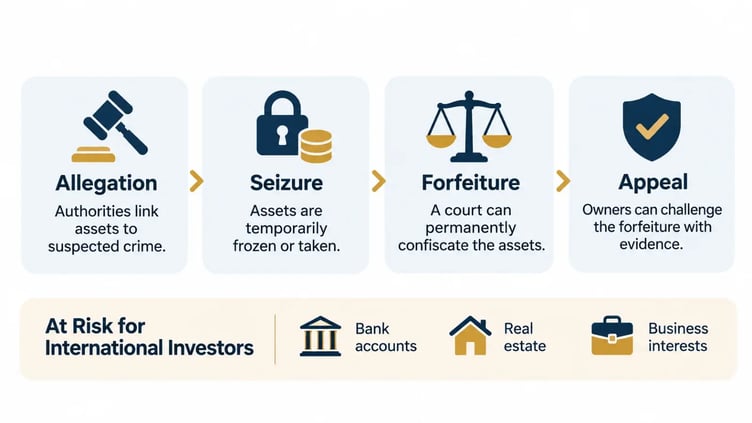
What is civil asset forfeiture?
Civil asset forfeiture is a legal process that allows governments to seize and permanently confiscate property connected to unlawful activity, even when the owner has not been convicted of a crime.
A civil asset generally refers to property, money or another item of economic value that is subject to civil legal rights or proceedings.
In the context of civil asset forfeiture, the term refers to property that a government may seek to confiscate because it is suspected of being obtained through or used to facilitate unlawful activity.
Unlike criminal forfeiture, which is imposed as part of a criminal prosecution against an individual, civil forfeiture proceedings are brought against the property itself.
This is known as in rem, meaning that the action is directed at the asset rather than its owner.
Assets potentially subject to forfeiture include cash, vehicles, real estate, financial investments or other valuable property.
Authorities must establish the legal grounds for forfeiture under the applicable law, and eligible property owners may have the right to challenge the action.
What is the goal of civil asset forfeiture?
The primary goal of civil asset forfeiture is to deprive individuals and organizations of property obtained through or used to facilitate criminal activity.
Governments use forfeiture to disrupt the financial operations of criminal enterprises, deter unlawful conduct and recover assets that may be used to compensate victims.
Civil forfeiture can also allow authorities to pursue assets when the suspected offender is outside the jurisdiction, has died or cannot be identified.
However, forfeiture remains subject to legal requirements and property owners' rights.
The government's objective of recovering illicit assets does not automatically establish that a particular property is forfeitable.
What is an example of a forfeiture?
Consider an international investor who purchases a commercial property in the United States through a foreign company.
The investment is funded through several overseas bank accounts, and some of the funds pass through an intermediary whose business is later investigated for money laundering.
Authorities may investigate whether the property or the money used to acquire it represents proceeds of unlawful activity.
If the government establishes the required connection under the applicable law, it may initiate civil forfeiture proceedings against the property.
The investor may not have been personally charged with a crime.
Nevertheless, the property could be seized or restrained while the legal proceedings continue.
The investor may challenge the action by demonstrating that the funds originated from legitimate investments, that the transaction was properly documented or that the property does not satisfy the applicable forfeiture requirements.
This is an illustrative example, not a prediction of the legal outcome.
A property's connection to an investigated transaction does not establish that forfeiture is justified.
What are the rules for civil asset forfeiture?
Civil asset forfeiture rules determine what property the government can seize, what evidence it must provide, and how owners can challenge the confiscation.
Generally, authorities must establish that the property is connected to criminal activity, follow the required notice and procedural rules, and allow eligible owners to contest the forfeiture.
The exact requirements vary by jurisdiction, the type of asset and the legal basis for the action.
In the United States, the Civil Asset Forfeiture Reform Act of 2000 (CAFRA) introduced important procedural protections for property owners in many federal civil forfeiture proceedings.
Under the general federal framework:
- The government must establish forfeiture: In covered civil forfeiture cases, the government generally must prove by a preponderance of the evidence that the property is subject to forfeiture.
- A connection to criminal activity must be established: Where forfeiture is based on property being used to commit or facilitate an offense, the government must establish a substantial connection between the property and the offense.
- Owners must receive appropriate notice: Interested parties must be notified of the forfeiture process, subject to applicable statutory requirements.
- Owners can challenge the action: A person with a legitimate ownership interest may file a claim and contest the forfeiture.
- Innocent owners may have a defense: An owner who meets the statutory requirements may protect their interest even if another person used the property unlawfully.
The rules are not identical for every asset or type of proceeding.
Administrative forfeiture, for example, can occur without a court case when the property qualifies and no one files a timely claim.
If an owner files a valid claim, the government generally must pursue judicial forfeiture to retain the property.
Do civil asset forfeiture laws differ across countries?
Yes. Civil asset forfeiture laws differ across countries in the types of property covered, the evidence required and the protections available to owners.
|
Country |
Key legal difference |
|
United States |
Maine, Montana and New Mexico have abolished state-level civil forfeiture, but federal forfeiture remains available. |
|
Canada |
Ontario and British Columbia have provincial civil forfeiture regimes, while Prince Edward Island has no equivalent. |
|
Australia |
Certain unexplained wealth laws allow recovery without proving that wealth came from a specific offense. |
|
New Zealand |
Qualifying foreign forfeiture orders can be registered and enforced against assets in New Zealand. |
Note: Forfeiture rules and owner protections vary by jurisdiction. In the US, state restrictions do not eliminate federal forfeiture powers, although transfers of state-seized assets to federal authorities may be restricted. The absence of a provincial civil forfeiture regime in Canada does not prevent federal criminal forfeiture.
What is subject to forfeiture?
Civil asset forfeiture can apply to cash, bank accounts, real estate, investments, business interests, vehicles and other property linked to criminal activity.
The specific assets subject to forfeiture depend on the applicable law and the circumstances of the case.
Potentially forfeitable assets include:
Bank accounts and cash
For international investors, this can include funds held in domestic or foreign financial institutions where the relevant jurisdiction has legal authority over the assets.
Real estate and investment properties
A property purchased using illicit funds or used to facilitate certain offenses may be targeted.
Real estate can present additional challenges because ownership, financing and beneficial interests may involve multiple parties or jurisdictions.
Stocks, securities and business interests
Shares, investment portfolios, corporate interests and other financial assets may be subject to forfeiture where the law permits and the required connection to an offense is established.
Investors using companies, trusts or other ownership structures should maintain clear records of beneficial ownership and the origin of invested funds.
Vehicles and other tangible assets
Vehicles, vessels, luxury goods and other valuable property may be forfeited if they were used in or acquired through unlawful activity.
Can assets be seized before a court decision?
Yes. Authorities may be able to seize or restrain assets before a final court decision if the relevant legal requirements are satisfied.
Seizure is often intended to preserve property while an investigation or forfeiture case proceeds.
Without such measures, assets could be transferred, concealed, spent or moved beyond the reach of authorities.
In the United States, the government may use seizure warrants, restraining orders or other authorized procedures to prevent the disposal of property.
However, the rules differ for various asset classes.
Federal civil forfeiture law generally restricts the pre-judgment seizure of real property, subject to specific exceptions and procedural safeguards.
What is the difference between seizure and forfeiture?
Seizure is the temporary taking or restraint of property by authorities, while forfeiture is the permanent transfer of its ownership to the government under the law.
|
Seizure |
Forfeiture |
|
The temporary taking or restraint of property by authorities. |
The legal process through which ownership of property is permanently transferred to the government. |
|
May occur during an investigation or before a final court decision. |
Usually follows a legal determination or completion of the applicable forfeiture process. |
|
Intended to preserve the asset while proceedings continue. |
Establishes the government's right to retain or dispose of the asset. |
|
Does not necessarily establish that the property is forfeitable. |
Requires the applicable legal grounds and procedural requirements to be satisfied. |
How civil asset forfeiture affects international investors
For international investors, civil asset forfeiture can disrupt cross-border investments when funds or properties become linked to suspected financial crimes, exposing them to frozen accounts, contested ownership and costly legal proceedings.
Cross-border investments can attract scrutiny
International investments often involve multiple financial institutions, intermediaries and jurisdictions.
These arrangements can make it more difficult to establish the origin and movement of funds, particularly when documentation is incomplete.
A transaction involving a foreign company, overseas bank account or investment property may attract scrutiny if authorities suspect that it is connected to money laundering, fraud, sanctions violations or another offense.
Foreign ownership does not automatically protect assets
Holding property through an overseas company or another legal structure does not necessarily prevent forfeiture.
Authorities may be able to pursue assets held by entities or third parties where the relevant laws permit.
Foreign investors may face complex legal proceedings
Investors whose assets are seized in another country may need to engage local legal counsel, respond to unfamiliar procedural requirements and coordinate with advisers in their home jurisdiction.
Differences in legal systems, deadlines and evidentiary requirements can make it difficult to challenge a forfeiture without specialist assistance.
Legitimate investments may still require a defense
A foreign investor may have acquired an asset through a legitimate transaction but later discover that a previous owner, business partner or intermediary is under investigation.
In such cases, the investor's ownership rights, knowledge of the alleged misconduct and the source of funds may become important to the legal proceedings.
The investor's position may also be affected by when the asset was acquired, what they knew or reasonably should have known about its history, and whether they gave value for it. These factors can be relevant to an innocent-owner defense under applicable law.
A legitimate purchase does not necessarily prevent authorities from investigating an asset, although it may provide grounds for challenging forfeiture.
Maintaining detailed records of transactions, ownership and investment funding can help establish the legitimacy of an asset and support a defense where appropriate.
How to protect assets from civil forfeiture
Investors cannot make assets immune from civil forfeiture, but they can take steps to reduce the likelihood of becoming involved in a dispute and strengthen their position if authorities challenge ownership.
- Trace investment capital: Retain records showing the original source of funds, transfers between accounts and payments used to acquire assets.
- Investigate third-party involvement: Check the background of intermediaries, business partners and sellers, particularly when transactions involve unfamiliar entities or unusual payment arrangements.
- Establish ownership clearly: Ensure company records, trust documents and investment agreements accurately identify legal and beneficial ownership.
- Check for existing legal claims: Before acquiring substantial assets, investigate relevant liens, ownership disputes and potential legal restrictions. These checks may not reveal an undisclosed forfeiture risk.
- Act within legal deadlines: If authorities issue a seizure or forfeiture notice, obtain advice in the relevant jurisdiction promptly. Missing a claim deadline can affect the ability to contest confiscation.
These steps can help investors identify questionable transactions before committing funds and preserve evidence needed to defend legitimate assets.
Can a forfeiture be reversed?
A forfeiture may be reversed or the property returned if the owner successfully challenges the legal basis for confiscation or qualifies for an available remedy.
Judicial challenge: An owner may argue that the government has not established the required connection between the property and criminal activity, that the seizure violated applicable legal requirements or that the owner qualifies for an innocent-owner defense.
Remission: An administrative process through which the government may return forfeited property, or its value, in certain circumstances.
Mitigation: A process through which the government may reduce the consequences of forfeiture, potentially allowing the owner to recover property subject to conditions.
These remedies are not automatic.
Eligibility, deadlines and the likelihood of success depend on the relevant law and the circumstances of the case.
For international investors, obtaining legal advice promptly is important because a failure to respond within the required period may limit the available options.
Conclusion
For international investors, civil asset forfeiture exposes a risk that can sit beneath an otherwise sound investment.
The source and movement of capital may become as significant as the asset itself.
A property held through a company, or funds routed through several jurisdictions, can attract scrutiny when authorities investigate the transactions behind it.
Even where an investor has a legitimate claim, establishing that claim may require tracing funds, documenting beneficial ownership and responding across legal systems.
The practical lesson is that an investment’s paper trail is part of its legal standing.
Clear records of where capital originated, how it moved and who ultimately owns the asset can make the difference between a defensible investment and a costly dispute.
FAQs
What assets cannot be seized?
Assets protected by statutory exemptions, qualifying innocent-owner rights or other legal safeguards may be exempt from seizure.
However, no asset is universally protected, as exemptions vary by jurisdiction and type of proceeding.
What is another word for asset forfeiture?
Asset forfeiture is also known as asset confiscation or property forfeiture. The precise legal meaning of these terms varies by jurisdiction.
What happens to forfeited money?
Forfeited money is generally transferred to the government and allocated according to applicable law, which may include law enforcement funding, asset recovery costs or victim compensation.
What happens after forfeiture of a lease?
The landlord may regain possession of the property and the tenant's leasehold interest may end.
In some jurisdictions, the tenant can apply for relief against forfeiture to restore the lease.
Related Articles
- What Does an Asset Protection Adviser Do for Expats?
- Expat Asset Protection: What Cross-Border Claims Can Reach
- How to Protect Your Assets From the Government
- How to Protect Assets From a Lawsuit: Key Strategies
- Are Offshore Accounts Legal? Rules, Red Flags, and Uses Explained
- Are Offshore Accounts Safe? It Depends on Jurisdiction, Regulation, and Use