Expats residing in Saudi Arabia can open an investment account through a CMA-authorized broker and use it to trade securities listed on the Saudi Exchange, commonly known as Tadawul.
The process typically involves verifying your eligibility, preparing your Iqama and other documents, opening a brokerage account, completing investor registration and funding the account before trading.
Key Takeaways
- Non-Saudi investors can access Tadawul through authorized Saudi financial institutions, subject to applicable rules.
- Saudi resident expats generally need a valid Iqama and other required identification and account opening documents.
- Equity trades carry a maximum commission of 0.155% per transaction, before any applicable VAT.
- Foreign ownership limits can still restrict access to certain Tadawul-listed securities.
My contact details are hello@adamfayed.com and WhatsApp +44-7393-450-837 if you have any questions.
The information in this article is for general guidance only. It does not constitute financial, legal, or tax advice, and is not a recommendation or solicitation to invest. Some facts may have changed since the time of writing.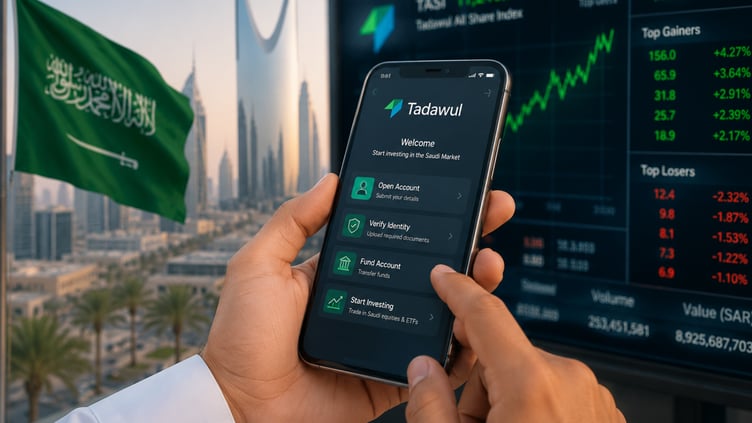
What is Tadawul in Saudi Arabia?
Tadawul is Saudi Arabia’s stock exchange and the main marketplace for trading listed shares and other securities.
The exchange is officially known as the Saudi Exchange and is regulated by the Capital Market Authority (CMA).
For expats, Tadawul provides access to part of Saudi Arabia’s domestic capital market, including shares of major Saudi-listed companies.
Access is generally provided through a Saudi financial institution authorized to offer securities services.
How do I open an account in Tadawul?
An expat generally opens an investment account with a CMA-authorized brokerage or financial institution, which provides access to the Saudi Exchange.
Opening an investment account does not mean registering directly with Tadawul as an individual investor.
The exact application process can vary between financial institutions, but the typical process involves:
Step 1: Make sure you are eligible to invest
If you are a Saudi resident expat, you can access the Saudi capital market through an authorized financial institution, provided you meet the applicable account opening and identification requirements.
Since 1 February 2026, Saudi Arabia has allowed all categories of foreign investors to invest directly in the Main Market without the former QFI qualification requirements.
Before opening the account, make sure you have a valid Saudi Iqama, passport and the personal, financial and banking information requested by your chosen broker.
Bank account may be required or preferred by the particular broker for funding.
You should also check whether the specific shares or securities you want to buy are subject to foreign ownership limits or other non-Saudi investment restrictions.
Step 2: Prepare your identification and personal information
You will normally need to provide identification and residency information when opening the investment account.
For a Saudi resident expat, this will typically include your Iqama, along with other personal and banking information requested by the financial institution.
The broker may also request information about your employment, income, investment experience and source of funds as part of its customer due diligence and suitability procedures.
Step 3: Open an investment account with an authorized broker
Choose a CMA-authorized Saudi brokerage or financial institution that accepts Saudi-resident expats and provides access to Tadawul.
The exact interface and sequence vary by broker, but the account opening process generally involves the following:
- Create an account through the broker’s website or app.
- Select the option to open an investment/brokerage account.
- Enter your personal, residency and financial information, including your Iqama details and Saudi bank account information where required.
- Complete the broker’s KYC and investor suitability requirements.
- Review and accept the brokerage agreement, disclosures and applicable terms.
- Submit the application and wait for the broker to verify your information and activate the account.
Once approved, you can proceed with the remaining investor registration and funding requirements before placing trades.
Step 4: Complete your investor and depository registration
Your broker or custody member will complete the necessary investor and depository account setup so that you can hold and settle securities on the Saudi Exchange.
For Saudi resident non-GCC individuals, Edaa's current requirements include a valid Iqama and passport for identification.
You do not need to separately apply to Tadawul itself as an individual investor; the relevant account arrangements are handled through the authorized financial institution or custody member.
Step 5: Fund your account
Once your investment account has been activated, transfer Saudi riyals from the bank account accepted by your broker.
Typically, you will:
- Confirm the bank account or investment cash account linked to your brokerage account.
- Add funds using the broker’s supported bank-transfer method.
- Check whether the broker imposes a minimum initial deposit.
- Wait for the transferred funds to appear as available cash in the trading account.
- Confirm that sufficient funds are available to cover the investment and applicable trading charges.
The minimum deposit, supported transfer methods and processing time depend on the broker, so check its current funding instructions before making the transfer.
Step 6: Start trading on Tadawul
Once your account is funded, you can place your first trade through your broker’s online trading platform or app.
To buy a Tadawul-listed security:
- Search for the company or security you want to buy using its name or trading symbol.
- Select Buy and enter the number of shares or units you want to purchase.
- Choose the appropriate order type, such as a market or limit order, if available.
- Review the price, quantity and applicable charges, then submit the order.
- Once matched, the trade will appear in your investment account and the securities will be recorded in your name through the Saudi market infrastructure.
You can then use the same platform to monitor your holdings, place additional trades and sell your investments.
What is required to open a Tadawul account?
To open a Tadawul investment account as a Saudi resident expat, you generally need a valid Iqama, Saudi bank account, personal and financial information, and the required brokerage and investor documentation.
- A valid Iqama or Saudi residency identification
- Passport or other identification where requested
- Saudi bank account details
- Contact and residential information
- Employment and financial information
- Tax residency information
- Source-of-funds information
- Investment experience and risk profile information
- Completed brokerage and investor documentation
The exact documents and information required can vary by broker, so check the institution's current requirements before submitting your application.
How much does it cost to open a Tadawul account?
Many Saudi brokers do not charge a separate fee to open a standard investment account, although account and service charges vary by institution.
Buying or selling listed shares carries a maximum commission of 15.5 basis points, equivalent to 0.155% of the transaction value. A broker may charge less by discounting its allocated portion of the commission.
Additional costs may include:
- VAT or other applicable taxes
- Currency conversion costs, if you are transferring or converting funds from another currency
- Other broker-specific service fees, where applicable
- Product-specific trading and custody charges
The actual amount you pay can vary by broker and transaction, so check the broker’s current fee schedule before opening and funding your account.
What can expats invest in through Tadawul?
Tadawul gives foreign investors access to Saudi equities, ETFs, REITs, sukuk and other securities traded on the Saudi Exchange, subject to the rules and restrictions applicable to each security.
These can include:
- Saudi-listed shares
- Exchange-traded funds (ETFs)
- Real estate investment traded funds (REITs)
- Debt instruments and sukuk available through the market
- Other securities permitted under the applicable Saudi market rules
Not every security is necessarily available to every non-Saudi investor. Certain investments can be subject to foreign ownership limits, sector restrictions or other regulatory conditions.
Tadawul vs Nomu
Tadawul’s Main Market is open to all categories of foreign investors under the 2026 rules, while Nomu – Parallel Market remains restricted to Qualified Investors.
The two markets also differ in their listing requirements, company profiles and investor access rules, so Nomu should not be viewed simply as a smaller version of the Main Market.
For an expat, this distinction is important because being eligible to invest directly in Tadawul does not automatically qualify you to trade on Nomu.
To access Nomu, you must meet the applicable Qualified Investor criteria, which can involve specific financial or investment experience requirements.
In practical terms, Tadawul is the more accessible market for most expat investors, while Nomu is intended for investors who meet the additional qualification requirements and are comfortable with a market focused on smaller and emerging companies.
Conclusion
Tadawul can be particularly relevant for expats who earn in Saudi Arabia because it provides direct access to the market in which they live and work.
However, the strongest case for investing is not simply access.
It is whether Saudi equities offer the right diversification, risk exposure and long-term role alongside assets already held in the expat’s home country and elsewhere.
For most investors, the more important consideration is how much Saudi exposure suits their wider financial plan, rather than simply whether they can open a Tadawul account.
FAQs
What is the meaning of Tadawul?
Tadawul is an Arabic word meaning “exchange” or “trading.” The name reflects the exchange’s role as a marketplace where securities are bought and sold.
Can non-Saudis invest in Tadawul?
Yes. Since 1 February 2026, all categories of foreign investors can invest directly in Saudi Arabia's Main Market without the former QFI qualification requirements, subject to applicable ownership and other regulatory restrictions.
What are the risks of investing in Tadawul?
The main risks include market volatility, concentration in Saudi assets, currency fluctuations, limited liquidity, company-specific losses and regulatory or foreign ownership restrictions.
Expats should also consider how changes in the Saudi riyal can affect their investment returns when converted into their home currency.
What are the best investment options for expats in Saudi Arabia?
Investment options for expats in Saudi Arabia include Tadawul-listed shares, ETFs, REITs, sukuk, mutual funds and internationally diversified investments.
The right mix should reflect the investor’s goals, risk tolerance, tax position and plans to remain in or leave Saudi Arabia.
Related Articles