Malaysia introduced a new expatriate employment policy on 1 June 2026. It raises the minimum monthly salary for Employment Passes (EPs). The new minimums are RM20,000 for Category I, RM10,000 for Category II and RM5,000 for Category III.
The rules also limit how long expatriates can work in Malaysia. Employers must prepare succession plans too. These plans help pass specialist knowledge to local employees. For Category II and III passes, they become mandatory on 1 January 2027.
The changes apply to new applications and renewals submitted from 1 June 2026. Existing pass holders don't need to reapply now. They must meet the new requirements when they renew.
Key Takeaways
- Minimum EP salaries rise to RM20,000, RM10,000 and RM5,000 by category.
- Only basic salary counts; allowances and bonuses cannot meet the threshold.
- Existing pass holders must meet new salary rules at renewal time.
- Succession plans become mandatory for Category II and III from January 2027.
Email hello@adamfayed.com if you have any questions.
The information in this article is for general guidance only. It does not constitute financial, legal or tax advice, and is not a recommendation or solicitation to invest. Some facts may have changed since the time of writing.
What is the Employment Pass for expatriates in Malaysia?
An Employment Pass is a work authorisation issued by the Malaysian Immigration Department that allows qualified foreign professionals to work for an approved employer in Malaysia.
Unlike a general visitor or social visit visa, an Employment Pass is linked to a specific employment arrangement. The application must be submitted by a registered Malaysian company on behalf of the expatriate.
The government recognises three main Employment Pass categories, depending on the applicant's monthly basic salary and the nature of their employment.
The three categories have different minimum salary requirements and maximum employment periods.
What is the minimum salary for Employment Pass in Malaysia?
The minimum salary requirements for Malaysia's Employment Pass categories increased on 1 June 2026. The revised thresholds are:
- Category I: RM20,000 and above per month, up to 10 years.
- Category II: RM10,000–RM19,999 per month, up to 10 years.
- Category III: RM5,000–RM9,999 per month, up to 5 years.
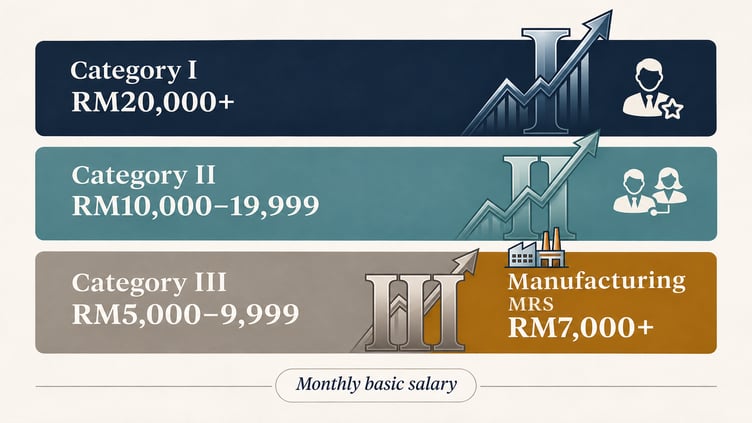
Category II and III require succession plans from 1 January 2027 onwards.
There is also an important exception for certain manufacturing and Manufacturing-Related Services (MRS) companies. Category III applicants in these sectors must receive a minimum monthly basic salary of RM7,000 rather than RM5,000.
The salary requirement is calculated using basic salary only. Allowances, bonuses, incentives and other payments are not included.
For example, an expatriate receiving a basic salary of RM9,000 and allowances worth RM2,000 would still be assessed against the RM9,000 basic salary.
The manufacturing exception also has specific eligibility conditions. Companies must meet the relevant licensing or MIDA approval requirements to qualify for the lower Category III salary range.
Why is Malaysia raising Employment Pass salary requirements?
Malaysia is increasing Employment Pass salary thresholds to encourage companies to prioritise local employees while ensuring that foreign professionals are recruited for positions requiring specialist expertise.
The previous salary requirements had been in place since 2016. The government believes that updating them will make the expatriate employment framework more aligned with the country's current economic priorities.
There are three main reasons behind the changes.
1. Reducing reliance on foreign labour
The government wants companies to make greater use of Malaysian talent, particularly for positions where suitable local professionals are available.
2. Encouraging knowledge transfer
Foreign professionals can contribute specialist knowledge and technical experience that may not be readily available within the local workforce.
The succession plan requirement aims to ensure that this expertise is transferred to Malaysian employees during the expatriate's employment period.
3. Attracting higher-value foreign investment
Malaysia wants to remain competitive as a destination for international businesses while encouraging investments that create skilled employment and improve local capabilities.
The government believes that attracting experienced executives, technical specialists and highly qualified professionals will support long-term economic growth.
These objectives form part of the Thirteenth Malaysia Plan, which emphasises productivity, workforce development and sustainable economic competitiveness.
For foreign professionals weighing a relocation, international financial planning can include coordinating investments, taxes, currency exposure and estate arrangements across countries.
How long can an expat work in Malaysia?
Under Malaysia's revised Employment Pass policy, expatriates can work for up to 10 years under Category I or II and up to five years under Category III.
Category I is intended for senior executives, specialist professionals and individuals who provide strategic expertise to Malaysian businesses. The employment period can extend to 10 years.
Category II also permits employment for up to 10 years, but employers must implement a succession plan to prepare Malaysian employees to take over expatriate positions.
Category III has a shorter maximum employment period of five years. It is intended for skilled professionals whose expertise is required by Malaysian businesses but who may eventually be replaced by suitably trained local employees.
These limits should not be confused with the validity of an individual Employment Pass document.
The Immigration Department's standard EP guidance provides for pass validity of up to 60 months, depending on the employment contract and approval from the relevant authorities.
An expatriate may need more than one approved pass period to reach the maximum employment duration allowed under the new framework.
The employment period is also calculated in relation to the employing company. Changes of employer or Employment Pass category can affect how the permitted period is calculated.
How long is the Employment Pass in Malaysia valid for?
A Malaysian Employment Pass is generally valid for up to 60 months, based on the employment contract and approval.
Separately, the revised policy permits total employment periods of up to 10 years for Category I, up to 10 years for Category II, and up to five years for Category III.
The succession plan requirement for Categories II and III begins on 1 January 2027. An expatriate approved to work beyond the validity of their current pass will need an approved renewal to continue.
For example, a Category I expatriate approved for an initial three-year period may need to renew their pass to continue working in Malaysia.
The employer must submit the renewal application before the pass expires. Renewal is not automatic, even if the expatriate continues working for the same company.
An Employment Pass is tied to its sponsoring employer. Accepting a job with another company does not automatically transfer the work authorisation.
What changes under Malaysia’s new Employment Pass policy?
From 1 June 2026, Malaysia raised the minimum salary thresholds and revised Employment Pass durations.
Category III holders can also bring dependants under the new policy.
The succession plan requirement for Categories II and III begins on 1 January 2027.
What is a succession plan for Malaysia Employment Pass?
A succession plan is an employer's formal strategy for preparing Malaysian employees to eventually take over positions currently held by expatriates.
The idea is to ensure that foreign professionals transfer their specialist knowledge, technical skills and experience to the local workforce during their employment period.
Under Malaysia's new policy, a succession plan can include:
- Identifying the expatriate positions that Malaysian employees will eventually take over.
- Selecting local employees who can develop the required skills.
- Providing training, mentoring and structured knowledge transfer.
- Establishing a reasonable timeline for preparing local employees.
- Ensuring that the transition does not disrupt business operations.
The Ministry of Home Affairs has explained that this requirement supports Malaysia's Thirteenth Malaysia Plan (RMK-13), which prioritises local workforce development and reduced dependence on foreign labour.
Do expats need a succession plan in Malaysia now?
The succession plan requirement is part of the new Employment Pass framework, but it is being introduced in phases.
The Malaysian Immigration Department's Expatriate Services Division announced on 26 May 2026 that the requirement would become effective from 1 January 2027.
This means that, as of November 2026, employers do not yet have to comply with the mandatory succession plan requirement.
From January 2027, the requirement will apply to Category II and Category III Employment Pass positions. Category I positions are not subject to this particular requirement under the revised policy.
The requirement is primarily an employer responsibility. Foreign employees may contribute their technical knowledge and training expertise, but the Malaysian company must develop and maintain the succession plan.
Will Malaysia's New EP Policy affect current visa holders?
Yes, but the effect varies based on when the existing Employment Pass was issued and when the next application is submitted.
People who already hold valid Employment Passes do not need to submit new applications simply because the revised policy took effect on 1 June 2026.
Their existing passes remain valid until their expiry dates, subject to the original conditions.
However, renewal applications submitted on or after 1 June 2026 must comply with the revised salary requirements.
For example, consider an expatriate who received a Category III Employment Pass in April 2026 with a monthly basic salary of RM4,000.
The existing pass remains valid until its expiry.
However, if the employer submits a renewal application after 1 June 2026, the expatriate must meet the new minimum Category III salary of RM5,000, or RM7,000 where the manufacturing and MRS exception applies.
The new rules also affect Category III holders who wish to bring family members.
Under the previous policy, Category III Employment Pass holders were not permitted to bring dependants. Category III passes issued under the revised policy allow dependants, but existing Category III holders whose passes were issued before 1 June 2026 remain subject to the previous restrictions.
Employers and expatriates should check the applicable rules before making renewal or family relocation arrangements.
An Employment Pass is an immigration authorisation, not a determination of tax residence.
Expatriates with income or assets in more than one country may also need to consider cross-border tax planning.
Can Employment Pass holders bring dependents to Malaysia?
Yes. Under the revised policy, expatriates holding Category I, II and III Employment Passes can bring eligible dependants to Malaysia.
This is an important change for Category III applicants because the previous rules did not permit them to bring dependants.
Eligible family members can apply for the appropriate immigration permission through a Dependant Pass (DP) or Long-Term Social Visit Pass (LT-SVP).
A Dependant Pass is generally available to:
- The Employment Pass holder's legal spouse.
- Biological, stepchildren and legally adopted children below 18 years of age.
- Disabled children, regardless of age.
A Long-Term Social Visit Pass may be available to:
- Unmarried children aged between 18 and 25 who are not studying or working in Malaysia.
- Parents and parents-in-law.
- Certain children of a common-law spouse.
- A common-law spouse, subject to consideration and approval.
Dependants are not automatically permitted to work in Malaysia. A spouse or family member who wants to take up employment must obtain their own appropriate work authorisation.
The application for dependant permission must also satisfy the relevant documentation and immigration requirements.
For expatriates moving with a spouse or children, the visa rules are only one part of the decision.
Moving abroad with a family also raises questions about schooling, healthcare, spouse employment and financial stability.
How does Malaysia’s revised Employment Pass policy affect employers and recruiters?
Malaysia's revised expatriate employment policy requires employers to reconsider how they recruit and retain foreign professionals.
The higher salary thresholds may increase employment costs, particularly for companies that previously hired expatriates under Category II and III with lower salaries.
For instance, a company that previously employed a foreign professional earning RM6,000 per month under Category II must now ensure that the position meets the revised RM10,000 minimum when submitting a new application or renewal.
Employers must also distinguish between basic salary and total compensation when evaluating candidates.
Offering a higher overall package through accommodation allowances, bonuses or other benefits will not necessarily satisfy the revised salary requirement.
Recruiters must also assess whether a candidate's experience and responsibilities justify the relevant Employment Pass category.
The policy does not eliminate opportunities for foreign professionals. However, it places greater emphasis on the specialist value they bring to Malaysian businesses.
FAQs
Is it hard for foreigners to work in Malaysia?
Foreigners need a qualifying job offer from an employer eligible to sponsor an Employment Pass.
The new salary thresholds make it harder to qualify for roles without specialist skills or senior experience.
Which job is in high demand in Malaysia?
Advertising and Marketing Professionals recorded the highest number of online job offerings in Q3 2026, with 44,989 job offerings, but demand does not guarantee Employment Pass eligibility.
What happens when my employment pass expires?
Your employer must secure an approved renewal before expiry if you want to keep working. If the contract isn't renewed, the employer must notify Immigration and cancel the pass.
How much is the renewal fee for EP in Malaysia?
The MYXpats application charge is RM2,000 plus 8% service tax (RM2,160). MIDA's 2026 guidelines list further fees: RM125 processing, RM200-RM300 pass issuance and a RM6-RM50 visa fee. Confirm exact costs with your employer.
Related Articles