Malta’s Individual Tax Programme offers eligible expats a 15% tax rate on qualifying foreign income received in Malta, subject to eligibility conditions and minimum annual tax liabilities.
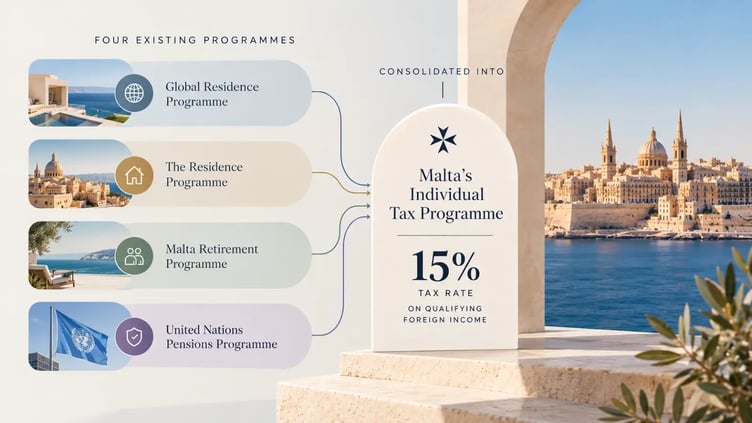
From January 1, 2027, Malta will consolidate four existing tax regimes into a single framework, retaining the 15% preferential rate while increasing minimum taxes, property thresholds and application costs.
Key Takeaways
- Eligible participants pay 15% tax on qualifying foreign-source income received in Malta.
- New applicants must pay a non-refundable €8,500 application fee, followed by a €2,500 renewal fee for each subsequent five-year period.
- Minimum annual tax liabilities range from €15,000 to €35,000 under the 2027 framework.
- Participation does not automatically eliminate tax obligations in other countries.
I can connect you with expert tax support for your specific situation. My contact details are hello@adamfayed.com and WhatsApp +44-7393-450-837 if you have any questions.
The information in this article is not tax advice and may have changed since the time of writing.
What is Malta’s New Individual Tax Programme?
Malta’s Individual Tax Programme Rules, 2026, will introduce a unified framework for special tax status from January 1, 2027, replacing the separate Global Residence Programme (GRP), The Residence Programme (TRP), Malta Retirement Programme (MRP) and United Nations Pensions Programme (UNPP).
The reform retains the 15% tax rate on qualifying foreign income remitted to Malta but changes minimum annual tax liabilities, qualifying property thresholds, application fees and the duration of special tax status.
Malta’s Individual Tax Programme: Old rules vs new rules
| Requirement | Existing programmes (through 31 December 2026) | New Individual Tax Programme (from 1 January 2027) |
|---|---|---|
| Programme structure | Four separate regimes: GRP, TRP, MRP and UNPP, each governed by its own rules. | One framework with four statuses: Global Resident, EU, EEA and Swiss Resident, Retired Pensioner, and UN Pensioner. |
| Tax rate on qualifying foreign income remitted to Malta |
Generally 15% under the GRP, TRP and MRP. Under the UNPP, other qualifying foreign income is generally taxed at 15%, while qualifying UN pension income is exempt subject to the applicable conditions. |
15% on qualifying non-Maltese income received in Malta. Qualifying UN pension income remains exempt under the applicable conditions. |
| Minimum annual tax liability | GRP: €15,000. TRP: €15,000. MRP: €7,500, plus €500 per dependant and per special carer. UNPP: €10,000, increasing to €15,000 if both spouses receive a UN pension. |
Global Resident: €35,000. EU, EEA and Swiss Resident: €35,000. Retired Pensioner: €15,000. UN Pensioner: €20,000. |
| Minimum purchase price for qualifying property | GRP, TRP, MRP and UNPP: generally €275,000 in Malta, or €220,000 for qualifying property in Gozo or southern Malta. | €700,000 for qualifying property in Malta or Gozo, subject to applicable transitional provisions for certain properties acquired before the new rules take effect. |
| Minimum annual rent for qualifying property | GRP, TRP, MRP and UNPP: generally €9,600 per year in Malta, or €8,750 for qualifying property in Gozo or southern Malta. | €14,000 per year for qualifying property in Malta or Gozo. |
| Initial application fee | GRP: €6,000, reduced to €5,500 for qualifying property in southern Malta. TRP: €6,000, with the same qualifying reduction. MRP: €2,500. UNPP: €4,000, reduced to €3,500 for qualifying property in southern Malta or Gozo. |
€8,500, non-refundable, for an application under the new framework. |
| Duration of status | Generally continues while the beneficiary satisfies the relevant programme conditions; no standard five-year status term. | Five years initially, renewable for further five-year periods subject to the applicable conditions and a €2,500 renewal fee. |
The minimum annual tax is a minimum liability under the relevant regime, not necessarily the final tax bill in every situation.
The UNPP and new UN Pensioner Status also require particular care. The minimum applies to the relevant taxable income, while qualifying UN pension income retains its separate exemption under the applicable conditions.
Who qualifies for Malta’s Individual Tax Programme?
Eligible non-Maltese applicants include non-EU nationals, EU/EEA/Swiss nationals, qualifying retirees and UN pension recipients, subject to category-specific conditions.
Eligible applicants qualify under four special tax-status categories: Global Resident Status; EU, EEA and Swiss Resident Status; Retired Pensioner Status; and UN Pensioner Status.
Eligibility is based on nationality, pension status, financial resources, and compliance with the programme’s residence and property requirements.
Retired Pensioner Status generally requires qualifying pension income received in Malta to account for at least 75% of the beneficiary’s chargeable income.
UN Pensioner Status has a separate threshold requiring at least 40% of the qualifying pension or benefit to be received in Malta.
Applicants must also meet the applicable general requirements, including:
- Maintaining qualifying property in Malta or Gozo as their primary residence.
- Having sufficient, stable financial resources to support themselves and their dependents without relying on Maltese social assistance.
- Holding the required sickness insurance.
- Providing valid identification and meeting applicable language requirements.
- Passing the relevant fit-and-proper assessment.
- Meeting the programme’s domicile conditions.
For new applicants under the 2027 framework, qualifying property generally requires a purchase price of at least €700,000 or annual rent of at least €14,000.
The property must satisfy the programme’s primary residence conditions and cannot be let or sublet while the status is maintained.
These requirements mean the programme is primarily suited to financially established individuals who can meet its property and ongoing compliance obligations.
How is income taxed under Malta’s Individual Tax Programme?
Qualifying foreign income received in Malta is taxed at 15%, subject to annual minimums; non-qualifying income is generally taxed at 35%.
Transfers of previously accumulated capital are generally distinguished from taxable income.
Malta-source income that falls outside the preferential regime is generally taxed at 35%.
This can include salary earned by expats working in Malta, even when their employer is based overseas, because employment income is generally sourced where the work is performed.
Double taxation relief may be available under an applicable treaty, but expats should assess their tax obligations in other countries separately.
How do expats apply for Malta’s Individual Tax Programme?
Expats applying under the new Individual Tax Programme must satisfy the relevant eligibility conditions and submit their application to Malta’s Commissioner for Tax and Customs through an Authorized Registered Mandatary.
The process generally involves the following steps:
- Identify the appropriate status category. Establish whether Global Resident Status, EU, EEA and Swiss Resident Status, Retired Pensioner Status or UN Pensioner Status is applicable.
- Arrange qualifying accommodation. Confirm that the property meets the relevant purchase or rental threshold and can be used as the applicant’s primary residence.
- Prepare supporting documents. These may include proof of identity, property documents, financial-resource evidence, health insurance and pension documentation where relevant.
- Appoint an authorized representative. Applications must be submitted through an Authorized Registered Mandatary under the new framework.
- Meet the tax and compliance requirements. Applicants must satisfy the applicable minimum tax liability and maintain the conditions required to retain their status.
Under the 2027 rules, the non-refundable application fee is €8,500, while renewal for a further five-year period carries a non-refundable fee of €2,500.
Status is granted for an initial five-year term and may be renewed for further five-year periods, subject to the applicable requirements.
The timing of the application is particularly important in late 2026.
Anyone considering the transition should verify the applicable rules and deadlines with an authorized representative before acting.
How does Malta ITP affect expats with jobs, investments and pensions?
Malta’s Individual Tax Programme requires expats to review their employment arrangements, investment transfers and pension eligibility before relocating to ensure their income receives the correct tax treatment.
Expats with Employment Income
Expats working remotely for overseas employers should review their employment contracts, work location and payroll arrangements before moving to Malta.
Working from Malta can create local tax and social security obligations even when the employer has no Maltese office.
Expats with Investment Income
Investors should review their portfolio structure and maintain records distinguishing investment income from previously accumulated capital.
Clear documentation helps establish the correct tax treatment of funds transferred to Malta.
Expats Receiving Pensions
Retirees should confirm that their pension type and payment arrangements meet the programme’s requirements before relocating.
They should also check how Malta’s tax treatment interacts with pension taxation and reporting obligations in their former country of residence.
Conclusion
Malta’s Individual Tax Programme changes the financial considerations for expats seeking special tax residence, particularly through higher minimum tax obligations and revised property requirements.
Applicants need to consider whether the potential tax advantages justify the costs of maintaining residence in Malta and how the rules affect their wider financial arrangements.
For those planning to relocate, reviewing the applicable requirements before committing to property, restructuring investments or changing tax residence can help avoid unnecessary costs and preserve flexibility.
FAQs
What are the requirements for being considered a tax resident of Malta?
An individual may qualify as a Maltese tax resident by spending more than 183 days in Malta during a calendar year or by establishing residence there under Malta’s tax rules.
Tax residence is separate from eligibility for Malta’s Individual Tax Programme.
Is Malta tax-free for foreigners?
No, foreigners may be liable to Maltese tax, although eligible participants in the Individual Tax Programme can benefit from a 15% rate on qualifying foreign income received in Malta.
Other income may be taxed at different rates, and foreign tax obligations may still apply.
Can you be a resident for tax purposes in two countries?
Yes, two countries can consider the same individual a tax resident under their respective domestic laws.
An applicable double taxation treaty may determine residence for treaty purposes and help resolve overlapping tax claims.
Related Articles
- Expat Retirement Tax Planning: What to Check Before First Withdrawal
- Cross-Border Tax Planning: What to Review Before & After Moving
- Special Tax Regimes in Europe: A Guide for Expats & HNWIs
- Tax on Investment Income Abroad: Is Overseas Investment Taxable?
- Malta Permanent Residency Program: Key Details and Changes Explained
- Malta Retirement Visa: Requirements, Costs, and Residency Options
- Preferential Tax Regimes Explained: Rates, Countries, and How it Works