Paraguay generally imposes a 0% tax rate on income that is genuinely foreign-source under its territorial tax system.
Under national tax law (Law 6380/2019), Paraguay primarily taxes income from Paraguayan-source activities, assets and rights, but the law also contains specific source rules that can apply to certain cross-border income.
Key Takeaways
- Genuinely foreign-source income is generally outside Paraguayan income tax, subject to statutory source rules.
- Paraguayan-source personal services are taxed at 8%, 9% or 10%, while capital income is generally taxed at 8%.
- Working from Paraguay for foreign clients can still trigger IRP, because the source of personal services is relevant to the tax treatment.
- Tax residence is separate from immigration residence, with the DNIT Tax Residence Certificate providing formal proof of Paraguayan tax residence.
My contact details are hello@adamfayed.com and WhatsApp +44-7393-450-837 if you have any questions.
The information in this article is for general guidance only. It does not constitute financial, legal, or tax advice, and is not a recommendation or solicitation to invest. Some facts may have changed since the time of writing.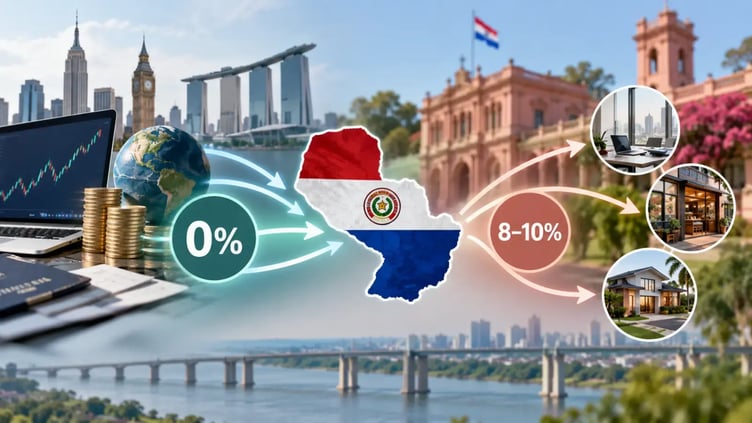
Does Paraguay tax foreign income?
There is zero foreign income tax in Paraguay for genuinely foreign-source earnings, but income connected to activities performed in Paraguay, assets located in Paraguay, or rights economically used in Paraguay can be taxable.
Law 6380/2019 contains specific source rules covering financial income, services, international transactions, and certain activities performed outside Paraguay.
The 0% tax on foreign income in Paraguay therefore depends on how the income is sourced, not simply whether the payer, employer, client, or bank account is located overseas.
Do the same foreign-income rules apply to individuals and businesses?
Paraguay’s personal income tax, known as IRP, and business income tax, known as IRE, use different rules to determine where income is sourced.
Foreign investments held personally can receive different tax treatment from investments held through a Paraguayan company.
Under Article 6 of Law 6380/2019, certain overseas interest, investment returns and foreign-company dividends received by entities incorporated or resident in Paraguay are treated as Paraguayan-source business income.
The law also covers certain other business activities abroad unless the taxpayer has paid foreign income tax at a rate at least equal to Paraguay’s business income tax rate.
Investors should assess both the income source and who legally owns the asset. Moving personally held foreign investments into a Paraguayan company can change their tax treatment.
The key issue for an expatriate is the statutory source of each income stream, rather than simply where the payer or payment is located.
| Income category | How the source is assessed |
|---|---|
| Foreign income held personally | Assess the underlying activity, asset or right under personal income tax source rules. An overseas payer or account alone does not establish foreign source. |
| Employment and freelance income | Work performed from Paraguay can generate Paraguayan-source income, even when the employer or client is overseas. |
| Property and capital income | Consider where the asset is located and where the relevant rights are economically used. Rent from Paraguayan property has a local source connection. |
| Business income | Apply business income tax source rules, which can also cover certain overseas investments and activities. |
How to become a Paraguay tax resident?
Paraguayan tax residence is established separately from immigration residence, with the DNIT providing a Tax Residence Certificate as formal proof.
Paraguayan immigration residence and tax residence are separate concepts; obtaining legal residence does not by itself determine your tax position or end tax residence in another country.
1. Obtain Paraguayan immigration residence
Foreign nationals first need an appropriate residence status through Paraguay's immigration authority. The requirements vary according to the residence category and the applicant's circumstances.
Under the current Migration Law, temporary residence is generally the route that precedes permanent residence, although certain categories can qualify for permanent residence directly.
Paraguay Investor Pass was also introduced in 2026, allowing qualifying investors to obtain permanent residence directly through specified investment routes.
Immigration requirements can include a valid passport or identity document, birth and criminal record certificates, proof of financial means and other documents depending on the residence category.
Foreign-issued documents generally need to be apostilled or otherwise legalized and translated into Spanish where required.
2. Obtain a Paraguayan national ID
After obtaining the relevant residence status, eligible foreign residents can apply for a Paraguayan national identity card, known as a Cédula de Identidad, through the National Police's identification department.
The Cédula serves as the individual's official identity document in Paraguay and is also used for tax administration and applications for a Tax Residence Certificate.
3. Register for a Tax ID
The Registro Único del Contribuyente (RUC) is Paraguay's taxpayer identification system, administered by the DNIT.
Individuals who are required to pay or report Paraguayan taxes generally need a RUC for tax administration and compliance.
However, having a RUC does not by itself establish tax residence; it is a taxpayer identification number.
4. Maintain records supporting your tax position
Tax residents should keep records of their residence status, immigration history, tax filings and other documents relevant to their Paraguayan tax position.
Physical presence can also be relevant when establishing tax residence and when another country assesses whether an individual remains tax resident there.
A Paraguayan address, utility bills or local bank account may help document ties to the country, but they should not be presented as mandatory requirements for tax residence unless a specific rule applies.
5. Apply for a Tax Residence Certificate
Once the relevant requirements are met, an individual can apply to the DNIT for a Tax Residence Certificate, officially known in Paraguay as the Certificado de Residencia Fiscal para Fines Tributarios.
For taxpayers, the DNIT's current procedure requires a RUC, compliance with tax obligations and a valid Paraguayan Cédula.
Individuals must also provide the relevant immigration travel record.
A person who is not a taxpayer or has ceased to be one can apply using a valid Cédula together with the applicable supporting documents.
The certificate formally documents an individual's Paraguayan tax residence for the specified fiscal period.
It can be useful when dealing with foreign tax authorities, banks and financial institutions or when seeking to establish tax residence for purposes of an applicable tax treaty.
How much tax do you pay in Paraguay?
Genuinely foreign-source income is generally taxed at 0% in Paraguay, while Paraguayan-source personal income is taxed at 8%, 9% or 10% under IRP, capital income at 8%, and business profits at 10% under IRE.
|
Tax category |
Applicable rate |
How to read the rate |
|
Foreign-source income |
Generally outside income tax (effectively 0%) |
Applies where the relevant tax’s source rules classify the income as foreign-source. |
|
Personal services income tax — IRP |
8%, 9% and 10% |
Progressive rates on taxable net income; the applicable entry threshold must also be considered. |
|
Personal capital income tax — IRP |
8% |
Applies to the taxable amount calculated for the relevant income or gain, subject to exemptions. |
|
Business income tax — IRE |
10% |
Applies to net taxable business income under the general regime. |
|
Value added tax — IVA |
Generally 10%; 5% for specified transactions |
Applies to taxable transactions, separately from income tax. |
Paraguay vs Panama territorial tax
Paraguay generally taxes foreign-source income at 0%, personal income at up to 10%, and corporate profits at 10%, while Panama taxes corporate profits at 25% and domestic individual income at progressive rates.
Paraguay and Panama are often compared by expatriates and internationally mobile investors because both use territorial tax systems that can limit taxation of genuinely foreign-source income.
|
Comparison Metric |
Paraguay |
Panama |
|
Tax System |
Territorial |
Territorial |
|
Foreign-Source Income |
Generally outside Paraguayan income tax when classified as foreign-source under Paraguay's statutory rules |
Generally outside Panamanian income tax when classified as foreign-source |
|
Individual Domestic Income |
IRP: 8%, 9% and 10% for personal services; 8% for capital income |
Progressive rates on Panamanian-source individual income |
|
Corporate Income Tax |
10% IRE on net taxable income |
Generally 25% on taxable income |
|
Permanent Residence Routes |
Standard temporary-to-permanent route; qualifying investors can use the 2026 Investor Pass for direct permanent residence |
Multiple routes, including Friendly Nations and Qualified Investor programs |
|
Investor Pass / Investment Route |
From USD 150,000 for qualifying tourism projects or USD 200,000 for qualifying real-estate or securities investments |
Investment threshold varies by residence program |
|
Tax Residence Evidence |
DNIT Tax Residence Certificate |
Panamanian tax-residence documentation |
|
General Cost of Living |
Generally lower |
Generally higher, particularly in Panama City |
Conclusion
Paraguay's zero tax on foreign income can offer significant tax efficiency for expatriates with genuine foreign-source income, but achieving a 0% outcome requires looking beyond where the money comes from.
Before relocating, map each income stream, including employment, consulting, investments, rentals, and business profits, and determine its source under Paraguayan law.
This is especially important for remote workers and business owners earning from abroad while operating from Paraguay.
The best approach is to establish the intended tax treatment before moving, document the source of each income stream, and keep records that support it.
That makes Paraguay’s territorial system a practical tax planning opportunity rather than simply a headline 0% rate.
FAQs
Do I have to pay local taxes if I work remotely from Paraguay?
Yes. If you perform remote services from Paraguay, the income is generally subject to IRP at 8%, 9% or 10%, even if your clients and payments are abroad.
Services physically performed outside Paraguay can fall outside Paraguayan IRP under the applicable source rules.
Is Paraguay a CRS country?
Paraguay has committed to implementing the OECD Common Reporting Standard, but has not yet begun exchanging financial account information under (CRS).
Its first exchanges are scheduled by 2028, according to the OECD’s updated commitment list.
Who is the highest taxed country in the world?
By the highest statutory personal income tax rate, Denmark has one of the highest rates in 2026, reaching 60.5% when its labor market tax is included.
Other high-tax jurisdictions include Austria and France at 55%, although rankings vary depending on whether social contributions and local taxes are included.
What is the least taxed country in the world?
The United Arab Emirates is among the least-taxed countries for individuals, with no personal income tax.
Other jurisdictions, including The Bahamas and Bahrain, also have no personal income tax.
Related Articles
- Zero Foreign Income Tax Countries and Territorial Systems
- Does Uruguay Still Offer Zero Tax on Foreign Income?
- Bolivia Zero Tax on Foreign Income: Opportunities and Realities for Residents
- Turkey Introduces 20-Year Foreign Income Tax Break for New Residents
- Cross-Border Tax Planning: What to Review Before & After Moving
- Paraguay Crypto Tax Reporting Guide for Investors
- Offshore Account Tax: Minimization Strategies and Tax Havens