Uruguay does not have a blanket zero-tax policy on foreign income. Since January 1, 2026, certain foreign-source capital income and capital gains earned by Uruguayan tax residents are subject to Impuesto a la Renta de las Personas Físicas (IRPF).
However, qualifying new tax residents can still access preferential treatment, including an 11-year tax holiday (the arrival year plus 10 years) or a reduced 6% post-holiday rate for qualifying foreign investment income.
Key Takeaways
- Eligible residents may elect a 6% rate for five years after the 11-year holiday.
- Tax-holiday access requires meeting physical presence or qualifying investment conditions.
- The holiday covers foreign passive income and gains, not work performed in Uruguay.
- Foreign LLCs do not automatically protect passive income from Uruguayan tax.
My contact details are hello@adamfayed.com and WhatsApp +44-7393-450-837 if you have any questions.
The information in this article is for general guidance only. It does not constitute financial, legal, or tax advice, and is not a recommendation or solicitation to invest. Some facts may have changed since the time of writing.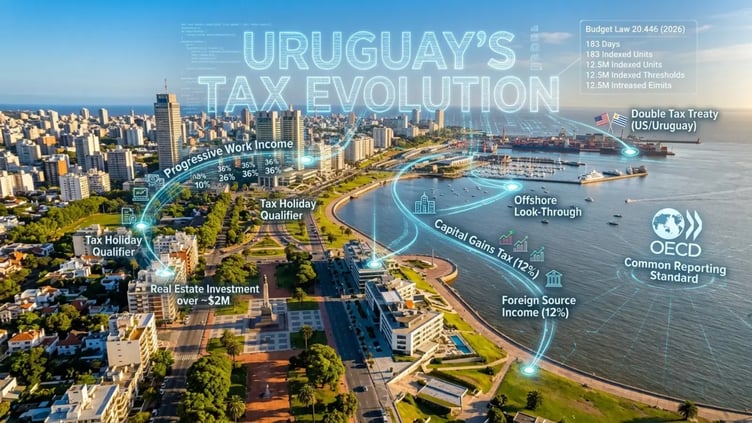
What are the tax rates for expats in Uruguay?
Expats who become tax residents of Uruguay pay progressive IRPF rates from 10% to 36% on employment and local work income, while foreign capital income is taxed separately at specific rates.
For employment and self-employment income, IRPF is progressive.
The 2026 monthly brackets begin at an exempt threshold of UYU 48,048, with rates scaling through 10%, 15%, 24%, 25%, 27%, 31%, and 36%.
Capital income is treated separately.
Foreign investment income and capital gains covered by the expanded rules are generally subject to IRPF at 12% when no tax-holiday election or other preferential treatment applies.
However, qualifying new tax residents can avoid this tax entirely during their 11-year tax holiday, or pay a reduced 6% rate thereafter.
What changed in Uruguay’s foreign income tax rules?
The Budget Law 20.446 expanded Uruguay's tax treatment of foreign income from January 1, 2026. The changes cover foreign rental income and gains from selling overseas shares, financial assets or real estate.
Previously, Uruguay generally taxed foreign dividends and interest at 12%, while foreign rental income and capital gains remained outside the scope of IRPF.
These additional income and gain categories are now generally taxed at 12%. Taxpayers may instead use simplified calculations, resulting in an effective rate of 1.8% on foreign property sale proceeds or 2.4% on securities sale proceeds.
How does tax work on foreign income in Uruguay?
Uruguay taxes its residents on foreign-source income using a hybrid framework. Foreign capital yields and capital gains are taxed at a flat 12% rate, while foreign employment income is subject to progressive rates up to 36%.
The starting point is tax residency. Uruguay distinguishes between residents and non-residents, with residents subject to Impuesto a la Renta de las Personas Físicas (IRPF).
One common route to residency is physical presence in Uruguay for more than 183 days during a calendar year, though economic ties or family connections can also establish status.
Under the expanded 2026 rules, Uruguayan tax residents face IRPF on specific categories of foreign income:
- Foreign dividends and interest: Dividends and interest earned from foreign financial assets remain taxable at the standard 12% IRPF rate for regular residents.
- Foreign rental income: Foreign-source real estate rental yields—previously excluded under Uruguay’s classic territorial framework—are now subject to the 12% IRPF rate.
- Foreign capital gains: Disposing of overseas assets, such as selling foreign shares, financial instruments, or foreign property, is taxable at 12% for residents.
- Foreign employment and business income: Foreign-source work and professional service income are taxed under standard progressive IRPF rates ranging up to 36%. Expats working remotely or providing independent services must evaluate their earned income separately from investment returns.
Does Uruguay still have a foreign income tax holiday?
Yes. Uruguay continues to offer a generous tax holiday regime for eligible foreign newcomers, though Law 20.446 and Decree 188/026 restructured how investors qualify and how the regime transitions over time.
Rather than a broad blanket exemption, the tax holiday specifically shields foreign capital income including dividends, interest, foreign real estate rentals, and foreign capital gains from Uruguayan taxation.
It does not apply to active employment or business income earned while living in Uruguay.
Uruguay’s 11-Year Foreign Income Tax Holiday Explained
The headline 10-year tax holiday is structurally an 11-year regime, the year residency is acquired plus the following 10 fiscal years.
Qualifying new residents are treated as non-residents (under the Impuesto a la Renta de No Residentes, or IRNR), for covered foreign capital income during this timeframe, reducing their tax rate on these returns to 0%.
What happens when the 11-year holiday ends?
Rather than forcing taxpayers directly into the full 12% rate, the updated framework introduces soft landing pathways:
- The 5-Year Extension (6% Rate): Taxpayers can extend their preferential status for an additional 5 years at an effective 6% rate, half the standard 12% IRPF, provided they maintain a qualifying investment. Examples include approximately $1M USD in urban real estate or about $100k annual productive fund contributions.
- The Fixed Annual Lump-Sum: High-net-worth individuals can opt for a fixed annual tax payment of roughly $200,000 to $300,000 USD to cover their foreign capital income year-by-year.
Note: Taxpayers who chose the permanent 7% rate option prior to the 2026 reforms are grandfathered into their existing terms.
Who qualifies for Uruguay's foreign income tax holiday?
To qualify for Uruguay’s 11-year foreign income tax holiday, new residents must satisfy one of three strict criteria: physical presence exceeding 183 days per year, a $2M+ USD investment in urban real estate, or an annual $100k+ USD contribution to approved productive funds.
Under the 2026 rules, obtaining tax residency alone is no longer enough to secure the 11-year exemption.
While lighter routes exist to gain residency, such as 60 days of presence plus a property purchase of about $590k, accessing the Tax Holiday requires meeting at least one of three higher thresholds:
- Physical Presence: Living in Uruguay for more than 183 days per calendar year throughout the holiday period.
- Real Estate Commitment: Investing at least 12.5 million Indexed Units, equivalent to approximately USD 2 million, in urban real estate. This must be a separate property from any real estate used to establish tax residency.
- Productive Funds: Investing at least 625,000 Indexed Units, equivalent to approximately USD 100,000, annually in approved Uruguayan business, innovation or technology funds.
Is Uruguay still attractive for international investors?
Uruguay may remain attractive to Uruguay may remain attractive to internationally mobile investors who can satisfy the updated tax holiday requirements, particularly those planning to spend more than 183 days in the country.
However, its appeal has shifted from a blanket zero-tax destination to a structured, highly predictable jurisdiction.
The higher investment thresholds and broader taxation of foreign capital income make the regime less accessible than it was before 2026.
Uruguay still offers substantial tax relief for eligible new residents, but the 2026 reforms narrowed access and expanded the foreign investment income covered by IRPF.
Before becoming tax resident, individuals should identify which income categories may be taxable, determine whether they meet a tax holiday route and consider how their position will change when the exemption ends.
Does holding assets in offshore companies protect foreign income from Uruguayan tax?
No. Under the updated tax transparency framework (Law 20.446 and Decree 95/026), Uruguay looks through offshore legal entities to attribute passive income directly to Uruguayan tax residents who are ultimate beneficial owners.
If a tax resident directly or indirectly holds at least a 5% stake or controlling interest in a foreign entity such as a BVI company, Panama foundation, or US LLC, that entity’s passive earnings are imputed directly to the individual for IRPF purposes.
These earnings include foreign dividends, interest, rental yields and capital gains.
Key compliance and structuring mechanisms include:
- Direct Look-Through Attribution: Setting up an offshore holding company no longer shields foreign investment yields or capital gains from the standard 12% IRPF rate once an individual is subject to regular Uruguayan tax residency.
- Foreign Tax Credits: To mitigate double taxation, Uruguay permits residents to credit foreign taxes paid abroad against their local IRPF liability, capped at the standard 12% Uruguayan tax rate.
- Local Custodian Withholding: Uruguayan financial intermediaries, brokerages, and custodians managing foreign securities for resident clients are designated as tax withholding agents. They typically apply an 8% monthly withholding rate, credited toward final tax liabilities.
For high-net-worth investors transitioning out of their initial tax holiday window, structural planning must account for these look-through rules rather than relying on legacy offshore holding structures.
Conclusion
Uruguay’s tax landscape has shifted from an unmonitored zero-tax environment to a highly regulated, predictable jurisdiction with clear international standards.
The 2026 reforms make it clear that successful relocation is no longer about finding a blanket loophole, but about timing and structural execution.
Investors and high-net-worth families should confirm their eligibility, understand which income the exemption covers and plan for the tax treatment that will apply after the 11-year holiday before obtaining Uruguayan tax residency.
FAQs
Does Uruguay have a tax treaty with the US?
No, Uruguay does not have a comprehensive bilateral double-taxation treaty with the US, though the two countries signed a Tax Information Exchange Agreement (TIEA).
Consequently, US citizens residing in Uruguay remain fully subject to US tax on worldwide income, relying on foreign tax credits rather than treaty exclusions.
Is Uruguay a high income country?
Yes, the World Bank classifies Uruguay as a high-income economy based on its gross national income per capita.
This status highlights that Uruguay combines its tax incentives with a stable, highly developed local economic framework rather than functioning as an offshore tax shelter.
How much is income tax in Uruguay?
For tax residents, active work income is taxed under progressive IRPF rates ranging from 10% to 36%.
In contrast, taxable foreign capital income and capital gains are taxed separately at a flat 12% rate, unless covered by an 11-year tax holiday for eligible new residents.
Which countries have 0% capital gains tax?
Several jurisdictions such as the UAE, Singapore, and Switzerland, offer broad 0% personal capital gains tax on qualifying private investments under specific conditions.
However, Uruguay no longer belongs to this category, as the 2026 Budget Law explicitly taxes foreign capital gains at a flat 12% rate for regular residents.
Is Uruguay a tax haven for foreigners?
No, Uruguay is a transparent, highly regulated economy that adheres to international OECD tax standards and automatic information exchange agreements.
Rather than an anonymous tax haven, Uruguay is a tax-friendly jurisdiction that offers predictable, structured tax holidays for eligible newcomers.
Related articles
- Zero Foreign Income Tax Countries and Territorial Systems
- Paraguay Tax on Foreign Income: When Does 0% Apply?
- Bolivia Zero Tax on Foreign Income: Opportunities and Realities for Residents
- Turkey Introduces 20-Year Foreign Income Tax Break for New Residents
- How to Avoid Capital Gains Tax on Foreign Property
- 10 Countries with the Highest Taxes for Expats
- Cross-Border Tax Planning: What to Review Before & After Moving