The global outlook for Q3 2026 remains cautiously optimistic, with leading investment firms expecting continued economic growth despite persistent inflation, geopolitical tensions, and market volatility.
The quarter is expected to favor disciplined, diversified investors as artificial intelligence, energy security, and selective regional opportunities continue shaping global markets.
This article covers:
- How does Q3 2026 compare with 2025?
- What's the forecast for Q3 2026?
- What assets are expected to perform in Q3?
- How will the economy be in 2026?
- How to position your portfolio
Key Takeaways:
- Global growth is expected to continue, but returns will vary significantly across regions and sectors.
- Artificial intelligence, energy security, and infrastructure remain the strongest long-term investment themes.
- Persistent inflation and higher interest rates continue to favor selective investing over broad market exposure.
- Diversified portfolios combining growth and defensive assets remain the preferred strategy for Q3 2026.
My contact details are hello@adamfayed.com and WhatsApp +44-7393-450-837 if you have any questions.
The information in this article is for general guidance only. It does not constitute financial, legal, or tax advice, and is not a recommendation or solicitation to invest. Some facts may have changed since the time of writing.

Is Q3 2026 expected to outperform 2025?
Q3 2026 is not necessarily expected to outperform the prior-year quarter. It is better viewed as a more complex investment environment than 2025 rather than a uniformly stronger one, as higher inflation, geopolitical tensions, and shifting global trade dynamics continue to influence market performance.
Allianz Global Investors describes the current environment as one where selectivity matters, with widening differences across regions, sectors, and asset classes creating a broader range of potential investment outcomes.
Rather than relying on broad market gains, investors may need to focus more on portfolio quality, valuation, and regional allocation.
What are Q3 projections?
Q3 2026 is expected to be characterized by moderate economic growth, manageable market volatility, and continued investment in long-term structural growth sectors.
Volatility is likely to remain a feature of financial markets as inflation, energy prices, and geopolitical developments continue influencing investor sentiment.
Despite these headwinds, continued spending on technology, infrastructure, and industrial transformation is expected to support corporate earnings during the second half of the year.
Which regions and countries offer the strongest opportunities?
The strongest investment opportunities in Q3 2026 are expected to be concentrated in the United States, selected Asian markets, and carefully chosen emerging economies.
- United States — Continues to stand out because of its resilient economy, deep capital markets, and leadership in AI innovation, making it a key destination for technology and productivity-driven investment.
- Mainland China — Offers opportunities through advanced manufacturing, industrial upgrading, and continued policy support for strategic industries despite ongoing geopolitical and economic challenges.
- Hong Kong — Remains an important international financial center that provides access to Chinese markets while benefiting from its established capital markets and cross-border investment activity.
- Singapore — Continues to attract capital through its stable regulatory environment, strong financial sector, and position as a regional hub for wealth management and innovation.
- South Korea — Maintains a competitive advantage in semiconductor manufacturing and other advanced technologies that remain essential to global supply chains.
- Japan — Continues to benefit from improving corporate governance, shareholder-friendly reforms, and renewed interest from international investors.
- Select emerging markets — Countries benefiting from supply chain diversification, manufacturing expansion, and rising foreign investment may offer attractive long-term opportunities as global production networks continue to evolve.
Which asset class will perform best in Q3?
Equities are expected to remain the primary driver of long-term returns in the third quarter of 2026, particularly alongside selective exposure to bonds, infrastructure, gold, private markets, and other alternative assets.
Fixed income may also regain importance as investors seek stable income and diversification alongside equity exposure.
However, no single asset class is expected to consistently outperform across all market conditions as inflation, interest rates, and geopolitical risks continue shaping investment performance.
A diversified multi-asset portfolio is therefore generally viewed as the most resilient approach, with real assets and alternative strategies providing additional diversification and potential protection against inflation and market volatility.
Growth assets vs defensive assets in Q3 2026
Growth assets are expected to offer stronger long-term return potential in Q3 2026, while defensive assets remain important for managing volatility and preserving portfolio resilience.
Rather than favoring one category exclusively, many investment outlooks support balancing both to navigate an environment shaped by persistent inflation, geopolitical uncertainty, and uneven market performance.
|
Growth assets |
Why they're attractive |
|
AI-related equities |
Continued investment in artificial intelligence and productivity gains |
|
Semiconductor companies |
Strong demand from AI, cloud computing, and digital infrastructure |
|
Technology stocks |
Long-term earnings growth supported by innovation |
|
Select emerging market equities |
Supply chain diversification and industrial expansion |
|
Private market investments |
Long-term capital appreciation and access to private growth opportunities |
|
Defensive assets |
Why they're attractive |
|
Potential portfolio stability and income if economic growth slows |
|
|
Gold |
Traditional hedge against geopolitical risks and inflation |
|
Inflation-linked cash flows and relatively stable returns |
|
|
High-quality dividend stocks |
More consistent income and potentially lower volatility |
|
Investment-grade corporate bonds |
Regular income with generally lower risk than equities |
What are the risks of the global market in Q3 2026?
The biggest risks facing global markets in third-quarter 2026 remain geopolitical tensions, inflation, energy disruptions, and policy uncertainty.
Trade fragmentation, supply chain disruptions, higher security spending, and renewed pressure on global energy markets could all increase volatility during the quarter.
Investors should also monitor semiconductor supply constraints and changing political developments that may influence global growth expectations.
What is the economic outlook for 2026?
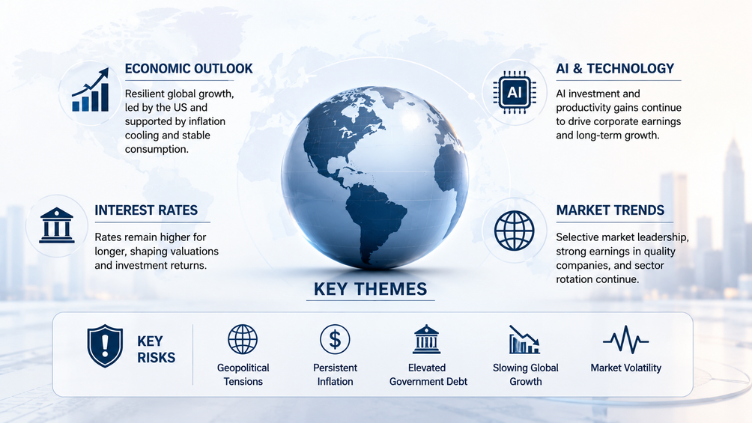
The global economic outlook for 2026 remains broadly positive, although growth is expected to be uneven across regions.
Governments and businesses continue adapting to geopolitical tensions by diversifying supply chains, trade relationships, and energy sources, helping support economic activity despite persistent inflation and market volatility.
Structural investment in artificial intelligence, infrastructure, and innovation is also expected to support long-term economic and corporate earnings growth.
What are the key investment trends in focus key themes for 2026?
Artificial intelligence remains the dominant long-term investment theme for 2026.
HSBC Private Bank identifies AI, energy independence, and security as the three structural forces expected to drive capital allocation globally.
These drivers are forecast to support continued investment in semiconductors, data centers, electrification, defense, and related infrastructure.
Private markets are also expected to play a growing role in financing long-term investment as governments and businesses address increasing funding requirements.
What sectors are predicted to outperform in 2026?
Technology remains the sector with the strongest long-term outlook, particularly companies benefiting directly from AI adoption.
Semiconductors, software, data centers, industrials, materials, utilities, energy infrastructure, and defense-related industries are also expected to benefit from continued investment in innovation, electrification, and national security.
Companies capable of improving productivity through AI may continue outperforming the broader market.
How to position portfolio for 2026?
Investors should position their portfolios for resilience, diversification, and long-term structural growth rather than short-term market swings.
A disciplined investment approach can help navigate ongoing inflation, geopolitical uncertainty, and changing economic conditions while remaining positioned for emerging opportunities.
Reflecting many of these priorities, J.P. Morgan's Mid-Year Outlook 2026 emphasizes preparing portfolios for a structurally different investment environment rather than relying on assumptions from the previous investment cycle.
Key portfolio considerations include:
- Maintain broad diversification across regions, sectors, and asset classes to reduce concentration risk.
- Keep exposure to long-term growth themes, particularly businesses benefiting from artificial intelligence and digital transformation.
- Limit excessive cash holdings, as persistent inflation may gradually erode purchasing power over time.
- Stress-test your portfolio against different economic and market scenarios to identify potential vulnerabilities.
- Review allocations regularly and rebalance when necessary to keep the portfolio aligned with long-term investment objectives.
Conclusion
Q3 2026 highlights a global investment landscape shaped by long-term structural change rather than short-lived market cycles.
Artificial intelligence, geopolitical realignment, energy security, and persistent inflation are reshaping how capital is allocated and where future opportunities may emerge.
Investors who stay diversified, remain disciplined during periods of volatility, and align their portfolios with these enduring trends are likely to be better positioned for the years ahead.
FAQs
Which country has the highest growth potential?
India is widely regarded as one of the fastest-growing major economies, supported by favorable demographics, infrastructure investment, manufacturing expansion, and a growing middle class.
Several ASEAN economies also continue benefiting from supply chain diversification and rising foreign investment.
What are the top 5 global risks?
The top five global risks in Q3 2026 are geopolitical tensions, persistent inflation, elevated government debt, slowing global growth, and market volatility driven by policy and earnings uncertainty.
These risks could weigh on investor confidence, corporate earnings, and financial market performance.
Is 2026 a bull or bear market?
Neither. Q3 2026 is better characterized as a selective bull market, where market gains remain concentrated rather than broad-based.
Which currency is expected to rise in 2026?
The US dollar is expected to remain one of the most resilient major currencies in the third quarter of 2026.
Relatively high US interest rates and continued economic resilience are likely to provide ongoing support for the dollar, although currency performance will continue to depend on inflation trends, central bank decisions, and geopolitical developments.
Geographic diversification therefore remains an important tool for managing currency risk.
What will the interest rate trend be in 2026?
Interest rates are expected to remain relatively high for longer, although major central banks may avoid significant additional tightening.
Monetary policymakers are likely to balance inflation risks against slowing economic growth rather than rushing into aggressive rate cuts.
Higher borrowing costs also continue to reinforce the importance of quality businesses, stable income-producing assets, and disciplined investment selection.
What is the outlook for inflation in 2026?
Inflation is expected to remain above central bank targets in many major economies throughout much of 2026.
Elevated energy prices, geopolitical uncertainty, and supply chain disruptions continue to create inflationary pressures even as price growth gradually moderates.
Investors should therefore prepare for inflation to remain more volatile than during the previous decade.
Related Articles:
- 2026 Global Investment Outlook: Winners & Risks Ahead
- Q1 2026 Investment Outlook: Trends, Opportunities, and Risks
- Investment Outlook Q2 2026: Energy Shocks, Overvalued Markets, and Emerging Risks
- Q2 2026 Market Outlook Explained: Portfolio Strategy for Investors
- 8 Best Investments During Inflation
- Can you profit from inflation? Investment options to protect your money