Reverse convertibles are structured investments that offer an enhanced coupon in exchange for accepting potential losses linked to an underlying asset.
Unlike traditional bonds, they can return the underlying asset instead of the investor’s full principal if the asset falls below a specified level.
Key Takeaways
- Reverse convertibles offer higher coupon income in exchange for greater downside exposure.
- Investors can lose part of their principal if the underlying asset declines.
- The underlying asset's performance determines the repayment outcome at maturity.
- The product's strike, barrier, maturity and tax treatment can materially affect the final outcome.
My contact details are hello@adamfayed.com and WhatsApp +44-7393-450-837 if you have any questions.
The information in this article is for general guidance only. It does not constitute financial, legal, or tax advice, and is not a recommendation or solicitation to invest. Some facts may have changed since the time of writing.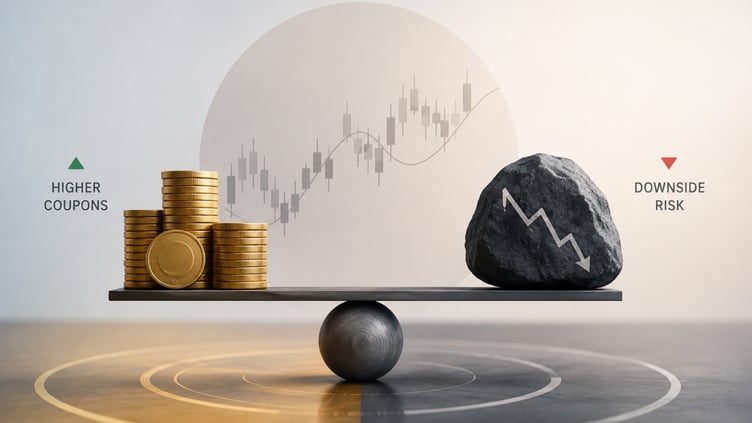
What are reverse convertibles?
Reverse convertibles are structured investments that pay an enhanced coupon while exposing the investor to potential losses in an underlying asset.
A typical reverse convertible has four key components:
- Underlying asset: The stock, index, currency or other asset whose performance determines the repayment outcome.
- Term: The period for which the investment remains outstanding.
- Coupon: The stated return paid to the investor, often higher than conventional fixed-income investments.
- Conversion or strike level: The predetermined level used to determine whether the investor receives the original cash amount or an amount linked to the underlying asset.
The higher coupon compensates investors for taking on risks that would not normally apply to a traditional bond, particularly downside exposure to the underlying asset and the credit risk of the issuer.
How does a reverse convertible work?
A reverse convertible pays periodic coupon income, but the amount and form of the final repayment are based on the underlying asset’s performance.
For example, consider a one-year reverse convertible with a US$100,000 face value, a 10% annual coupon, and a stock trading at US$100 when the investment is issued.
- During the term: The investor receives US$10,000 in coupon payments over the year.
- If the stock meets the maturity condition: The investor receives the US$100,000 principal in cash.
- If the stock falls below the specified level: The investor may receive shares or a cash amount based on the lower value of the underlying asset.
The investor therefore exchanges some downside protection for a higher coupon, making the maturity outcome just as important as the headline yield.
Who is a reverse convertible most suitable for?
Reverse convertibles may suit investors with a neutral to moderately bullish outlook on the underlying asset who prioritize income over full participation in its potential upside.
These products may appeal to investors who:
- Want a higher potential coupon than conventional fixed-income investments
- Would be comfortable receiving the underlying asset at maturity under the product's terms
- Have sufficient liquidity to hold the investment until maturity
- Understand the structured-product terms and associated risks
- Are prepared to accept less upside in exchange for enhanced income
They may be less appropriate for investors seeking full capital protection or unrestricted participation in gains from the underlying asset.
A key consideration is whether the investor's market view and income objective justify the trade-off between the higher coupon and limited upside.
What are the tax implications of reverse convertibles?
Reverse convertibles can generate taxable coupon income, capital gains or losses, and other tax liabilities, with the exact treatment determined by the investor's tax residence and the product's structure.
The coupon payments may be treated as interest income, investment income or another form of taxable return under local rules.
Gains or losses recognized at maturity may also receive different treatment from the periodic coupon.
An investor may therefore face separate tax considerations for:
- Coupon payments received during the term
- Capital gains or losses linked to the underlying asset
- Repayment of principal at maturity
- Shares or other assets delivered instead of cash
Cross-border investors should also consider withholding taxes and reporting requirements in the issuer's jurisdiction.
Investors should review the product's tax documentation and obtain advice based on their specific tax residence before investing.
What are the disadvantages of Reverse convertibles?
The main disadvantages of reverse convertibles are potential capital loss, limited upside participation, issuer credit risk and potentially limited liquidity.
Potential loss of principal
Investors can lose part of their original investment if the underlying asset declines significantly.
Limited upside
The investor generally receives the agreed coupon but does not participate fully in gains in the underlying asset.
If the stock rises sharply, the investor may still receive only the predetermined coupon and principal rather than the full increase in the stock's value.
Issuer credit risk
A reverse convertible is typically an obligation of the issuing financial institution.
If the issuer experiences financial difficulties or defaults, investors may lose some or all of their investment regardless of the underlying asset's performance.
Liquidity risk
Reverse convertibles may be difficult or costly to sell before maturity. A secondary market may exist, but the price can be below the amount originally invested.
Complexity
The final outcome can depend on several variables, including the underlying asset, strike price, coupon, maturity, barrier and settlement mechanism.
Investors therefore need to understand the specific terms rather than judging the product solely by its headline coupon.
Reverse convertible vs barrier reverse convertible
The key difference between a reverse convertible and a barrier reverse convertible is the additional barrier condition used to determine whether the investor is exposed to the underlying asset at maturity.
A standard reverse convertible typically uses a predefined conversion or strike level.
A barrier reverse convertible introduces a barrier that can affect whether the investor receives full principal or becomes exposed to the underlying asset.
For example, a barrier reverse convertible might have:
- Initial underlying price: US$100
- Strike price: US$80
- Barrier: US$60
- Maturity: 12 months
If the underlying asset remains above the applicable levels according to the product terms, the investor may receive the agreed principal at maturity.
If the barrier is breached, the investor may become exposed to the downside performance of the underlying asset.
The exact mechanics vary between products, so investors should check whether the barrier is observed continuously, only on specified dates or according to another methodology.
Neither structure should be considered equivalent to a conventional capital-protected bond simply because it offers a fixed coupon.
Reverse convertible vs convertible bond
A reverse convertible and a convertible bond have fundamentally different payoff structures, with a reverse convertible typically emphasizing enhanced income and a convertible bond giving the investor potential participation in the issuer's equity upside.
A convertible bond is a debt security that generally pays interest and gives the holder the right, subject to its terms, to convert the bond into shares of the issuing company.
A reverse convertible, by contrast, gives the investor enhanced coupon income while exposing them to the possibility of receiving the underlying asset or a reduced cash amount if the product's conditions are met.
|
Feature |
Reverse Convertible |
Convertible Bond |
|
Primary objective |
Enhanced coupon income |
Interest income with an option to participate in the issuer's equity |
|
Coupon |
Fixed coupon specified in the product terms |
Fixed or floating coupon specified in the bond terms |
|
Equity exposure |
Downside exposure to the specified underlying asset |
Upside exposure to the issuer's shares through conversion |
|
Principal |
Can lose value if the
underlying asset falls and the product settles against that decline |
Repayable at maturity, subject to the issuer's creditworthiness and bond terms |
|
Conversion |
Settlement can require delivery of the underlying asset or its cash equivalent |
Investor can convert the bond into the issuer's shares according to the conversion terms |
|
Upside participation |
Limited to the contractual coupon and principal repayment |
Investor can benefit from an increase in the issuer's share price after conversion |
Why would an investor prefer a convertible bond?
An investor may prefer a convertible bond when they want fixed-income characteristics with the potential to benefit from an increase in the issuer’s share price.
Conversion allows the investor to participate in equity gains while retaining the bond’s contractual features until conversion.
This can make a convertible bond more suitable than a reverse convertible for investors who place greater value on upside participation than enhanced coupon income.
FAQs
How does a barrier reverse convertible work?
A barrier reverse convertible links the investor’s repayment to the performance of an underlying asset and whether it breaches a predetermined barrier level.
If the barrier is breached, the product may expose the investor to losses in the underlying asset at maturity, according to its settlement terms.
How does volatility affect investments?
Higher volatility increases the risk of adverse price movements in the underlying asset and can lead to a higher coupon on a reverse convertible.
However, greater coupon income comes with greater downside risk, so investors should assess volatility alongside the strike price, barrier, maturity and underlying asset.
Do you lose money if you sell a bond before maturity?
Yes, you can lose money if you sell a bond before maturity because its market price may be lower than the amount you paid.
Changes in interest rates, credit risk and market conditions can affect its resale value.
Related Articles
- Onshore vs Offshore Investment Bonds: Which Suits Expats?
- Secured Bonds vs Unsecured Bonds: 10 Key Steps To Maximize Earnings
- Investment Strategies for Expats or People Who Frequently Change Residency
- Dual Currency Investments Explained: Returns, Risks and Repayment
- Target Redemption Forward (TRF): How It Works and Key Risks
- A Guide to Structured Products vs ETFs