The British Virgin Islands (BVI) makes company formation relatively straightforward through a streamlined incorporation process and flexible corporate regulations.
Its established legal framework and generally tax-neutral local regime make BVI companies popular for holding assets, managing cross-border investments, and structuring international business operations, although tax and reporting obligations may still arise elsewhere.
Key Takeaways
- BVI companies are commonly used for international holding, investment, and cross-border business structures.
- Foreigners can generally own and manage a BVI company without local residency requirements.
- BVI Business Companies benefit from a tax-neutral regime but must still meet applicable compliance and reporting obligations.
- The BVI remains one of the world's leading offshore jurisdictions due to its efficient incorporation process and internationally recognized legal framework.
My contact details are hello@adamfayed.com and WhatsApp +44-7393-450-837 if you have any questions.
The information in this article is for general guidance only. It does not constitute financial, legal, or tax advice, and is not a recommendation or solicitation to invest. Some facts may have changed since the time of writing.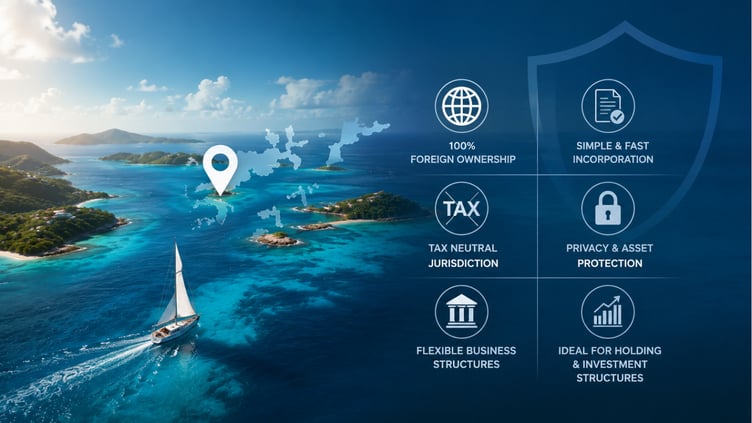
Why do people set up companies in BVI?
People start companies in the BVI to efficiently own international assets, facilitate cross-border business, and benefit from a business-friendly legal and tax environment.
The jurisdiction is particularly popular for holding companies, investment structures, intellectual property ownership, and international joint ventures.
Some of the main reasons include:
- Tax neutrality – BVI Business Companies generally are not subject to corporate income tax, capital gains tax, dividend tax, or withholding tax in the jurisdiction.
- Simple incorporation process – Companies can typically be incorporated quickly through a licensed registered agent with relatively few formation requirements.
- Foreign ownership – Non-residents can generally own 100% of a BVI company, with no local shareholder or director requirements.
- Flexible corporate structure – Companies can be formed with a single shareholder and director, and there are no minimum capital requirements for most businesses.
- Strong legal framework – The BVI's English common law system is well established and widely recognized by international investors and financial institutions.
- Suitable for international holding structures – BVI companies are commonly used to hold shares in subsidiaries, real estate, intellectual property, investment portfolios, and other international assets.
- Privacy balanced with compliance – While the BVI complies with international transparency standards, certain corporate information remains non-public, providing a degree of commercial privacy.
Rather than serving as operating businesses within the British Virgin Islands, most BVI companies are established to own, manage, or invest in assets and businesses located in other jurisdictions.
What are the different types of companies in the British Virgin Islands?
The main types of business entities available in the British Virgin Islands are the BVI Business Company (BC), Restricted Purpose Company, Segregated Portfolio Company (SPC), and Limited Partnership.
BVI Business Company (BC)
This is the standard company used for:
- Holding investments
- International trading
- Asset ownership
- Intellectual property holding
- Investment funds
- Joint ventures
It is highly flexible and suitable for most international business activities.
Restricted Purpose Company
Designed for structured finance and securitization transactions where the company's activities are limited to specific purposes.
Segregated Portfolio Company (SPC)
Available primarily for regulated entities such as insurance businesses and certain investment funds.
It separates assets and liabilities into legally distinct portfolios.
Limited Partnership
Often used for private equity funds, venture capital funds, and investment partnerships.
How to set up a BVI company
To establish a BVI company, you must register the business through a licensed registered agent, submit the required incorporation and due diligence documents, and complete the company's post-incorporation requirements.
The process typically involves the following steps:
- Choose a company name.
- Appoint a licensed BVI registered agent.
- Prepare the incorporation documents.
- Submit shareholder and director identification documents for KYC and AML verification.
- File the incorporation application.
- Receive the Certificate of Incorporation.
- Issue shares and appoint directors.
- Open a corporate bank account.
- Maintain ongoing compliance requirements.
Many BVI companies can be incorporated within a few business days after the registered agent receives complete documentation and successfully completes the required due diligence checks.
Can foreigners set up a company in the BVI?
Yes. Foreign individuals and foreign companies can generally own 100% of a BVI company.
The jurisdiction does not require:
- Local shareholders
- Local directors
- Local ownership percentages
- Citizenship
- Permanent residency
Most incorporations are completed remotely through licensed corporate service providers without requiring the owners to travel to the BVI.
However, all applicants must satisfy anti-money laundering (AML) and know-your-customer (KYC) requirements before incorporation.
What are the requirements to start a company in the British Virgin Islands?
The requirements to create a company in the British Virgin Islands include having a licensed registered agent, a registered office, at least one shareholder and director, and the documentation needed to satisfy incorporation and compliance rules.
Generally, you will need:
- An approved company name
- A licensed BVI registered agent
- A registered office in the BVI
- At least one shareholder
- At least one director
- Memorandum and Articles of Association
- Identity verification documents
- Proof of residential address
- Source of funds information where required
There is no requirement for shareholders or directors to reside in the British Virgin Islands.
Certain business activities, particularly those involving financial services, insurance, or investment management, may require additional licensing.
How much does it cost to set up a company in BVI?
Setting up a BVI company typically costs around USD 1,500 to USD 3,500 for the first year, with the final cost varying according to the registered agent, company structure, and services included.
Typical expenses include:
- Government incorporation fees
- Registered agent fees
- Registered office fees
- Due diligence and compliance costs
- Beneficial ownership compliance services
- Annual renewal fees
Additional costs may apply if the company requires nominee services, accounting support, legal advice, expedited processing, or assistance with opening an international bank account.
A BVI company is generally less expensive to establish than similar structures in some offshore financial centers.
However, you should also budget for recurring annual maintenance costs, which typically range from USD 1,100 to USD 2,500, depending on the company's structure and compliance requirements.
Does a BVI company need to pay taxes?
Generally, no. A BVI Business Company is not subject to corporate income tax, capital gains tax, dividend tax, withholding tax, or inheritance tax in the British Virgin Islands.
This tax-neutral regime is one of the main reasons the jurisdiction is popular for international business structures.
However, tax neutrality in the BVI does not necessarily eliminate tax obligations elsewhere.
For example:
- Shareholders may owe taxes in their country of residence.
- Companies with operations in other jurisdictions may become taxable there.
- Economic substance rules may apply to companies carrying out certain relevant activities.
- Companies must still comply with international reporting standards where applicable.
Professional tax advice is essential when using a company in the BVI as part of an international structure.
BVI company vs other offshore jurisdictions
Compared with many other offshore jurisdictions, the BVI offers a balanced combination of tax efficiency, corporate flexibility, affordability, and international credibility.
Each jurisdiction, however, has its own strengths and trade-offs.
|
Jurisdiction |
Main Strength |
Considerations |
|
British Virgin Islands |
Well-established international holding company jurisdiction with tax neutrality |
Economic substance and international compliance requirements apply |
|
Popular for hedge funds and institutional investment structures |
Generally higher setup and maintenance costs |
|
|
Seychelles |
Cost-effective incorporation |
May have lower international recognition than the BVI |
|
Affordable offshore company formation |
Banking access may be more limited depending on business activities |
|
|
Excellent reputation and banking ecosystem |
Corporate taxation and greater operational compliance |
|
|
Regional business hub with various tax advantages |
Costs and licensing requirements vary by free zone and business activity |
Conclusion
The BVI's enduring appeal lies in providing legal certainty for international ownership.
As offshore regulations continue to evolve, jurisdictions that balance business flexibility with global compliance are becoming more favored over those built solely on secrecy.
For many businesses and investors, the real question is no longer whether a BVI company is tax-efficient, but whether it is the right legal and operational vehicle for their long-term international strategy.
FAQs
Is BVI still a tax haven?
Yes, the BVI is still widely regarded as a tax haven because BVI Business Companies generally are not subject to corporate income tax, capital gains tax, or withholding tax.
However, it now operates under robust international transparency, anti-money laundering (AML), and beneficial ownership reporting standards, making it far more regulated than the traditional image of a secretive offshore jurisdiction.
How long does it take to set up a BVI company?
Many BVI companies can be incorporated within two to five business days once the registered agent has received all required documents and completed the necessary KYC and AML checks.
More complex structures or additional due diligence requirements may extend the timeline.
How to open a bank account for a BVI company?
To open a bank account for a BVI company, you must apply with a bank and provide the company's incorporation documents, identity verification, and information about its business activities and source of funds.
Many BVI companies choose banks outside the British Virgin Islands to better support their international operations.
Does a BVI company need to be audited?
Generally, no. Most BVI Business Companies are not required to have their financial statements audited, although they must maintain adequate financial records and file annual financial returns with their registered agent.
Regulated businesses and certain entities may still be subject to audit requirements.
Related Articles