Singapore Savings Bonds (SSBs) are 10-year Singapore Government securities that offer step-up interest rates and allow investors to redeem their holdings before maturity.
Compared with Singapore Treasury Bills (T-bills), SSBs provide greater flexibility but are designed for a much longer investment horizon.
Key Takeaways
- SSBs offer flexible access to your money because you can redeem them before their 10-year maturity without selling them on the secondary market.
- SSB returns increase with the holding period as their coupon rates step up over time.
- SSBs have a S$200,000 individual holding limit, while T-bills have no equivalent overall cap.
- T-bills suit defined short-term needs because they typically mature in six months or one year.
My contact details are hello@adamfayed.com and WhatsApp +44-7393-450-837 if you have any questions.
The information in this article is for general guidance only. It does not constitute financial, legal, or tax advice, and is not a recommendation or solicitation to invest. Some facts may have changed since the time of writing.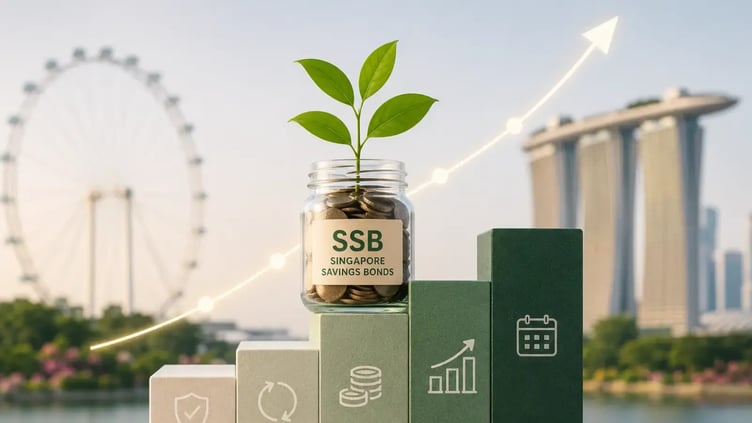
What are Singapore Savings Bonds?
Singapore Savings Bonds are debt securities issued by the Singapore Government through the Monetary Authority of Singapore (MAS).
They are designed specifically to encourage individuals to save and invest over the longer term while maintaining flexibility to redeem their investment.
An SSB has an approximately 10-year maturity.
Rather than offering one fixed coupon for the entire period, its interest rate increases according to a predetermined schedule. This is known as the step-up feature.
The September 2026 SSB issue starts with a 1.52% coupon in the first year and increases progressively to 2.82% in the tenth year.
If held for the full 10 years, the average annual return is 2.25%.
The important distinction is that the 2.25% figure is not the interest paid every year. The actual coupon changes from year to year.
SSBs also differ from conventional bonds because investors do not need to sell them through a secondary market if they want their money back.
They can request redemption directly, subject to the applicable redemption process and fee.
How do Singapore Savings Bonds work?
SSBs are issued regularly, with each issue having its own interest rate schedule.
When an investor purchases an SSB, the coupon rates for each of the 10 years are already determined.
The longer the investor holds the bond, the higher the annual coupon generally becomes.
The September 2026 issue illustrates this structure:
|
Holding period |
Coupon rate |
Average annual return |
|
Year 1 |
1.52% |
1.52% |
|
Year 2 |
1.84% |
1.68% |
|
Year 3 |
2.02% |
1.79% |
|
Year 4 |
2.15% |
1.88% |
|
Year 5 |
2.28% |
1.95% |
|
Year 6 |
2.39% |
2.02% |
|
Year 7 |
2.47% |
2.08% |
|
Year 8 |
2.56% |
2.14% |
|
Year 9 |
2.66% |
2.19% |
|
Year 10 |
2.82% |
2.25% |
The average annual return column shows the effective average return if the bond is held for that period and then redeemed.
SSB interest is paid every six months.
For the September 2026 issue, for example, the bonds are issued on 1 September 2026, mature on 1 September 2036, and pay interest on 1 March and 1 September.
What is the maximum amount I can invest in Singapore Savings Bonds (SSB)?
The maximum amount an individual can hold across all Singapore Savings Bonds is S$200,000. The minimum investment is S$500, with subsequent investments made in multiples of S$500.
The S$200,000 limit applies across an individual's SSB holdings rather than being a separate S$200,000 allowance for every issue.
The amount an investor can actually receive in a particular issue can also be affected by the total amount of SSBs offered and the amount investors apply for.
When an issue is oversubscribed, MAS uses a quantity-ceiling allocation method intended to distribute the bonds among as many applicants as possible.
For investors with substantial cash holdings, the S$200,000 cap is therefore an important consideration.
Someone looking to allocate substantially more than this amount to Singapore Government securities may need to consider T-bills, SGS bonds or other instruments.
Do I have to pay tax on a savings bond?
No. For Singapore individual investors, interest earned from SSBs falls within the tax treatment for qualifying debt securities and can be exempt from Singapore income tax under the relevant provisions of the Income Tax Act.
The exemption applies to qualifying individual investors rather than automatically to every type of investor or investment structure.
For tax residents outside Singapore, however, Singapore's tax treatment is only one part of the analysis.
The investor's country of tax residence may tax interest or investment income earned from SSBs.
How to buy Singapore Savings Bond
Individuals can apply for SSBs through participating local banks, including DBS/POSB, OCBC and UOB.
Applications can generally be made through internet banking or ATMs, while eligible SRS (Supplementary Retirement Scheme) investors can also use SRS funds through the applicable banking channels.
The basic process is:
- Have an eligible CDP Securities account.
- Maintain an account with a participating bank.
- Check the current SSB issue and its interest rate schedule.
- Apply during the application period.
- Choose the amount to invest, subject to the S$500 minimum and S$200,000 overall holding limit.
- Pay the applicable application fee.
- Receive the allocation if the application is successful.
- Receive interest payments every six months.
SSBs are issued in individual tranches, so the application dates, issue date and interest schedule should be checked for each new issue.
Who is eligible to buy Singapore Savings Bonds?
Individuals aged 18 or above can buy Singapore Savings Bonds (SSBs), including Singapore citizens, permanent residents and eligible foreigners.
Companies and other corporate entities cannot apply for SSBs under the individual Savings Bond program.
To invest, applicants generally need a CDP Securities account and a bank account with one of the participating financial institutions.
For investors considering SSBs as part of their savings strategy, eligibility is relatively broad, but the required Singapore banking and CDP arrangements are an important practical consideration for foreigners and non-residents.
Is SSB worth buying?
Yes, SSBs can be worth considering when the priority is capital preservation, flexibility and predictable government-backed income, rather than maximizing investment returns.
One of their biggest advantages is that an investor does not have to decide at the outset whether they will hold the bond for one year, five years or 10 years.
The investor can redeem the SSB earlier if circumstances change.
This makes SSBs particularly useful for money that is not needed immediately but may be required at an uncertain point in the future.
For example, an investor might use SSBs for:
- Part of a cash reserve above their immediate emergency fund
- A future property purchase
- A relocation fund
- Medium- to long-term savings
- The lower-risk portion of a diversified portfolio
- Cash that would otherwise remain in a low-interest bank account
However, SSBs are not necessarily the best choice for every investor.
The current rate may be less attractive than other investments with comparable risk over a particular period.
SSBs also have a maximum holding limit of S$200,000, which can be restrictive for investors with larger amounts of capital.
Most importantly, the headline 10-year average return should not be interpreted as a guaranteed 10-year return for someone who expects to redeem after one or two years.
What are the risks of Singapore Savings Bonds?
Singapore Savings Bonds (SSBs) have very low credit risk because they are issued by the Singapore Government, but investors still face inflation, reinvestment, opportunity-cost and, for foreign investors, currency risks.
Inflation risk
SSBs protect the nominal value of your investment, but they do not protect its purchasing power.
If inflation is higher than the SSB's return, the money may buy less in the future even though the investor receives the expected principal and interest.
Reinvestment risk
When an SSB is redeemed or reaches maturity, the investor must decide where to invest the proceeds.
If interest rates have fallen by then, comparable low-risk investments may offer lower returns than those available when the original SSB was purchased.
Currency risk for foreign investors
Foreign investors face Singapore-dollar currency risk if their future spending or financial obligations are in another currency.
Even if an SSB generates a positive return in SGD, exchange-rate movements can reduce or increase the investment's value when converted into the investor's home currency.
For instance, an SSB earning 2% in Singapore dollars does not necessarily produce a 2% return for an investor whose portfolio or future spending is primarily in US dollars, euros or pounds.
Is SSB better than T-bill?
An SSB is generally better for flexible medium- to long-term savings, while a T-bill is generally better for short-term cash that you know you can leave invested until maturity.
The better option therefore depends primarily on when you expect to need the money and whether you value early redemption.
A T-bill is a short-term Singapore Government security with a typical maturity of six months or one year.
It is issued at a discount to its face value, with the investor receiving the full face value at maturity.
The difference between the purchase price and face value represents the investor's return.
An SSB, by contrast, has a 10-year maturity, pays interest every six months and allows investors to redeem their holdings before maturity.
Its interest rate also increases over the holding period, making it more suitable for investors who may keep their money invested for several years.
|
Feature |
SSB |
T-bill |
|
Typical maturity |
10 years |
6 months or 1 year |
|
Interest structure |
Step-up coupon |
Issued at a discount to face value |
|
Early access |
Can be redeemed before maturity |
Generally held until maturity |
|
Secondary-market trading |
No |
No for individual investors |
|
Minimum investment |
S$500 |
S$1,000 |
|
Maximum holding |
S$200,000 across all SSBs |
No equivalent SSB-style individual holding limit |
|
Interest payment |
Every 6 months |
Return received at maturity |
|
Rate determined at purchase |
Yes |
Yes, based on the auction |
|
Best suited to |
Flexible medium- to long-term savings |
Short-term cash management |
Conclusion
The biggest value of Singapore Savings Bonds may not be their interest rate, but the optionality they give investors.
You can commit capital to a government-backed asset without having to know today exactly when you will need that money back.
That makes SSBs particularly interesting for capital that has a purpose but not yet a fixed date, such as money being accumulated for a future property purchase, relocation or major financial decision.
Rather than forcing investors to choose between keeping cash idle and locking it away for a fixed term, SSBs occupy a useful middle ground.
The trade-off is that this flexibility has a cost.
Investors should view SSBs as a tool for capital management and preservation, not as a substitute for growth assets or a strategy built around maximizing returns.
FAQs
Can I buy a savings bond online?
Yes. Eligible investors can apply for Singapore Savings Bonds (SSBs) online through participating banks such as DBS/POSB, OCBC and UOB during the subscription period for each issue.
Applications may also be made through selected ATM and mobile-banking channels.
Can I withdraw my Singapore savings bond anytime?
No. SSBs cannot be withdrawn instantly like money in a savings account, but you can redeem your Singapore Savings Bonds early during the monthly redemption period.
You can redeem part or all of your holdings and receive your principal plus any interest due under the applicable redemption schedule.
How do I sell my Singapore bonds?
You do not sell Singapore Savings Bonds (SSBs) on the secondary market; you redeem them through the applicable banking channel.
You can redeem part or all of your SSB holdings before maturity, subject to the applicable monthly redemption process and fee.
Related Articles