Singapore offers British expats a strong base for investing through Singapore government securities, REITs, global equities and index funds, as well as the tax-advantaged Supplementary Retirement Scheme (SRS).
Its favorable treatment of many personal investment gains, established financial sector and access to Asian and global markets make it particularly worth considering for long-term investors.
Key Takeaways
- Global diversification can help British expats avoid concentrating their wealth in Singapore alone.
- Singapore government securities can provide a lower-risk component for SGD-based savings.
- UK pensions and existing ISAs can generally be retained after moving to Singapore, but ISA contributions are restricted while non-UK resident.
- The Global Investor Program offers eligible investors a PR route, with business investment option starting at S$10 million.
Request an international portfolio review. My contact details are hello@adamfayed.com and WhatsApp +44-7393-450-837 if you have any questions.
The information in this article is for general guidance only. It does not constitute financial, legal, or tax advice, and is not a recommendation or solicitation to invest. Some facts may have changed since the time of writing.
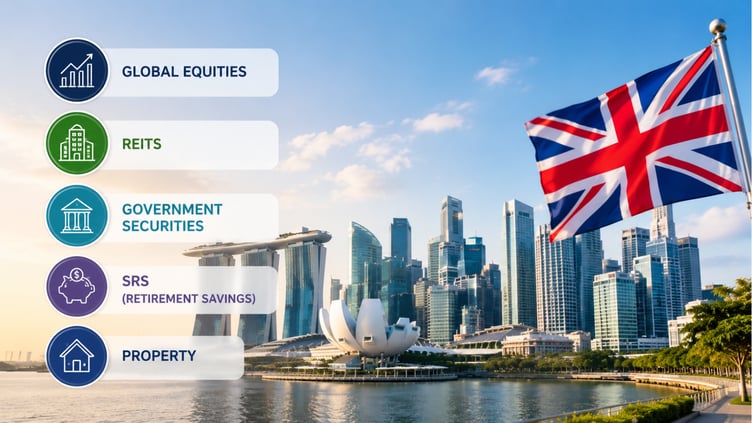
Is Singapore good for UK expats
Singapore can be a good investment base for UK expats, particularly those with a medium- to long-term horizon and income or assets in multiple currencies.
One of the biggest attractions is Singapore’s treatment of investment gains.
Gains from selling shares and other financial instruments are generally not taxable when they are regarded as personal investments rather than trading income.
Singapore also generally does not tax dividends paid by Singapore-resident companies under the one-tier corporate tax system, while foreign dividends received in Singapore by resident individuals are generally not taxable, subject to specific exceptions.
Singapore also offers British expats access to a broad investment ecosystem, including Singapore-listed equities, REITs, government securities, global funds and professionally managed portfolios.
There are, however, several factors to consider first:
- Your UK tax position: Becoming non-UK resident does not automatically eliminate every UK tax obligation associated with UK assets.
- Existing ISAs and pensions: These can remain valuable even after moving abroad, but contribution and tax rules can change once you become non-resident.
- Currency risk: A portfolio built around SGD assets may not be appropriate if your future spending or retirement liabilities will remain primarily in GBP.
- Investment horizon: Someone moving to Singapore for two years may need a different strategy from someone planning to retire there.
- Property costs: Singapore residential property can involve significant upfront taxes and restrictions for foreigners, making it less straightforward than buying shares or funds.
For many British expats, the most sensible approach is therefore not to choose between the UK and Singapore, but to build a portfolio that uses both jurisdictions where appropriate.
What are the best investment options for UK expats in Singapore?
For British expats in Singapore, practical investment options range from lower-risk Singapore government securities to global equities, REITs, index funds, SRS and, for wealthier investors, property and private markets.
1. Singapore government securities
Singapore Treasury Bills and Singapore Savings Bonds can suit British expats who want relatively low-risk SGD investments for capital preservation and short- to medium-term goals.
Singapore Savings Bonds are issued by the Singapore government, can be redeemed before maturity and have a 10-year tenor with stepped interest payments.
Individual holdings are capped at S$200,000.
They can provide stability within a diversified portfolio, although SGD exposure may create currency risk for British expats whose future spending will be in GBP.
2. Singapore and global equities
British expats seeking long-term growth can combine Singapore-listed shares with global equities rather than concentrating their portfolio in either Singapore or the UK.
Singapore stocks provide exposure to sectors such as banking, property and telecommunications, while global equities can diversify across the US, Europe and Asia.
Singapore generally does not tax gains from shares and other financial instruments when they are treated as personal investments rather than trading income, which can make Singapore a tax-efficient base for personal investing under current rules.
3. Singapore REITs
Singapore REITs can give British expats exposure to property markets and potential income without the cost and restrictions associated with directly buying Singapore property.
They cover sectors including retail, commercial, industrial, logistics and hospitality, but remain market investments whose prices and distributions can fluctuate.
For individuals, Singapore REIT distributions are generally not taxable in Singapore, subject to specific exceptions.
4. Global index funds and ETFs
Global index funds and ETFs can spread risk across countries, sectors and currencies without requiring investors to select individual stocks.
British expats should check the fund's domicile, underlying holdings, fees and UK and Singapore tax treatment before investing.
Fund domicile can affect dividend withholding tax, estate exposure, platform availability and treatment after a future return to the UK.
5. Singapore dollar cash and fixed-income investments
British expats who earn and spend in SGD can keep part of their short-term savings in Singapore dollars to match their local financial needs.
SGD can be appropriate for emergency funds and near-term expenses, but holding all long-term wealth in SGD may create currency risk for someone who eventually expects to return to the UK.
6. Supplementary Retirement Scheme (SRS)
The Supplementary Retirement Scheme can benefit British expats who are eligible for Singapore tax relief and want to build retirement savings alongside their UK pension arrangements.
SRS contributions can qualify for tax relief and funds can be invested, but withdrawals are generally taxable and early withdrawals normally incur a 5% penalty.
Foreigners who meet the relevant conditions can make a one-time full withdrawal after maintaining an SRS account for at least 10 years, with only 50% of the withdrawal subject to tax and no early withdrawal penalty of 5%.
SRS tax relief is available only when the contributor qualifies as a Singapore tax resident for the relevant year.
7. Singapore property
Foreigners can generally purchase condominium units without prior approval, while most landed residential property requires government approval.
Singapore property may suit British expats with substantial capital who plan to remain long term.
However, Additional Buyer’s Stamp Duty, financing limits, property tax, maintenance costs and ownership restrictions can make it less accessible than financial investments.
8. Private markets and family office structures
Very high-net-worth British expats can consider private equity, private credit, venture capital and Singapore family office structures for managing substantial international wealth.
These options are generally unsuitable for ordinary investors because of their higher capital requirements, complexity and risk.
Singapore's Global Investor Program is relevant to a much narrower group of wealthy investors, with current investment routes starting at S$10 million and additional eligibility requirements.
It should not be confused with ordinary investing, which does not automatically lead to Singapore PR.
Active vs passive investing in Singapore: Which is better for British expats?
For most British expats building a long-term portfolio in Singapore, passive investing can offer a simpler and lower-cost approach, while active investing may make more sense when specialized market knowledge or more tailored portfolio management is needed.
|
Factor |
Passive investing |
Active investing |
|---|---|---|
|
Approach |
Tracks an index or benchmark |
Manager selects investments to outperform a benchmark |
|
Typical costs |
Generally lower |
Generally higher |
|
Diversification |
Usually broad |
Depends on the manager and strategy |
|
Time commitment |
Low |
Higher if selecting investments yourself |
|
Portfolio control |
Limited |
Greater flexibility |
|
Goal |
Capture market returns |
Try to outperform the market |
|
Suitable for |
Long-term, hands-off investors |
Investors seeking specialized strategies |
For British expats in Singapore, passive investing can be particularly useful for the core of a portfolio that may need to remain intact across future moves between Singapore and the UK.
A globally diversified index fund can provide broad market exposure without requiring the investor to continually adjust individual holdings as their residence, income currency or retirement plans change.
Active management may have a stronger case for specialized or less efficient markets, concentrated holdings, or portfolios requiring tailored currency and withdrawal management.
The key is therefore not choosing one approach exclusively, but using passive investments for broad diversification and reserving active strategies for areas where a British expat's Singapore-UK financial position creates a genuine need for customization.
Conclusion
Singapore gives British expats an unusual combination of local investment access and international financial connectivity, but that advantage can be lost through unnecessary portfolio complexity.
Holding numerous accounts, funds and structures across Singapore and the UK can create administrative and tax-reporting burdens that outweigh the benefits of marginal diversification.
A cleaner portfolio is often easier to maintain across currencies, jurisdictions and future moves.
For British expats, investment decisions should therefore be judged not only by projected returns, but also by fees, reporting obligations, portability and the practical effort required to manage each holding over time.
FAQs
What happens to my UK investments if I move abroad?
You can generally keep your UK pensions and existing ISAs after moving to Singapore, but you usually cannot contribute new money to an ISA while non-UK resident.
Your UK investments may still be subject to UK tax rules, so check the treatment of each asset before selling or restructuring your portfolio.
Is SGD a good currency to keep?
Yes, SGD is a practical currency for British expats who earn and spend in Singapore, particularly for emergency savings and near-term expenses.
Keeping all long-term wealth in SGD can create currency risk if you later return to the UK and need GBP.
How much do I need to invest in Singapore to get PR?
Through Singapore’s Global Investor Program (GIP), eligible investors can qualify for PR by investing at least S$10 million in a new or existing Singapore business.
Other GIP options require S$25 million in a GIP-select fund or a Singapore-based single-family office with at least S$200 million in AUM, including at least S$50 million transferred to Singapore and invested in specified assets.
Meeting an investment amount alone is insufficient because applicants must also satisfy the GIP’s business and track-record requirements.
Can a British expat transfer an SRS account to the UK?
No. An SRS account generally cannot be transferred directly to a UK pension. It usually remains in Singapore until withdrawal, which may be taxable and subject to applicable SRS withdrawal rules.
Related Articles