Financial planning for expats in Colombia means managing banking, taxes, budgeting, investments, and retirement across borders.
Most expats worry about currency fluctuations and inflation. That’s not what destroys wealth in Colombia.
The real risk is misaligned financial planning across jurisdictions.
Colombia is financially attractive, but expats face a hidden challenge: jurisdiction mismatch.
Your income, taxes, and investments often span multiple countries, and without alignment, even a high income can lead to long-term inefficiency.
This article covers:
- Why is financial planning important for expats?
- How much money is needed to live comfortably in Colombia?
- Do expatriates have to pay taxes in Colombia?
- What makes you a tax resident in Colombia?
- What are the best investment options?
- When should you consult a financial advisor as an expat in Colombia?
Key Takeaways
- Financial planning must align with residency, currency, and tax exposure.
- Colombia offers low living costs but requires structured budgeting.
- Tax residency rules significantly impact global income obligations.
- Investment success depends on diversification beyond Colombia.
My contact details are hello@adamfayed.com and WhatsApp +44-7393-450-837 if you have any questions. We also offer bespoke structuring solutions tailored to your situation.
The information in this article is for general guidance only, does not constitute financial, legal, or tax advice, and may have changed since the time of writing.

Why Financial Planning Is Important For Expats In Colombia?
Financial planning in Colombia for expats ensures income, taxes, and investments remain efficient across borders.
Without it, expats face double taxation, currency risks, and liquidity issues.
Colombia has a growing economy, but its systems differ significantly from Western markets.
Planning helps expats avoid structural risks, not just market volatility.

What are the key principles of financial planning?
The core financial planning principles include diversification, tax efficiency, liquidity management, and long-term alignment with residency status.
- Diversification must include geographic exposure, not just assets
- Tax efficiency is critical due to global income taxation rules
- Liquidity matters in countries with capital controls or delays
- Planning must align with visa and residency status
Here’s what most expats get wrong: They focus on returns, not structure. Structure determines long-term wealth survival.
A practical example:
An expat earning in USD but spending in Colombian pesos faces currency spread loss + conversion timing risk.
Over time, this can reduce effective income by 3% to 7% annually if unmanaged.
How Does the Banking System Work in Colombia for Expats?
Colombia’s banking system is stable but documentation-heavy and slower than Western systems. Expats can open accounts, but requirements vary.
Banks typically require:
- Passport
- Visa or residency proof
- Local address
- Sometimes income proof
Major banks like Bancolombia and Davivienda are widely used.
Challenges include:
- Limited English support
- Transaction delays
- Currency conversion costs
- Another overlooked issue is banking accessibility risk.
Some accounts may be restricted or closed if documentation is not maintained, especially for non-residents or temporary visa holders.
Many expats use a hybrid approach:
- Local account for expenses
- International account for savings and investments
This reduces currency and transfer friction.
Cost of Living for Expats in Colombia
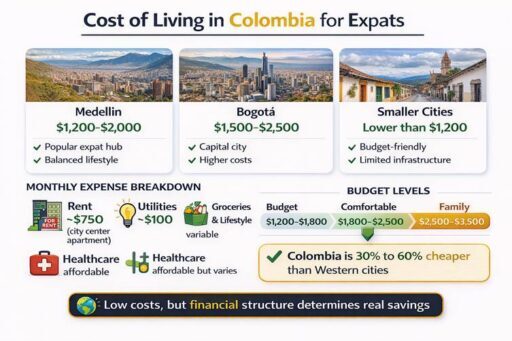
Colombia offers a relatively low cost of living, but lifestyle choices significantly impact expenses. A family of four needs $2,500-3,500, including upscale rent.
Cities like Medellín and Bogotá differ in cost, especially for housing and healthcare.
A single expat can live comfortably on $1,200 to $2,500 per month, depending on lifestyle and city.
- Medellín: $1,200 to $2,000
- Bogotá: $1,500 to $2,500
- Smaller cities: Lower costs
This includes rent, food, utilities, and basic leisure.
Rent dominates as an 85m² apartment in city centers averages COP 3 million ($750), with utilities costing an additional $100.
Colombia remains 30% to 60% cheaper than major Western cities, but imported goods, private healthcare, and international schooling can significantly increase expenses.
Budgeting strategies for expats in Colombia
Effective budgeting focuses on currency management, fixed vs variable costs, and emergency planning.
- Keep part of the funds in USD or stable currencies
- Track rent and healthcare as primary fixed costs
- Build a 6-month emergency fund
- Avoid overexposure to local currency fluctuations
Your required budget also depends on whether you rely on local services or international standards.
For example, private healthcare, imported goods, and international schooling can significantly increase monthly expenses beyond average estimates.
So, what actually matters for expats? Not how much you earn, but how well you control cross-border cash flow.
Here’s what most expats underestimate:
- Lifestyle inflation happens faster in low-cost countries.
- Savings increase initially, but discretionary spending often expands just as quickly.
What Are the Taxes In Colombia For Expats?
Expats in Colombia may pay income tax on global earnings, capital gains tax, and wealth tax (in some cases).
Taxable income includes employment income, business profits, rental income, and certain foreign earnings.
Deductions and exemptions may apply, but they depend on proper filing and documentation.
Filing deadlines vary annually, and missing them can result in penalties, making compliance timing critical.
Rates can go up to 39% depending on income levels.
Colombia taxes residents on global income, making tax planning essential. If you stay long enough, you may become a tax resident, even unintentionally.
Colombia’s tax system is progressive and compliance-driven, meaning late filings or incorrect declarations can result in penalties and interest charges.
What is the tax residency in Colombia?
You are considered a tax resident in Colombia if you stay more than 183 days within a 365-day period, even if the days are non-consecutive.
This rule applies regardless of Colombian visa type, meaning even tourists or short-term visitors can unintentionally trigger tax residency.
It is important to track your days carefully, especially if you frequently enter and exit the country.
Additionally, Colombia may consider other factors such as economic ties and family presence when determining residency in complex cases.
How to avoid double taxation in Colombia?
Colombia double taxation can be reduced through tax treaties (if applicable), foreign tax credits, and proper residency structuring.
Tax friction compounds faster than inflation for expats. Ignoring it erodes wealth silently.
Not all countries have tax treaties with Colombia.
Expats from non-treaty countries face higher risks of double taxation, making professional tax planning even more important.
What Are The Investment And Property Options For Expats In Colombia?
The best investment options for expats in Colombia include stocks (via Bolsa de Valores de Colombia), businesses, and real estate. Regulations are relatively open.
However, all foreign investments must be properly registered with the central bank to ensure legal protection and repatriation rights.
Failure to do so can create complications when transferring funds out of Colombia.
These investments come with currency, regulatory, and liquidity risks.
Currency risk is one of the biggest hidden factors. Even if local investments perform well, peso depreciation against USD or EUR can offset returns.
Some expats prefer offshore investment diversification to reduce country-specific risks.
Can you buy property in Colombia without being a citizen?
Yes, foreigners can buy property without citizenship in Colombia.
The process includes:
- Registering funds with the central bank
- Legal due diligence
- Title verification
Is buying property in Colombia a good investment?
Buying real estate in Colombia can offer attractive yield potential, particularly in cities like Medellín where rental demand is strong and tourism areas support short-term rental income.
However, risks include:
- Currency depreciation
- Legal complexity
- Liquidity challenges
Additionally, property markets in Colombia can be less liquid than in developed countries, meaning selling quickly during downturns may be difficult.
This makes returns highly dependent on location selection, rental strategy, and long-term holding horizon rather than short-term capital appreciation.
What is the best investment strategy for expats in Colombia?
The best strategy for Colombia expats is global diversification with selective local exposure.
- Keep core investments internationally
- Allocate a smaller portion to Colombia
- Avoid overconcentration in one country
Most people mistakenly overinvest locally because it feels familiar, which increases their overall risk.
Retirement and Financial Planning For Expats In Colombia
Colombia is a popular retirement destination due to its affordability and climate. Healthcare and living costs are lower compared to many Western countries.
However, planning must account for:
- Currency risks
- Healthcare access
- Long-term residency rules
Can you get a retirement visa in Colombia?
Yes, Colombia offers a retirement visa for individuals with stable income.
Requirements typically include:
- Proof of pension income
- Minimum income threshold (linked to minimum wage multiples)
Do you need a financial advisor as an expat in Colombia?
Yes. A financial advisor in Colombia can help with tax structuring, investment allocation, and cross-border planning.
This becomes especially important for expats with multiple income sources, international assets, or changing residency status.
A poorly structured plan can lead to long-term inefficiencies that are difficult to reverse.
Retirement planning tips for expats in Colombia
Retirement planning for expats in Colombia should focus on building globally diversified income, managing healthcare costs, and protecting against currency and tax risks.
- Diversify globally, not just locally
- Plan for healthcare inflation
- Maintain income in stable currencies
- Review tax exposure annually
Retirement isn’t about low costs. It’s about sustainable income across borders.
Healthcare is also a key variable.
While Colombia offers affordable healthcare, access to private facilities and international-standard care may require additional insurance.
FAQs
Is Colombia a good place for expats?
Yes, due to low living costs, climate, and lifestyle. However, financial planning is essential to manage taxes and currency risks.
How to retire in Colombia?
Secure a retirement visa, prove stable income, and plan healthcare, taxes, and long-term financial sustainability.
How to invest as an expat?
Use a globally diversified portfolio with limited local exposure to reduce country-specific risks.
Do expats pay tax?
Yes, if classified as tax residents, expats pay tax on global income in Colombia.
Is it safe to buy property in Colombia?
Yes, but requires proper legal checks, due diligence, and understanding of currency and liquidity risks.