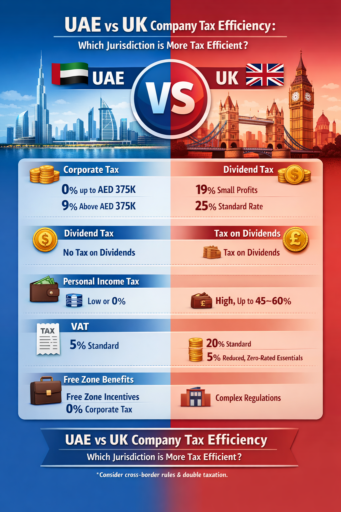
A UAE company is generally more tax-efficient than a UK company due to lower corporate tax, zero personal income tax, and fewer layers of taxation.
In contrast, UK companies face higher corporate rates, dividend taxes, and personal income tax that can significantly reduce net profits.
This article covers:
- How high is corporate tax in the UK?
- How much is personal income tax in the UK?
- What is the personal income tax rate in the UAE?
- What is the corporate tax rate threshold in the UAE?
- Is freezone exempted from corporate tax in the UAE?
Key Takeaways:
- UAE offers 0% personal income tax and low corporate tax (9%).
- UK business owners can face 50%–60% combined tax exposure.
- UAE free zones may still qualify for 0% corporate tax under conditions.
- Maximizing tax efficiency requires aligning company location, personal residency, and profit extraction strategies with both UAE and UK regulations.
My contact details are hello@adamfayed.com and WhatsApp +44-7393-450-837 if you have any questions.
The information in this article is not tax advice and may have changed since the time of writing. I can connect you with expert tax support for your specific situation.

What are the three major business taxes?
The three major business taxes are corporate tax, value-added tax (VAT), and income or dividend tax on owners.
- Corporate tax – charged on company profits
This is the primary tax businesses pay on their net earnings after deducting allowable expenses. It directly impacts how much profit a company retains for reinvestment or distribution. - Value-added tax (VAT) – applied to goods and services
VAT is a consumption tax added at each stage of the supply chain and typically passed on to the end customer. Businesses are responsible for collecting and remitting VAT, making it a key compliance and cash flow consideration. - Income or dividend tax – paid by business owners on extracted profits
This applies when owners take money out of the business as salary or dividends. It determines the final, personal tax burden on business profits after they leave the company.
How much do business owners get taxed in the UK vs UAE?
Business owners in the UK are generally taxed at a much higher combined rate than those in the UAE, often ranging from 40% to 60%+ in the UK compared to 0% to 9% in the UAE.
In the UK, business owners are typically subject to multiple layers of taxation:
- Corporation tax on company profits (19%–25%)
- Dividend tax on distributed profits
- Income tax and National Insurance on salary income
This layered system increases the total tax burden significantly, especially for higher earners using both salary and dividends.
In the UAE, the structure is simpler:
- 0% personal income tax
- 0% tax on most dividends
- 9% corporate tax only above AED 375,000 in profits
As a result, many businesses fall into a low or near-zero effective tax range depending on eligibility and structure (particularly in free zones).
What is one strategy for minimizing taxes in the UK?
Maximizing pension contributions remains one of the most effective ways to reduce UK tax exposure.
By contributing to a pension, UK-based profits or personal income are reduced before tax, which lowers the combined income, dividend, and corporate tax burden, especially for high earners facing rates of 50%–60%.
This strategy is particularly relevant if you are a UK tax resident but operate a UAE company, as it allows you to legally minimize UK taxation on income that might otherwise be subject to high rates.
Combined with careful income timing, salary structuring, or dividend planning, pension contributions can shift a potentially high-tax scenario toward a more tax-efficient position.
Ultimately, integrating UK tax-saving strategies alongside the lower-tax environment of a UAE company can optimize overall profitability, letting business owners retain more earnings while remaining fully compliant.
How to reduce corporate tax in the UAE?
Businesses in the UAE can reduce their corporate tax liability through proper structuring, eligibility planning, and use of available exemptions under the corporate tax framework.
One of the most common approaches is establishing a Qualifying Free Zone Person (QFZP) structure.
If a business meets specific conditions, certain types of income may still be taxed at 0%, even after the introduction of corporate tax.
However, this depends on maintaining regulatory compliance, adequate substance, and earning qualifying income as defined by UAE tax law.
Another key strategy is carefully separating mainland and free zone activities.
Income generated within approved free zone activities may benefit from preferential treatment, while mainland-sourced income is typically subject to the standard 9% corporate tax above AED 375,000.
Businesses may also optimize tax exposure by:
- Ensuring proper economic substance (office presence, employees, operational activity)
- Structuring transactions to align with approved free zone activities
- Maintaining accurate accounting to correctly classify taxable vs exempt income
- Avoiding unintended tainting of free zone benefits through non-qualifying income
Unlike jurisdictions with multiple relief bands, UAE tax efficiency hinges heavily on structural compliance and eligibility, rather than progressive deductions or tiered allowances.
What is the income tax rate in the UAE vs UK?
The UAE has a 0% personal income tax, while the UK has progressive rates up to 45%, with effective marginal rates reaching 60% for high earners.
In the UAE, salaries, dividends, and most personal earnings are not subject to tax, making it highly attractive for entrepreneurs and professionals.
In contrast, the UK’s personal income tax applies to wages and other earnings, and tapering of allowances can push the effective rate much higher for top earners.
This difference is one of the most significant factors for business owners and expatriates when deciding where to establish residency or operate a company.
How much is the British VAT tax?
The standard VAT rate in the UK is 20%. A reduced rate of 5% applies to certain goods and services, while essential items like food staples and some essentials are zero-rated.
VAT is charged at each stage of the supply chain and must be collected and remitted by businesses, making compliance critical.
This tax significantly affects pricing, cash flow, and overall costs for companies selling to UK consumers.
How much VAT do you pay in the UAE?
The standard VAT rate in the UAE is 5% on most goods and services.
This rate applies across the country and is collected by businesses at each stage of the supply chain.
Certain essential items and specific sectors may be exempt or zero-rated under UAE law.
The low VAT rate helps reduce pricing pressure for businesses and improves profit margins compared to higher-VAT jurisdictions.
What are economic substance regulations in the UAE and UK?
Economic substance regulations in the UAE and UK require companies to demonstrate genuine business activity within the jurisdiction, including real operations, staff, and premises, to prevent tax avoidance and align with international standards.
In the UAE, these rules target specific sectors such as holding companies, finance, and intellectual property, requiring companies to show they have adequate employees, a physical office, and actual operational decision-making.
The regulations are designed to ensure that profits are generated by real economic activity rather than shell or paper entities.
In the UK, similar requirements are enforced through permanent establishment rules, transfer pricing regulations, and anti-avoidance laws, which assess whether a company is truly operating and managed locally.
Both jurisdictions increasingly focus on substance over form, making it essential for businesses to have tangible operations where they claim tax residency.
Double Taxation and International Considerations
Double taxation rules and international tax treaties affect how much tax you ultimately pay when operating across the UK and UAE.
Key factors include tax residency, permanent establishment rules, and controlled foreign company (CFC) rules, which can still trigger tax in another country even if a company is incorporated abroad.
The UAE has an extensive treaty network with 130+ double taxation agreements, while the UK maintains 120+ active treaties worldwide.
These agreements help reduce withholding taxes and prevent the same income from being taxed twice, including through the UK–UAE Double Taxation Convention.
However, treaty protection does not eliminate tax exposure if a UK tax resident remains liable under UK residency rules or if a UAE company is effectively managed and controlled from the UK.
Ultimately, tax outcomes depend not just on incorporation, but also on residency status, management location, and overall corporate structure.
Conclusion
Choosing between a UAE company vs UK company is not just a matter of comparing tax rates but aligning your business structure with long-term strategic goals.
The UAE offers significant tax advantages, but these benefits are maximized only when residency, substance, and operational realities are properly structured.
Conversely, the UK’s higher tax environment can still make sense for businesses seeking access to established markets, talent, and financial infrastructure, provided careful planning mitigates excessive tax exposure.
Ultimately, the most effective approach balances jurisdictional efficiency, compliance, and the practical realities of running and managing a company across borders, rather than chasing low rates alone.
FAQs
Is there a double tax treaty between the UK and the UAE?
Yes, the UK and UAE have a double taxation agreement that helps prevent the same income from being taxed twice and reduces withholding taxes.
Do you pay tax if you work for a UK company and live in Dubai?
If you remain a UK tax resident, your income may still be subject to UK tax.
If you become a Dubai tax resident, your earnings are generally tax-free locally, though proper planning is needed to avoid dual taxation.
How to avoid the 60% tax trap in the UK?
You can reduce exposure to the 60% UK tax trap through pension contributions, salary sacrifice schemes, and careful timing or structuring of income.
This trap occurs when income exceeds £100,000 and personal allowances begin to taper, effectively increasing the marginal rate to 60%.
Are UK taxes the highest in the world?
The UK does not have the highest taxes globally, but combined income tax, national insurance, and dividend taxes make it a relatively high-tax jurisdiction, especially for top earners.
Is UAE income taxable in the UK?
If you are a UK tax resident, your worldwide income—including income earned in the UAE—may be subject to UK tax, though double taxation treaties between these countries can reduce or eliminate overlapping tax.
If you are a UAE tax resident and not resident in the UK, UAE income is generally not taxed in the UK.
Pained by financial indecision?

Adam is an internationally recognised author on financial matters with over 830million answer views on Quora, a widely sold book on Amazon, and a contributor on Forbes.