To live comfortably overseas in 2026 on investment income alone, most individuals will need a passive income stream of roughly $2,000–$7,000+ per month.
This depends on location, lifestyle, family size, and currency dynamics.
Calculating your required investment income begins with setting realistic monthly expense targets, adjusting for country-specific cost of living differentials, and applying sustainable withdrawal strategies such as the 3% or 4% rule.
This article covers:
- How much money do you need to live abroad?
- How much investment income to retire overseas?
- What is the average portfolio size to live abroad?
- What is the cost of living abroad?
Key Takeaways:
- Investment income needs vary based on location and lifestyle.
- $2,000–$7,000/month is a reasonable expat range.
- Use 3%–4% withdrawal rules.
- Inflation and currency matter.
- A diversified nest egg increases resilience.
My contact details are hello@adamfayed.com and WhatsApp +44-7393-450-837 if you have any questions.
The information in this article is for general guidance only. It does not constitute financial, legal, or tax advice, and is not a recommendation or solicitation to invest. Some facts may have changed since the time of writing.

How Much Income From Investments Is Enough To Live Abroad?
In 2026, most people need about $2,000–$3,000/month for a lean lifestyle, $4,000–$6,000/month for a comfortable lifestyle, and $7,000+/month for a premium lifestyle to live abroad on investment income.
A practical target is your actual monthly expenses plus a buffer for taxes, healthcare, and emergencies, typically covering housing, food, transport, healthcare, and discretionary spending.
Expenses vary widely between countries, regions, and even cities. For example, living in rural Mexico is typically cheaper than in large cities in Western Europe.
What Determines The Income Needed To Live Overseas?
The income needed to live overseas is determined by the cost of living, currency strength, family size, healthcare costs, housing costs, and inflation rates.
Below are the key factors that shape your investment income requirement:
1. Country
Different countries have vastly different living costs. For example, Thailand and Portugal are known for lower living costs compared to Switzerland or Japan.
2. City vs. Rural
Urban centers typically cost more for rent/housing, transportation, and services. Rural areas are cheaper but may offer fewer amenities.
3. Family Size
A single person’s expenses are markedly lower than those of a family with children, especially when factoring in education.
4. Healthcare
Healthcare costs vary dramatically. Some countries offer low-cost or free public healthcare (e.g., Spain via EU residency), while others require private insurance.
There are certain considerations. For example, Medicare in the US doesn’t generally cover care outside the country.
5. Housing
Rent or mortgage varies widely. This is usually the highest monthly cost for expats.
6. Inflation
Inflation erodes purchasing power. Therefore, high-inflation countries require bigger income buffers.
Cost Of Living For Expats In Popular Countries
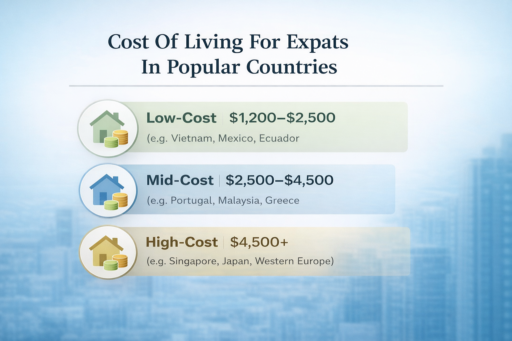
In 2026, expat living costs typically range from $1,200–$2,500/month in low-cost countries, $2,500–$4,500/month in mid-cost countries, and $4,500+/month in high-cost countries.
Low-Cost Countries
In places like Thailand, Mexico, Vietnam, and Ecuador, many expats live comfortably on $1,200–$2,500/month.
Lower housing costs and affordable daily expenses make these attractive for early retirees and digital nomads.
Mid-Cost Countries
In Portugal, Spain, Malaysia, and parts of Central/Eastern Europe, monthly budgets of $2,500–$4,500 can support a comfortable lifestyle with decent housing, food, and activities.
High-Cost Countries
In countries such as Switzerland, Japan, Singapore, and major Western European capitals, expats often need $4,500+ per month to cover housing, insurance, transportation, and discretionary spending.
How Big Should A Portfolio Be?
Your portfolio must be large enough to generate your required annual income while preserving capital against inflation, market volatility, and longevity risk.
In practical terms, is calculated using sustainable withdrawal rates such as the 3% rule, 4% rule, or conservative dynamic withdrawal strategies.
Rather than asking “how much money do I need?”, the more precise question is: “How much reliable annual income must my portfolio safely produce?”
Once you know that number, portfolio sizing becomes a straightforward calculation.
Understanding Withdrawal Rules in Real Terms
Most international retirement planners use three core withdrawal approaches:
The 4% Rule
This rule suggests withdrawing 4% of your portfolio in the first year, then adjusting for inflation annually.
Example:
If your portfolio is $1,000,000 x 4% = $40,000 per year
Monthly income ≈ $3,333
This model originated from US retirement studies but remains widely referenced globally.
Pros:
- Higher income potential
- Faster lifestyle independence
Cons:
- Higher risk during prolonged bear markets
- Less margin for currency depreciation
The 3% Rule
The 3% rule prioritizes capital preservation over income.
Example:
$1,000,000 × 3% = $30,000 annually
Monthly income ≈ $2,500
This model is increasingly popular among early retirees and international expats because it:
- Provides stronger downside protection
- Reduces sequence-of-returns risk
- Supports longer retirement horizons (40+ years)
Conservative Withdrawal Models (2.5% to 3.5%)
These models incorporate:
- Variable withdrawals
- Cash buffers
- Geographic arbitrage
- Partial employment income
They are ideal for:
- Early retirees
- Families with dependents
- People relocating to volatile currency regions
Portfolio Size Examples Based on Monthly Income Targets
Let us back-calculate realistic portfolio sizes.
- $2,000 per month ($24,000 annually)
3% rule:
$24,000 ÷ 0.03 = $800,000
4% rule:
$24,000 ÷ 0.04 = $600,000
This income level supports lean living in low-cost countries.
- $4,000 per month ($48,000 annually)
3% rule:
$48,000 ÷ 0.03 = $1,600,000
4% rule:
$48,000 ÷ 0.04 = $1,200,000
This range supports comfortable lifestyles in mid-cost regions.
- $7,000 per month ($84,000 annually)
3% rule:
$84,000 ÷ 0.03 = $2,800,000
4% rule:
$84,000 ÷ 0.04 = $2,100,000
This supports premium global living, including Western Europe, Japan, or Singapore.
How Does Inflation Affect Your Investments?
Inflation steadily erodes purchasing power, meaning your investment income must grow over time just to maintain the same standard of living.
Even modest inflation compounds dramatically.
At 4% annual inflation:
- $3,000 today requires $4,440 in 10 years
- $3,000 becomes nearly $6,500 in 20 years
This makes inflation one of the greatest long-term threats to overseas retirees.
Local Inflation vs Portfolio Inflation
Expats face two layers of inflation:
- Inflation in the country you live in
- Inflation affecting your investment currency
For example:
You invest in USD but live in Thailand. If Thai inflation rises faster than U.S. inflation, your lifestyle becomes more expensive even if your portfolio grows.
This mismatch creates purchasing power drag.
High-Inflation Countries Increase Withdrawal Pressure
In regions with elevated inflation:
- Food costs rise faster
- Rent escalates rapidly
- Healthcare becomes unpredictable
This forces higher withdrawals, accelerating portfolio depletion.
Inflation-Resistant Asset Classes
To counter inflation, most globally diversified portfolios include:
- Equities
- Real estate
- Inflation-linked bonds
- Commodities
- Dividend growth stocks
Cash-heavy portfolios struggle to preserve purchasing power over long periods.
Why Overseas Retirees Need Growth, Not Just Income
Many retirees focus only on dividends or rental income. This approach ignores capital appreciation.
Without growth:
- Income stagnates
- Inflation wins
- Lifestyle shrinks
Your portfolio must both pay you and grow.
What Is The Role Of Currency?
Currency exchange rates directly impact your overseas spending power.
Example: If you earn in USD but live in a country that uses EUR, fluctuations in exchange rates can increase or decrease the real value of your investment income.
A weakening USD relative to the local currency means less spending power abroad.
How Much Does A Single Person Need To Live Comfortably?
On average, single expats target $2,500–$4,000 per month for a comfortable life with moderate housing, health coverage, and discretionary spending.
Where reported cost data exists, this aligns with international expat cost surveys.
How Much Does A Family Of Four Need To Live Comfortably?
A family of four typically requires $4,000–$8,000+ per month to cover housing, schooling, transportation, healthcare, and food in mid-cost countries.
Higher costs apply in Western Europe, Japan, and North America.
What Is Considered A Good Nest Egg?
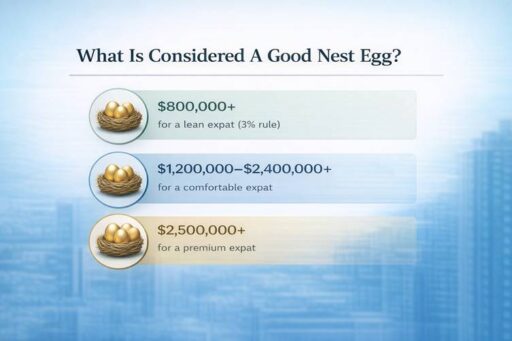
A good nest egg for living overseas typically ranges from $800,000 to $2,500,000+.
This level of capital is generally sufficient to generate sustainable investment income under conservative withdrawal assumptions.
- $800,000+ for a lean expat (3% rule)
- $1,200,000–$2,400,000+ for a comfortable expat
- $2,500,000+ for a premium expat
These figures assume prudent investment strategies, diversified assets, and realistic withdrawal rates.
How Much Investment Income And Employment Income Should Be Combined?
A hybrid income model is common for expats, where investment income covers most living costs and employment or freelance work fills the gap.
For instance, 40% to 70% of living expenses come from investments, and the remaining portion comes from light employment, consulting, freelancing, or business income.
This blended approach dramatically improves financial sustainability, reduces portfolio stress, and increases geographic flexibility.
Instead of forcing your investments to carry 100% of your lifestyle, hybrid planning allows your portfolio to compound longer while you maintain optional income streams.
Why Hybrid Income Is Used
Hybrid income reduces reliance on portfolio withdrawals and improves financial stability during geopolitical uncertainties, inflation shifts, and currency fluctuations.
Example:
- Monthly expenses: $4,000
- Investment income: $2,500
- Active income: $1,500
- Result: lower withdrawal pressure and improved capital preservation
Impact on Portfolio Size
Hybrid income significantly reduces required capital.
- Investment-only: $1,600,000 (3% rule on $48,000/year)
- Hybrid model: $1,000,000 (with $1,500/month active income)
That’s a $600,000 reduction in required portfolio size.
Common Forms of Hybrid Income
- Remote work (consulting, writing, marketing, tech)
- Freelancing or contract-based work
- Online businesses (content, digital products, affiliates)
- Property or rental income
Conclusion
Living overseas in 2026 on investment income is entirely achievable with disciplined planning, realistic expense targeting, and careful portfolio management.
Your required investment income flexes widely based on location, family size, lifestyle, inflation, and currency conditions.
By aligning withdrawal strategies with your goals and adjusting for the cost of living, you can live a financially independent expat life.
FAQs
Is $2000 a month enough to live off of?
Yes, in many low-cost countries like Mexico, Thailand, and some Eastern European nations, $2,000/month can support a comfortable lean lifestyle.
How much money do I need to invest to retire?
Assuming the 4% rule, multiply your desired annual income by 25 (e.g., $48,000 × 25 = $1,200,000 portfolio).
Will $500,000 be enough to retire on?
It depends. Using the 4% rule, $500,000 yields ~$20,000 annually, which is ideal for lean lifestyles in low-cost regions, but insufficient in high-cost areas.
Can you live comfortably with 1 million dollars?
Yes, especially in mid to low-cost countries. Using the 3–4% rule, $1M can produce $30,000–$40,000 per year.
Can you live off rental income alone?
Yes, if rental income reliably covers your living costs after expenses, taxes, and vacancies.
Always stress-test rental income against market fluctuations.
Pained by financial indecision?

Adam is an internationally recognised author on financial matters with over 830million answer views on Quora, a widely sold book on Amazon, and a contributor on Forbes.