To create a will in Germany, you must draft a legally valid Testament that follows strict formal requirements under the Bürgerliches Gesetzbuch.
Any mistake in format or wording can make the will invalid or partially unenforceable.
This article covers:
- What is the inheritance system in Germany?
- What is a will also called?
- How do you write a will in Germany?
- Is a handwritten will valid in Germany?
Key Takeaways:
- A German will must either be fully handwritten and signed, or properly notarized, to be valid.
- Forced heirship rules limit full freedom in asset distribution.
- Handwritten wills are simple but more prone to errors and disputes.
- Notarial wills offer stronger legal protection and smoother probate.
My contact details are hello@adamfayed.com and WhatsApp +44-7393-450-837 if you have any questions. We also offer bespoke structuring solutions tailored to your situation.
The information in this article is for general guidance only, does not constitute financial, legal, or tax advice, and may have changed since the time of writing.

What is a will called in Germany?
In Germany, a will is called a Testament. It is a legally binding document that sets out how your estate should be distributed after death and must comply with formal requirements under the Bürgerliches Gesetzbuch.
Unlike in some countries, even small errors in form or wording can affect validity, making it important to understand the different types available.
There are several recognized types of wills:
Holographic will (Eigenhändiges Testament)
This is a will entirely handwritten and signed by the testator, with the date ideally included to avoid disputes over validity.
It is the simplest and most cost-effective option, but it carries a higher risk of errors, unclear language, or challenges during probate if not carefully drafted.
Notarial will (Notarielles Testament)
This will is prepared or formally certified by a notary, ensuring it complies with all legal requirements and accurately reflects the testator’s intentions.
It provides stronger legal certainty, is automatically registered, and significantly reduces the likelihood of disputes or delays during the probate process.
Joint will (Gemeinschaftliches Testament)
Typically used by married couples, this type of will allows spouses to make mutual and binding arrangements regarding the distribution of their estate.
A common version is the Berlin will, where one spouse inherits everything first, and the children inherit after the surviving spouse’s death, which can simplify succession but may have tax implications.
Each type carries different levels of legal security, cost, and flexibility, making the choice especially important for individuals with complex or cross-border estates.
How do wills work in Germany?
Wills in Germany work by legally directing how your estate is distributed after death, but only if they comply with strict rules under the Bürgerliches Gesetzbuch.
Key principles include:
- Freedom of testation
You can distribute your assets according to your wishes, but this freedom is limited by mandatory inheritance rights that protect close family members. - Forced heirship (Pflichtteil)
Certain relatives, including children and spouses, are legally entitled to a minimum share of the estate, even if they are excluded from the will, which can override full distribution control. - Formal validity rules
A handwritten will must be entirely written and signed by the testator to be valid, while typed or unsigned wills are generally invalid unless formally executed and certified by a notary. - Probate process
After death, the will is submitted to the probate court (Nachlassgericht), which verifies its validity and supervises the legal transfer of assets to the rightful heirs.
What is the inheritance law in Germany?
German inheritance law under the Bürgerliches Gesetzbuch governs how estates are distributed based on the order of heirs, prioritizing children and direct descendants as the first in line to inherit, followed by other relatives if no closer heirs exist.
- Order of heirs
If no will exists, relatives inherit in a strict legal hierarchy:- Children and descendants
- Parents and siblings
- Grandparents and extended relatives
- Spousal rights
A surviving spouse is entitled to a significant share of the estate, which varies depending on the marital property regime and the presence of other heirs. - Compulsory share
Even if disinherited, certain heirs such as children and spouses can claim a mandatory financial portion of the estate, typically as a cash entitlement rather than specific assets.
This system limits complete freedom of distribution but ensures that close family members are financially protected.
How to write a will in Germany
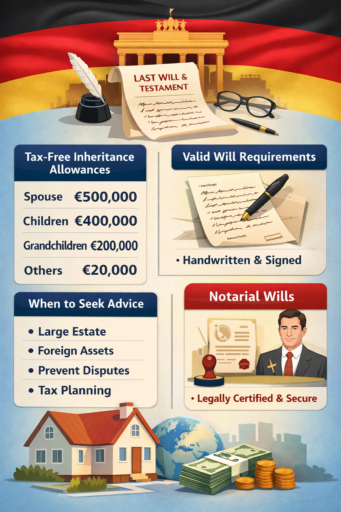
To make a will in Germany, you must either handwrite a legally compliant Testament or have it formally executed by a notary.
Creating a valid will nvolves clear legal steps:
1. Choose the will type: Decide whether to create a handwritten (holographic) will or a notarial will, depending on your needs and complexity of your estate.
2. Write the will (if handwritten): The will must be entirely handwritten by you and include your full name, date, and signature to be legally valid.
3. Define beneficiaries and assets: Clearly identify who inherits what to avoid confusion or disputes during probate.
4. Ensure clarity and consistency: Avoid vague language, contradictions, or missing details that could lead to challenges or misinterpretation.
5. Store the will properly: Keep the will in a secure place, and note that notarial wills are automatically registered in the Central Register of Wills.
For complex estates, especially those involving multiple countries, professional advice is strongly recommended.
What is the easiest way to write a will?
The simplest method is the handwritten (holographic) will.
Why it’s considered easiest in Germany:
- No legal fees required: You can create it yourself without paying a notary or solicitor.
- No need for witnesses: Unlike some jurisdictions, a holographic will in Germany only needs your handwriting and signature.
- Can be written anytime: You can draft or update the will whenever you want, as long as it remains fully handwritten and signed.
However, ease comes with risks:
- Errors can invalidate the will: Mistakes in wording, missing signatures, or dates can render the document legally void.
- Ambiguous wording may cause disputes: Vague or unclear instructions can lead to disagreements among heirs or court interpretation.
- It may be challenged more easily than a notarized will: Without formal notarization, the authenticity and intent of the will are harder to prove.
For higher-value or complex estates, a notarial will is often the safer route despite the added cost, as it ensures legal compliance and reduces the risk of disputes.
How long does it take to get inheritance in Germany?
Receiving an inheritance in Germany usually takes from a few weeks to several months, based on the estate’s complexity and any legal or administrative issues.
Typical time frames:
- Simple estates: 6–12 weeks to complete probate and transfer assets.
- Moderate complexity: 3–6 months when multiple heirs or slightly complicated assets are involved.
- Complex or disputed estates: 6–24 months or longer, especially if there are legal challenges or international assets.
Factors affecting timing include:
- Probate court processing: The court must verify the will and oversee distribution.
- Tax clearance requirements: Inheritance tax must be assessed and paid before assets can be released.
- Disputes among heirs: Legal challenges or disagreements can significantly delay distribution.
- International assets: Assets held outside Germany often require additional legal and administrative steps.
Delays are common when documentation is incomplete, unclear, or contested.
What is the biggest mistake in drafting a will?
The most common and costly mistake in Germany is ignoring forced heirship rules (Pflichtteil), which can leave close relatives entitled to a mandatory portion of the estate even if you try to exclude them.
Other significant errors include:
- Failing to clearly specify alternative heirs or contingencies: Not accounting for what happens if a primary beneficiary predeceases you can create legal uncertainty.
- Inconsistent or contradictory clauses: Including instructions that conflict with each other can cause parts of the will to be challenged or disregarded.
- Improper storage or registration of the will: Even a valid will can face delays or disputes if the probate court cannot locate it easily.
- Neglecting international considerations: Assets or heirs in other countries can create cross-border complications if not explicitly addressed in the will.
A poorly drafted will, even if technically valid, can result in disputes, court interventions, and significant delays in the transfer of assets, highlighting the importance of careful planning and, when necessary, professional guidance.
Forced Heirship in Germany and Neighboring Countries
Germany’s inheritance law protects close family members through forced heirship, guaranteeing children and spouses a minimum portion of the estate, even if the will attempts to exclude them.
This ensures family protection but limits complete freedom in asset distribution.
Several neighboring countries in Europe have similar protections, though details vary:
- Austria: Children and the spouse are entitled to a compulsory portion of the estate, calculated similarly to Germany.
- Switzerland: Children, spouses, and sometimes parents have a reserved share, restricting full testamentary freedom.
- France: Children have a strictly enforced réserve héréditaire, which mandates a specific minimum inheritance.
- Italy: The legittima guarantees children and spouses a statutory share, limiting what can be freely allocated by a will.
Key point: If you have assets or heirs across borders, understanding these rules is critical. A will valid in Germany may need adjustments to respect local inheritance laws in other jurisdictions.
Conclusion
Creating a will in Germany is as much about shaping relationships and expectations as it is about legal compliance.
A carefully planned testament can prevent family tensions, provide clarity about your intentions, and reduce uncertainty during the probate process.
For those with complex assets, international holdings, or blended families, foresight becomes essential to avoid disputes and delays.
By approaching inheritance strategically and seeking professional guidance when needed, a will becomes more than a legal formality.
It becomes a tool for lasting certainty, fairness, and peace of mind for both you and your heirs.
FAQs
Who inherits if there is no will in Germany?
If there is no will in Germany, assets are distributed according to statutory inheritance rules under the Bürgerliches Gesetzbuch.
Priority goes first to children and descendants, then the spouse, followed by parents and siblings, in a fixed legal order.
What is the rule of law in Germany?
Germany follows a civil law system, where codified statutes, primarily the Bürgerliches Gesetzbuch, form the basis of all legal decisions.
Courts interpret and apply these written laws rather than create new law, making legal outcomes generally predictable and consistent.
How much inheritance is tax-free in Germany?
In Germany, spouses can inherit up to €500,000, children up to €400,000, grandchildren up to €200,000, and other heirs typically up to €20,000 tax-free.
Any amount above these thresholds is subject to progressive inheritance tax rates.
Do I need a solicitor if there is a will?
You do not need a solicitor or notary for a valid handwritten will in Germany.
Professional advice is recommended for large or complex estates, international assets, dispute prevention, or tax planning, and a notarial will can help minimize legal challenges and probate delays.
Pained by financial indecision?

Adam is an internationally recognised author on financial matters with over 830million answer views on Quora, a widely sold book on Amazon, and a contributor on Forbes.