Writing a will in India means clearly recording how your assets should be distributed after your death in accordance with the Indian Succession Act, 1925.
A valid will must be written by an adult of sound mind, signed by the testator, and attested by at least two witnesses who see the testator sign or acknowledge the will.
Registration is optional but recommended, and probate may be required in specific situations to make the will effective in court.
This article covers:
- How does a will work in India?
- What is the process of making a will in India?
- What information is needed to make a will?
- Who can contest a Will in India?
- Is it compulsory to register a will in India?
Key Takeaways:
- A will in India must be written and signed, and attested by two competent witnesses.
- Registration and probate are not always mandatory, but they make enforcement easier.
- Review and update your will after major life events to keep it accurate and enforceable.
My contact details are hello@adamfayed.com and WhatsApp +44-7393-450-837 if you have any questions. We also offer bespoke structuring solutions tailored to your situation.
The information in this article is for general guidance only, does not constitute financial, legal, or tax advice, and may have changed since the time of writing.

What Is A Will And How Does It Work In India?
A will is a legal declaration by which a person (testator) states how their property will be distributed after their death.
In India, wills are governed mainly by Part VI of the Indian Succession Act, 1925.
Under Section 59 of the Indian Succession Act, any person of sound mind who is not a minor can dispose of property by will.
A will operates only after the testator’s death; during life, the testator can revoke or change it under Section 62.
The will names beneficiaries, may appoint an executor, and may include guardians for minor children.
Are wills legally binding in India?
Yes, a properly executed will that complies with the Indian Succession Act is legally binding in India.
Once the testator dies, the will governs how the estate is administered, subject to probate where required.
Section 63 requires signature and attestation by two witnesses, and courts enforce such wills unless invalidated due to fraud, coercion, or lack of capacity.
What happens if you die without a will in India?
If you die without a will (intestate), your property is distributed as per statutory succession laws, not personal wishes.
The rules differ by religion and marital status and can lead to shares for multiple legal heirs.
For many Hindus, Buddhists, Jains, and Sikhs, intestate succession follows the Hindu Succession Act, which sets fixed shares for Class I and other heirs.
Without a will, there is a greater scope for family disputes and delays, and specific wishes (gifts to friends, charities, or unequal shares) generally cannot be enforced.
Who Should Write A Will In India?
Any adult in India with assets, dependants, or specific distribution wishes should make a will.
Section 59 confirms the capacity for anyone of sound mind who is not a minor.
Young professionals with savings, investments, or property should write a will to protect parents, spouses, or partners.
Business owners, NRIs with assets in India, and people in blended families.
When should you write a will?
You should create a will as soon as you have meaningful assets or dependants.
Waiting until old age increases the risk of incapacity or unexpected death.
Common triggers include marriage, childbirth, property purchase, inheritance, divorce, or major financial changes.
How To Create A Will In India?
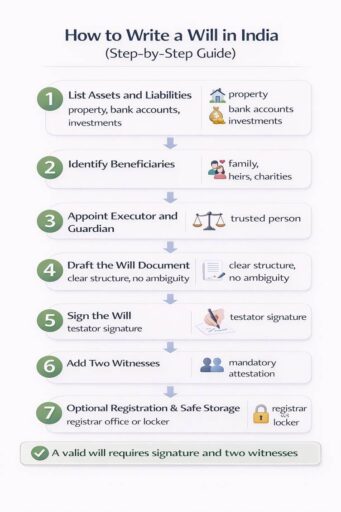
Writing a will in India follows a simple step-by-step process: list assets and beneficiaries, decide distributions, draft the document, sign it, and have it witnessed, with optional registration and safe storage.
The process should align with Sections 59 and 63 of the Indian Succession Act.
Step-by-step process to write a will
1. List all assets and liabilities. Prepare a clear inventory of all movable and immovable assets and any loans or guarantees.
Note joint holdings and nominations to avoid conflict between nominations and will instructions.
2. Identify beneficiaries and shares. Decide who should receive which assets and in what proportion, including alternate beneficiaries if someone predeceases you.
Consider dependants, special needs family members, and desired charitable gifts.
3. Appoint an executor and a guardian. Choose a trustworthy adult as executor to carry out your will; you may appoint more than one.
If you have minor children, name a guardian and an alternate guardian, with clear powers and responsibilities.
4. Draft the will document. Start with a clear identification of yourself (name, age, address) and a declaration that this is your last will.
Include clauses on revocation of previous wills, asset distribution, specific bequests, residue of the estate, executor’s powers, and guardianship.
5. Execute (sign) the will correctly. Sign or affix your mark at the end of the will in the presence of at least two witnesses, who also sign in your presence.
Ensure witnesses are adults of sound mind and preferably not major beneficiaries to avoid challenges.
6. Optional registration and safe storage. You may register the will with the local Sub-Registrar to create an official record, though it is not mandatory.
Store the original in a safe place (locker, bank safe custody, or with a trusted person/lawyer) and inform the executor where it is kept.
How do you make a valid will in India?
The best way is to keep the Indian will simple, clear, legally compliant, and easy to prove, with professional help where the estate is complex.
Ambiguity and informal oral directions should be avoided.
- Use plain language, avoid contradictions, and ensure every asset is either specifically bequeathed or covered under a residuary clause.
- For large or multi-jurisdictional estates, consult an estate planning lawyer or wealth manager to cover tax, foreign assets, and cross-border succession issues.
What Can Be Included In A Will in India?
A will in India can cover almost all types of assets you legally own, along with directions about guardianship, debts, and funeral wishes.
You can include both movable and immovable assets, including future interests you expect to receive.
You may also specify charitable bequests, set up simple family arrangements, and appoint executors and guardians for minors.
- Immovable property such as houses, flats, plots, and agricultural land.
- Movable assets such as bank accounts, FDs, mutual funds, shares, bonds, insurance proceeds (subject to nomination rules), vehicles, jewellery, and valuables.
- Digital assets (online accounts, domains, crypto), business interests, partnership shares, intellectual property rights, and any other transferable rights.
What information is needed to draft a will?
To draft a clear will, you need full details of your assets, beneficiaries, and key persons involved.
- Asset details: property addresses, bank and demat details, policy numbers, and folio numbers.
- Beneficiary details: full names, relationships, addresses, and identification references (e.g., PAN or Aadhaar).
- Executor and guardian details: names, relationships, and consent.
What Is The Format Of A Will In India?
There is no fixed legal format, but a standard structure makes the will easier to understand and enforce.
Common sections include:
- Title
- Declaration
- Revocation clause
- Asset and beneficiary details
- Executor appointment
- Guardian appointment
- Signature
- Attestation block
Using numbered paragraphs and clear headings reduces the risk of misinterpretation.
Can you write a will on a piece of paper?
Yes, a will in India can be written on plain paper; there is no requirement to use stamp paper. What matters is that it is properly executed and attested.
- A handwritten or typed will on plain paper is valid if signed and witnessed as per Section 63.
- However, clear writing, legibility, and complete details are important to avoid disputes about words or intent.
What makes a will legally valid in India?
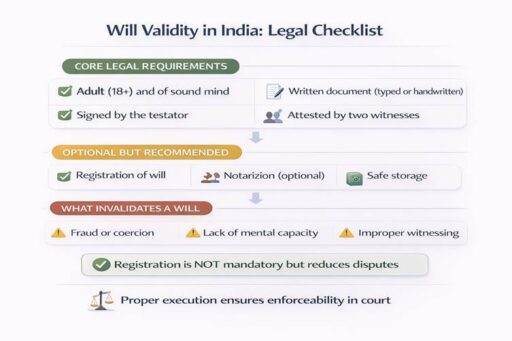
A will is valid if the testator has capacity, acts voluntarily, and follows statutory execution requirements.
- Section 59 (capacity) and Section 63 (execution) of the Indian Succession Act lay down the core validity requirements.
- The will must clearly express the intention to dispose of property after death, identify the testator and beneficiaries, be signed by the testator, and be attested by two witnesses.
Do You Need A Lawyer To Make A Will In India?
You do not legally need a lawyer to make a will in India, but legal advice is recommended for complex estates or sensitive family situations.
Any competent adult can write a will without a lawyer as long as legal requirements for capacity, execution, and attestation are met.
A lawyer can help ensure compliance with the Indian Succession Act and reduce future litigation risk.
A wealth manager may also be useful where the will forms part of broader estate planning involving trusts, succession planning, tax exposure, or multi-jurisdiction assets.
For NRIs, business owners, or those with multiple properties, professional drafting is more important.
Self-drafted wills should still follow a structured format, avoid contradictory clauses, and mention revocation of earlier wills.
Independent witnesses who understand that they are witnessing your will should sign with date and place.
Can a will be notarized in India?
Notarization of a will is not legally required, but some people get it notarized as an extra proof of execution.
Registration and notarization are distinct.
Notarization alone does not convert an invalid will into a valid one; execution must still follow Section 63.
Courts give more weight to proper attestation and, where applicable, registration than to notarization alone.
Is It Mandatory To Register A Will In India?
No, it is not mandatory to register an Indian will.
The Registration Act, 1908, under Section 18, treats registration of wills as optional.
An unregistered will can still be valid and enforceable if properly executed and proved.
Courts, including the Supreme Court, have held that non-registration does not, by itself, make a will invalid.
Registration is often recommended to reduce the chances of tampering or allegations of forgery.
How much will it cost to register a will in India?
Registration costs vary by state, but generally, stamp duty is not payable on wills, and registration fees are nominal.
State registration department websites provide specific fee schedules.
- Typical charges may include a small registration fee and service charges fixed by the state government.
- For exact amounts, check your State Registration Department portal.
Is a registered will valid forever in India?
A registered will remains valid until it is revoked, replaced by a later will, or declared invalid by a court.
There is no expiry period under the Indian Succession Act.
- Section 62 allows revocation or alteration at any time while the testator is competent, so a later valid will overrides an earlier registered one.
- Registration does not freeze the will; the testator can still execute a new will or codicil.
Can A Will Be Contested In India?
Yes, a will can be contested in India on grounds such as lack of capacity, undue influence, fraud, forgery, or improper execution.
Contests typically arise during probate or succession proceedings.
Objectors may question the testator’s mental state, question suspicious circumstances, or allege coercion.
Courts examine evidence around execution, medical records, and witness testimony to decide validity.
Can a registered will be changed in India after it is written?
Yes, a registered will can be changed or revoked by the testator at any time while competent. Registration does not prevent executing a fresh will.
- A new will with a clear revocation clause normally overrides earlier wills, whether registered or not.
- The testator may also execute a codicil to modify specific clauses without rewriting the entire will.
Can a will be changed after death?
No, a will in India cannot be changed after the testator’s death; only courts can interpret or invalidate it. Beneficiaries themselves cannot legally amend its contents.
- Parties may, however, enter separate family settlements about how to share property, but that is outside the will.
- Probate courts can refuse to grant probate if the will is proved invalid, but they do not edit the will.
How often should a will be reviewed?
Review your will every 2–3 years or whenever a major legal, personal, or financial change occurs.
Regular reviews ensure asset lists, beneficiaries, and tax or regulatory considerations stay current.
If the will still reflects your wishes and circumstances, you may keep it unchanged, but record the review date.
If small changes are needed, use a codicil; for major changes, execute a fresh will clearly revoking previous wills.
When Should You Update Your Will?
You should update your will whenever there is a major change in your life, assets, or family structure.
A static will can quickly become outdated and misaligned with your true intentions.
- Common triggers include marriage, divorce, birth or adoption of children, death of a beneficiary or executor, or major asset changes.
- Changes in tax law or succession law affecting your community may also justify a review.
Is it necessary to update a will?
It is not legally mandatory to update a will, but it is practically necessary to keep it accurate and effective.
Outdated wills can cause disputes and unintended distributions.
- If a named asset is sold or replaced, but the will is not updated, beneficiaries may lose out unless the will has a proper residuary clause.
- If relationships change or new dependants emerge, failing to update the will can leave them unprotected.
What Are The Common Mistakes To Avoid When Making A Will In India?
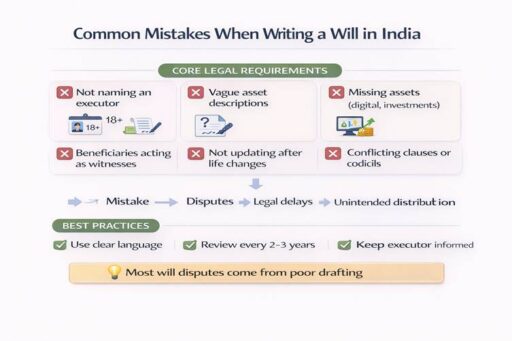
The most common mistakes when making a will in India include failing to appoint a competent executor, using unclear or vague wording for assets and beneficiaries, and omitting key assets.
Most problems arise from unclear drafting or poor execution.
- Not naming an executor or naming someone unwilling or incapable of acting.
- Vague descriptions of assets or beneficiaries, leading to confusion about who gets what.
- Failing to account for all assets, including new investments, digital assets, and foreign holdings.
- Allowing major beneficiaries or their spouses to act as witnesses, which can lead to allegations of undue influence.
- Not updating the will after major events or writing contradictory codicils without legal review.
Avoiding common mistakes is key to preventing disputes and ensuring your will is honored.
FAQs
Is a handwritten will valid in India?
Yes, a handwritten (holograph) will is valid in India if the testator has capacity and it is signed and attested by two witnesses as required by Section 63.
Does a will need to be witnessed in India?
Yes, an unprivileged will must be attested by at least two witnesses who have seen the testator sign or have received personal acknowledgment of the signature.
Can an NRI make a will in India?
Yes, an NRI can make a will in India for assets located in India, and may also need separate wills for assets in other countries, coordinated to avoid conflicts.
On what grounds can a will be challenged in India?
A will can be challenged for lack of testamentary capacity, undue influence, fraud, forgery, suspicious circumstances, or non-compliance with execution and attestation requirements.
Is an unregistered will valid?
Yes, an unregistered will can be perfectly valid if properly executed; registration is optional under Section 18 of the Registration Act, 1908.
Pained by financial indecision?

Adam is an internationally recognised author on financial matters with over 830million answer views on Quora, a widely sold book on Amazon, and a contributor on Forbes.