A second passport for Afghanistan citizens is most realistically pursued through residency and humanitarian pathways in countries like Germany, Canada, and Turkey, while investment-based options in St. Kitts and Nevis and Dominica remain available but less accessible.
These options provide a legal pathway to improved global mobility, security, and long-term opportunities beyond the limits of an Afghan passport.
This article covers:
- Can you have dual citizenship in Afghanistan?
- Why do Afghans flee their country?
- Where do most Afghans migrate to?
- What is the best second citizenship for Afghans?
- What is the easiest second citizenship to get?
Key Takeaways:
- Afghan passport holders have access to only around 30 visa-free or visa-on-arrival destinations.
- Second passport options vary by profile, including investment, residency, and humanitarian pathways.
- Dual citizenship laws in Afghanistan remain unclear and inconsistently applied.
- A second passport can improve mobility, security, and economic opportunities.
My contact details are hello@adamfayed.com and WhatsApp +44-7393-450-837 if you have any questions.
For digital nomad or residence visas that require income, assets, or qualifying investments, we can help structure suitable investment solutions that may align with those requirements, depending on your circumstances.
The information in this article is for general guidance only, does not constitute financial, legal, or tax advice, and may have changed since the time of writing.

Does Afghanistan allow dual citizenship?
Afghanistan does not officially recognize dual citizenship under its nationality laws, particularly under Article 7 of the Afghan Citizenship Law, which states that an Afghan citizen cannot be in the status of dual citizenship.
However, the legal framework is inconsistent and partially conflicting with later constitutional developments and real-world practice.
- Citizenship Law (Article 7): Prohibits dual citizenship in principle.
- 2004 Constitution (post-2001 reforms): Introduced limited tolerance of dual nationality in practice, especially for returning diaspora, although restrictions remain for high-ranking officials.
- Government restrictions: Dual nationals are typically barred from senior public offices (e.g., president, ministers) unless they renounce other citizenships.
- Practical reality: Many Afghans, especially those abroad, hold dual citizenship without enforcement, due to legal gaps and evolving governance.
In addition, Afghan law has historically followed a single nationality principle, meaning acquiring another citizenship could risk loss of Afghan nationality, although this is not consistently applied.
Because of these contradictions between statutory law, constitutional practice, and enforcement, Afghanistan’s position on dual citizenship remains legally ambiguous.
Anyone pursuing a second passport should seek professional advice to avoid conflicts or unintended loss of nationality.
Why are Afghans leaving their country?
Afghans are leaving their country primarily due to ongoing conflict, economic collapse, and humanitarian crises following the Taliban takeover of Afghanistan in 2021, which severely disrupted security, livelihoods, and basic services.
Several factors contribute to emigration from Afghanistan:
- Security concerns and instability: Continued violence, threats to personal safety, and risks for specific groups (e.g., journalists, women, former government workers)
- Economic hardship: Widespread unemployment, sanctions, and reduced international aid have led to a sharp decline in income and business activity
- Political uncertainty: Governance changes and lack of international recognition have created long-term instability
- Humanitarian crisis: Limited access to food, healthcare, and essential services has affected millions
- Education restrictions: Especially impacting women and girls, limiting future opportunities
These overlapping pressures have forced many Afghans to seek safety, stability, and better prospects abroad, often through migration, asylum, or resettlement pathways.
Where do Afghan immigrants go?
Afghan immigrants primarily go to neighboring countries like Pakistan and Iran, as well as to Europe and North America through asylum pathways, while high-net-worth individuals (HNWIs) pursue residency and citizenship options in investment-friendly countries.
Afghan migrants tend to relocate to nearby regions and developed countries:
- Neighboring countries like Pakistan and Iran
Host the largest Afghan populations due to proximity and established migration routes - Europe, particularly Germany
A major destination for asylum seekers and long-term protection - North America, including Canada and the United States
Known for refugee resettlement and humanitarian entry programs - Regional hubs like Turkey and United Arab Emirates
Popular for business, temporary residence, and as stepping stones to other countries - For HNWIs: investment and residency destinations
Wealthier Afghans often pursue structured second residency or citizenship in countries like Turkey, Portugal, and Caribbean programs such as St. Kitts and Nevis or Dominica
What is the best country to get a second passport?
The best second passports for Afghan citizens come from a mix of long-term immigration routes (Germany, Canada), accessible investment programs (Turkey), and fast-track Caribbean citizenship options (St. Kitts and Nevis, Dominica).
The top second citizenship option depends on budget, timeline, and eligibility.
- Turkey
- Pathway: Citizenship by investment (real estate purchase)
- Key requirements: Property investment (commonly ~$400,000), due diligence checks, proof of legal funds
- Why it’s ideal for Afghans: Fast processing, regional accessibility, and relatively flexible entry requirements compared to Western programs
- Portugal
- Pathway: Residency by investment leading to citizenship (long-term route)
- Key requirements: Qualifying investment, legal residency maintenance, basic integration requirements
- Why it’s ideal for Afghans: Access to EU mobility, stability, and a strong long-term settlement pathway
- St. Kitts and Nevis
- Pathway: Direct citizenship by investment (donation or real estate)
- Key requirements: Investment starting around $250,000+, strict background checks
- Why it’s ideal for Afghans: One of the fastest second passport programs globally with strong visa-free travel benefits
- Dominica
- Pathway: Citizenship by investment (donation or real estate)
- Key requirements: Lower investment threshold (starting ~$200,000), due diligence screening
- Why it’s ideal for Afghans: More affordable entry point into citizenship-by-investment programs
- Asylum and humanitarian routes
- Countries like Germany and Canada provide protection-based pathways for Afghan citizens through asylum claims or resettlement programs.
- Pathway: Asylum applications or government/UN-linked resettlement
- Key requirement: Demonstrated protection need based on conflict, persecution, or humanitarian risk
- Why it fits Afghans: No investment requirement and access is based on eligibility rather than capital, with potential long-term residency and eventual citizenship outcomes
- Additional viable options:
- Grenada, Antigua and Barbuda, Saint Lucia – Similar Caribbean CBI programs with fast processing and varying investment thresholds
- Vanuatu – Fast-track citizenship with lower entry cost but more limited global travel power
- Egypt and Jordan – Regional alternatives offering investment-based citizenship with geographic proximity advantages
What is the easiest 2nd passport to get?
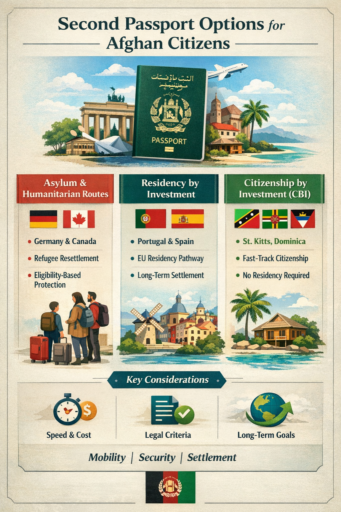
The easiest second passports for Afghans are typically obtained through citizenship by investment programs in countries like Antigua and Barbuda, Dominica, and St. Kitts and Nevis, while longer-term residency pathways exist in countries such as Greece and Spain.
Easiest refers to speed, low residency requirements, and predictable approval processes, though all routes still require background checks and proof of legal funds.
The main pathways fall into three categories:
Citizenship by investment (CBI)
Caribbean countries like Antigua and Barbuda, Dominica, and St. Kitts and Nevis offer citizenship within months, usually without long-term residence requirements.
Residency → naturalization
Countries like Greece (around 7 years) and Spain (around 10 years) offer structured but longer pathways to citizenship, requiring residence and integration.
Asylum or humanitarian programs
Some Afghans may qualify for protection in countries such as Canada, based on eligibility and risk factors.
How strong is the Afghan passport?
The Afghan passport is one of the weakest passports in the world, offering around 30 visa-free or visa-on-arrival destinations, and consistently ranking at or near the bottom of global passport strength indices.
Afghan passport ranking in global indices
| Index | Latest ranking (approx.) | Notes |
| Henley Passport Index | 101st | Extremely low mobility score due to minimal visa-free access |
| Arton Capital Passport Index | 94th | Very weak global access and limited travel privileges |
| Nomad Capitalist Passport Index | 199th | Poor overall score factoring taxation, visa access, perception, and global reputation |
Note: Rankings and access figures fluctuate slightly year to year based on diplomatic updates and visa policy changes.
What are the benefits of having a dual citizenship?
Dual citizenship provides Afghan citizens with greater global mobility, improved access to healthcare, stronger economic opportunities, and enhanced personal security by allowing legal residence and work rights in more than one country.
Holding dual citizenship can offer significant advantages:
- Greater travel freedom with visa-free access to more countries, reducing reliance on visa applications and travel restrictions
- Access to better education and healthcare systems, often at subsidized or higher-quality public institutions in the second country
- Expanded business and investment opportunities, including the ability to open companies, own property, and access new markets more easily
- Security and stability in times of political uncertainty, providing an alternative place to live if conditions change in the home country
- Ability to live and work in multiple countries, offering flexibility for career growth, relocation, or family settlement options
For Afghans, these benefits can be life-changing, particularly in improving long-term mobility, safety, and economic prospects.
What are the risks of dual citizenship?
Dual citizenship can expose Afghan citizens to conflicting legal obligations, potential double taxation, mandatory military service in some countries, and possible restrictions or complications in maintaining Afghan nationality rights.
- Legal conflicts between two countries’ laws, which can create uncertainty over issues like inheritance, custody, or legal jurisdiction
- Tax obligations in multiple jurisdictions, where individuals may be required to report or pay taxes in both countries
- Military service requirements in some countries, which may still apply even if the individual primarily resides abroad
- Potential loss of Afghan rights or recognition, especially in cases involving public office eligibility or nationality disputes
Careful planning is essential to avoid unintended consequences, particularly when laws between the two countries are not aligned.
Most Recommended Pathways by Profile for Getting a Second Passport
The most suitable route for Afghan citizens hinges on financial capacity, eligibility, and long-term relocation goals, with different pathways generally recommended for individual circumstances.
High-net-worth individuals (HNWIs)
For applicants with significant capital, investment-based citizenship routes are typically considered most appropriate due to their structured approval systems and reduced reliance on long-term residence requirements.
- Best aligned with applicants prioritizing administrative speed and predictability
- Requires strong financial documentation and compliance transparency
- Typically used as a diversification tool for global mobility planning
Middle-income applicants
For those without access to large capital, structured residency pathways are generally more practical, even though they require longer time frames before citizenship is granted.
- More dependent on sustained legal residence and integration conditions
- Suitable for gradual relocation planning rather than immediate passport acquisition
- Often chosen when long-term settlement is the primary objective
Refugees and humanitarian applicants
For individuals in protection-based situations, eligibility-driven systems remain the most relevant pathway, as access is based on risk profile rather than financial or investment criteria.
- Determined primarily by protection assessment outcomes
- Focused on legal safety and long-term resettlement stability
- Highly case-dependent with variable timelines
Conclusion
A second passport for Afghanistan is ultimately not a single upgrade decision, but a reflection of how mobility is structured in a world where access is increasingly tiered by law, capital, and eligibility.
The practical reality is that most viable routes sit in completely different systems, each operating under its own logic rather than a shared pathway.
What this means in practice is that outcomes are less about choosing the right country and more about matching the right legal mechanism to the applicant’s circumstances at a specific point in time.
A fast-track citizenship program, a decade-long residency route, and a protection-based resettlement process are not alternatives on the same scale; they are fundamentally different categories of migration access.
Seen this way, second citizenship for Afghanistan is less a product to be selected and more a multi-stage outcome shaped by constraints, timing, and eligibility filters.
FAQs
What country won’t allow dual citizenship?
Several countries do not allow or strictly restrict dual citizenship, including China and India, while others such as Saudi Arabia generally prohibit it with limited exceptions.
What are the 4 types of citizenship?
The four main types of citizenship are birth, descent, naturalization, and investment, which define how a person acquires nationality based on location, ancestry, residency, or financial contribution.
What is the main reason for refugees in Afghanistan?
The main reason for refugees from Afghanistan is ongoing insecurity and political instability, which has been intensified by conflict and the 2021 government takeover, leading to widespread economic and humanitarian hardship.
These conditions continue to force many Afghans to seek safety abroad.