A second passport for Argentina is most commonly pursued through Spain, Portugal, Italy, and select Caribbean citizenship-by-investment programs because Argentina allows dual and multiple citizenship without requiring renunciation of the original nationality.
It is often used to gain stronger global mobility, economic stability, and access to more powerful travel documents.
This article covers:
- Does Argentina allow multiple passports?
- Why did so many people migrate from Argentina?
- Where do most Argentines migrate to?
- What is the best second passport for Argentines?
Key Takeaways:
- Argentina permits dual citizenship with no mandatory renunciation.
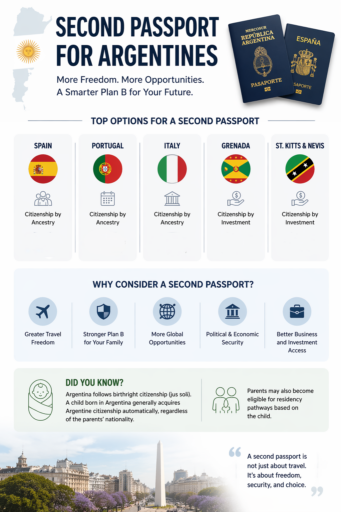
- Spain, Portugal, Italy, and Caribbean programs are top options for a second passport for Argentines.
- Citizenship by descent and investment are the fastest global routes for Argentines.
- A second citizenship for Argentina improves mobility but may create tax/legal complexity.
My contact details are hello@adamfayed.com and WhatsApp +44-7393-450-837 if you have any questions.
For digital nomad or residence visas that require income, assets, or qualifying investments, we can help structure suitable investment solutions that may align with those requirements, depending on your circumstances.
The information in this article is for general guidance only. It does not constitute financial, legal, or tax advice, and is not a recommendation or solicitation to invest. Some facts may have changed since the time of writing.

Does Argentina allow dual passports?
Yes, Argentina allows dual and multiple citizenships under its nationality framework.
Argentine nationality law does not require citizens to renounce their original citizenship when acquiring another nationality, making Argentina one of the more flexible jurisdictions for holding multiple passports.
The legal basis comes from constitutional principles on nationality, supported by immigration and civil registry regulations that govern how citizenship is recognized and administered.
- Argentines can hold multiple passports without losing Argentine citizenship
- Foreigners naturalizing in Argentina can often retain their original citizenship, depending on their home country’s laws
- Dual nationality is recognized in line with reciprocity agreements or compatible legal systems
Within Argentina, dual nationals are treated solely as Argentine citizens, regardless of which passport they use for entry.
This means Argentine authorities prioritize Argentine nationality domestically, while other citizenships are mainly relevant for international travel and consular protection abroad.
Which country is best for a second passport for Argentines?
For citizens of Argentina, the best second passport options are Spain, Portugal, Italy, Paraguay, Uruguay, and select Caribbean citizenship-by-investment programs, chosen based on speed, eligibility, and long-term mobility outcomes.
- Route / program: Citizenship by residency (fast-track for Latin Americans)
- Minimum stay: ~2 years of legal residency (one of the fastest in Europe)
- Requirements to consider: Legal residence, integration, background check, basic Spanish integration proof
- Investment requirement: None (standard residency route; some use work, self-employment, or passive income visas)
- Why it’s ideal: Fast EU citizenship pathway, strong passport access, cultural and linguistic compatibility for Argentines
- Route / program: Residency → citizenship pathway (e.g., D7 visa, digital nomad visa, or investment residency)
- Minimum stay: ~5 years
- Requirements to consider: Legal residency maintenance, basic Portuguese language requirement at citizenship stage (A2 level), proof of income or funds depending on visa type
- Investment requirement: Not mandatory for citizenship (investment routes such as the Golden Visa exist, typically starting around €250,000, but citizenship is based on maintaining legal residency rather than investing itself)
- Why it’s ideal: Stable EU base, flexible residency options, strong quality of life, and consistent path to EU citizenship
- Route / program: Citizenship by descent (jure sanguinis)
- Minimum stay: No fixed residency requirement if claiming by descent (process is documentation-based)
- Requirements to consider: Proof of uninterrupted Italian lineage, complete civil documentation, and eligibility under recently tightened jure sanguinis rules, including stricter generational limits and increased documentation scrutiny.
- Investment requirement: None
- Why it’s ideal: Full EU citizenship without residency if eligible, strong passport, and high global mobility
- Route / program: Citizenship by descent (Foreign Births Registration)
- Minimum stay: No residency requirement if eligible through ancestry registration
- Requirements to consider: Proof of Irish ancestry (typically parent or grandparent born in Ireland), registration in the Foreign Births Register, and verified civil documentation
- Investment requirement: None
- Why it’s ideal: Strong EU citizenship pathway for those with Irish heritage, relatively simple administrative process, and highly relevant for Argentines due to significant historical Irish migration links
- Route / program: Residency → naturalization
- Minimum stay: Paraguay ~3 years; Uruguay ~3–5 years (varies by integration and residency status)
- Requirements to consider: Physical presence, clean criminal record, proof of income or self-sufficiency
- Investment requirement: None (residency is typically low-cost or income-based)
- Why it’s ideal: Simple legal systems, regional mobility, low barriers to entry, and flexible long-term settlement options
Caribbean citizenship-by-investment (e.g., Grenada, St Kitts & Nevis)
- Route / program: Citizenship by investment (CBI programs)
- Minimum stay: Usually none or minimal (no long-term residency requirement)
- Requirements to consider: Government due diligence checks, financial proof, application approval
- Investment requirement: Yes, typically a minimum of US$200,000
- Why it’s ideal: Fastest route to a second passport (often 3–6 months), visa-free travel benefits, and no relocation requirement
Which country has the most Argentina immigrants?
Spain hosts the largest Argentine diaspora, with over 400,000 people born in Argentina living there, making it the top destination globally for emigrants from Argentina.
The main countries with the largest Argentine communities are:
- Spain
- United States
- Chile
- Brazil
- Paraguay
Spain leads primarily due to shared language, historical migration links, and easier access to citizenship pathways for Latin Americans.
It also offers EU mobility, which makes it especially attractive for Argentines seeking long-term relocation and a stronger second passport strategy.
Why do people emigrate from Argentina?
People emigrate from Argentina mainly due to recurring economic instability, inflation, and uncertainty around long-term financial security, which have remained persistent even after periods of partial stabilization in Argentina.
Key drivers include:
- Persistent inflation and economic instability
- Currency devaluation and savings erosion
- Limited high-income job opportunities in some sectors
- Better education, healthcare, and institutional stability abroad
- Growing interest in global mobility and second citizenship options
Overall, emigration is typically driven by a mix of financial pressure and long-term planning, with many Argentines viewing relocation or a second passport as a practical form of security rather than a lifestyle choice.
Is Argentina a strong passport?
The passport of Argentina is considered mid-tier globally, offering visa-free or visa-on-arrival access to around 160 destinations, but it remains outside the top tier in global mobility rankings.
Passport strength in major global indices
| Index | Ranking (latest available range) | Key insights |
| Henley Passport Index | 15th | Based purely on visa-free access and travel freedom; Argentina performs well regionally but ranks lower due to visa requirements for US, Canada, and parts of Schengen |
| Arton Capital Passport Index | 13th | Uses a broader scoring system including UN mobility data and passport strength parity; Argentina ranks lower due to fewer reciprocal visa agreements with high-income countries |
| Nomad Capitalist Passport Index | 48th | Factors in tax policy, dual citizenship friendliness, perception, and global lifestyle freedom; Argentina ranks lower due to economic instability despite decent travel access |
Why is it good to have two passports?
Having two passports gives Argentine citizens access to expanded international access, stronger legal and economic flexibility, and an additional layer of security in case conditions in Argentina change in the future.
Holding dual citizenship offers several advantages:
- More visa-free travel options, allowing easier entry to countries with fewer visa restrictions
- Access to multiple residency and work rights, enabling the ability to live and work legally in more than one country
- Economic diversification, including the ability to hold bank accounts, manage assets, and access different currencies and investment environments
- Backup citizenship in case of political or economic instability, providing an alternative legal residence option if conditions worsen domestically
- Education and healthcare access in more than one country, expanding opportunities for personal development and long-term security
What is the negative side of dual citizenship?
While dual citizenship can significantly expand opportunities for citizens of Argentina, it can also create tax obligations in more than one country, legal complexity, and compliance burdens.
- Double taxation risks in some cases, depending on tax residency rules and treaties between countries
- Military service obligations in certain countries, which may still apply regardless of dual nationality status
- Complex legal and reporting requirements, including disclosure of foreign assets, income, or bank accounts
- Potential conflicts of law between two countries, especially in areas such as inheritance, family law, or taxation
- Banking and compliance complications, including stricter due diligence checks for dual nationals in international financial systems
Best Second Passport Strategy Based on Different Profiles
The best strategy for a second passport for Argentina is strongly influenced by income level, ancestry eligibility, timeline expectations, and long-term mobility goals.
Different profiles benefit from very different pathways.
Young professionals / digital workers
- Best options: Spain, Portugal
- Why: Accessible residency visas (work, remote income, or self-employment routes); long-term EU mobility and strong career opportunities
- Strategy: Build legal residency first, then transition to EU citizenship over time
Ancestry-eligible applicants
- Best options: Italy, Ireland, Spain (fast-track cases)
- Why: Citizenship can be obtained through lineage rather than investment or long residency; direct access to EU citizenship without major financial requirements
- Strategy: Prioritize document verification and eligibility confirmation early
High-net-worth individuals
- Best options: Caribbean citizenship-by-investment (e.g., Grenada, St Kitts & Nevis)
- Why: Fast processing and no residency requirement; portfolio diversification
- Strategy: Use investment-based programs for immediate second passport diversification
Regional movers (South America-focused lifestyle)
- Best options: Paraguay, Uruguay
- Why: Simplified residency, cultural proximity, and relatively flexible naturalization rules; low-barrier alternative base with regional mobility benefits
- Strategy: Obtain residency first, then maintain physical presence for citizenship eligibility
Conclusion
Planning a second citizenship for Argentines is ultimately a form of risk management as much as it is a mobility upgrade.
The most effective outcomes come from understanding how different legal systems convert time, ancestry, or capital into citizenship, and choosing the structure that best matches one’s personal constraints.
What becomes clear across all pathways is that citizenship value is not static.
A passport gained through ancestry can outperform one acquired through investment in long-term utility, while slower residency-based routes can produce the most stable legal foundations over time.
The trade-off is not simply speed versus strength, but predictability versus flexibility.
Another key insight is that eligibility is often more important than optimization.
Many of the strongest routes, particularly Italy and Ireland, are not about strategy execution but about documentation precision and timing.
In contrast, residency and investment programs reward planning discipline and financial readiness rather than heritage.
In reality, successful second passport strategies tend to be built backwards: starting from the desired level of global access and then working toward the most realistic legal pathway to reach it, rather than selecting the most popular option upfront.
FAQs
How hard is it to get an Argentinian citizenship?
Naturalization in Argentina is relatively straightforward.
In most cases, foreigners can apply after 2 years of legal residency, provided they demonstrate integration and stable living conditions.
What happens if a foreigner gives birth in Argentina?
A child born in Argentina generally acquires Argentine citizenship automatically, regardless of the parents’ nationality, as Argentina follows birthright citizenship (jus soli).
Parents may also become eligible for residency pathways based on the child.
When should I use my second passport?
A second passport should be used when it offers stronger visa-free access, better entry conditions, or more effective consular support than your primary passport.
It is also useful for optimizing visa duration, simplifying travel logistics, or improving privacy depending on the destination.
What is the strongest passport in the world?
The strongest passports in the world include Singapore, Japan, Germany, South Korea, Finland, and Spain, along with a small group of other high-ranking EU countries such as France, Italy, and the Netherlands.
These countries consistently provide near-visa-free access to most global destinations.