A second passport for Colombians typically involves obtaining citizenship in countries like Portugal, Spain, Uruguay, or Caribbean nations such as Dominica and St. Kitts & Nevis, with the aim of improving global mobility and access to stronger travel rights.
For many Colombians, this serves as a practical pathway to overcome visa restrictions, expand visa-free travel access, and gain legal options for living, working, or settling abroad.
This article covers:
- Does Columbia accept dual citizenship?
- Why do people migrate from Colombia?
- Where are the Colombian migrants now?
- What is the best second passport to have for Colombians?
- Which country gives the easiest passport?
- Is it worth it to have two passports?
Key Takeaways:
- Colombia permits dual citizenship, so second passports are legally accessible
- Spain is a top option due to a relatively fast citizenship eligibility for Colombians
- The Colombian passport offers moderate travel freedom
My contact details are hello@adamfayed.com and WhatsApp +44-7393-450-837 if you have any questions.
For digital nomad or residence visas that require income, assets, or qualifying investments, we can help structure suitable investment solutions that may align with those requirements, depending on your circumstances.
The information in this article is for general guidance only. It does not constitute financial, legal, or tax advice, and is not a recommendation or solicitation to invest. Some facts may have changed since the time of writing.

Can a Colombian have two passports?
Yes. Citizens of Colombia are allowed to hold dual or multiple citizenships without losing their Colombian nationality.
Since constitutional reforms in 1991, Colombia has recognized dual citizenship.
However, when entering or leaving Colombia, dual citizens are required to use their Colombian passport.
The second passport is mainly used for travel and residency rights in other countries.
It is also important to note that acquiring a second citizenship for Colombia does not cancel legal or civic obligations, such as tax residency rules that may still apply depending on where a person lives and earns income.
Why are people migrating from Colombia?
People are migrating from Colombia mainly due to persistent economic pressure, security concerns in certain regions, and limited upward mobility compared to opportunities abroad.
In recent years, higher living costs, youth unemployment challenges, and uneven recovery after inflation spikes have also reinforced the push to seek stability outside the country.
While Colombia has made significant progress in stability and development, challenges remain.
Many Colombians also migrate to diversify their income opportunities and gain access to international residency or citizenship pathways.
Where do Colombian migrants go?
Colombian migrants primarily move to a small number of high-demand destinations, with over one-third living in the United States alone.
As per Cancilleria migration data, the largest destinations include:
- United States – The largest destination, especially cities like Miami, New York, and Houston
- Spain – Popular due to language and historical ties
- Chile – Strong labor migration destination in South America
- Canada – Skilled migration and study pathways
- Italy and other EU countries – Family and work opportunities
The United States remains the primary destination due to job availability, higher wages, and large established Colombian communities, which make integration easier for new migrants.
Which country is best for a second passport for Colombians?
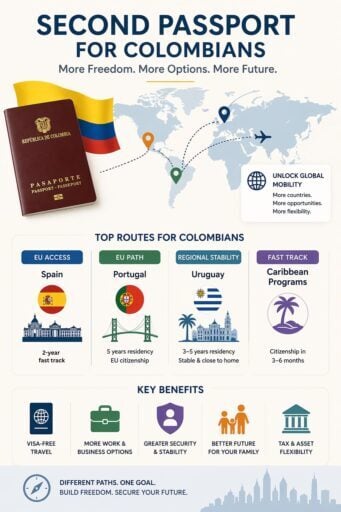
For Colombians, the best second passport options are Spain, Portugal, Uruguay, and Caribbean citizenship programs like Dominica or Saint Kitts and Nevis, each offering a different balance of speed, cost, and long-term flexibility.
- Spain
- Route: Residency → citizenship
- Key requirement: Legal residence (work, study, or non-lucrative visa)
- Timeline: 2 years to citizenship for Colombians
- Investment: Not required (unless using investor visa routes)
- Why it’s ideal: Fastest naturalization pathway for Colombians due to historical ties, plus full access to the EU
- Portugal
- Route: Residency (e.g., investment, D7 passive income, or other visas) → citizenship
- Key requirement: Maintain legal residency and minimal physical presence
- Timeline: 5 years to citizenship
- Investment: Optional (€250,000 to €500,000 for investment route)
- Why it’s ideal: Flexible residency rules, strong passport, and access to the EU with relatively low stay requirements for Colombians
- Uruguay
- Route: Residency → citizenship
- Key requirement: Establish residence and demonstrate ties to the country
- Timeline: 3–5 years depending on individual circumstances
- Investment: Not strictly required, but proof of income or economic activity is needed
- Why it’s ideal: Stable country, relatively straightforward legal process, and culturally accessible for Colombians
- Dominica / Saint Kitts and Nevis
- Route: Citizenship by investment
- Key requirement: Government-approved donation or real estate investment
- Timeline: ~3–6 months
- Investment: Typically starts around $200,000-$250,000
- Why it’s ideal: Fastest way to obtain a second passport for Colombia, with no residency requirement and expanded visa-free travel
For many Colombians, Spain stands out as the most strategic option due to its uniquely fast citizenship timeline and access to the entire European Union.
What is the easiest 2nd passport to get?
The easiest second passports to obtain for Colombians include Spain (fastest low-cost route after residency), Dominica or Saint Kitts and Nevis (fastest overall via investment), and lesser-known programs like Vanuatu or São Tomé and Príncipe that offer simplified pathways but come with limitations.
Fast and straightforward options
- Spain (best balance of ease + value)
- Route: Residency → citizenship
- Timeline: 2 years
- Why it’s easy: Special fast-track for Colombians
- Drawback: Requires relocation and physical presence
- Dominica / Saint Kitts and Nevis (fastest overall)
- Route: Citizenship by investment
- Timeline: 3–6 months
- Why it’s easy: No residency, remote process
- Drawback: Expensive and not tied to major economic regions
Lesser-known easy but limited passports
- Vanuatu (fast but weaker passport)
- Route: Citizenship by investment
- Timeline: 1–3 months
- Requirement: Donation-based program
- Why it’s easy: One of the fastest processing times globally
- Drawback: Lost visa-free access to the Schengen Area, limiting its usefulness
- São Tomé and Príncipe (low-profile, emerging option)
- Route: Investment / naturalization pathways
- Timeline: around 2 months processing; 5 years of legal residency for naturalization
- Why it’s easy: Lower demand, simpler processing compared to major programs; application can be fully remote
- Drawback: Very limited global mobility and less-established program credibility
- Nauru (emerging and uncertain CBI program)
- Route: Citizenship by investment (new program launched 2024–2025)
- Timeline: 3–6 months (reported processing window)
- Why it’s easy: Low entry cost compared to Caribbean programs and no residency requirement
- Drawback: Very new program with limited track record and higher policy uncertainty compared to established CBI countries
Reality check (important for credibility)
Some passports are easy because:
- They require money instead of residency, or
- They have less strict due diligence, or
- They are simply less powerful and less in demand
How strong is the Colombian passport?
The Colombia passport offers moderate global mobility, with visa-free or visa-on-arrival access to around 130–140 destinations, giving it mid-tier global ranking compared to stronger EU or North American passports.
Colombian passport rankings
| Index | Rank | Key insights |
| Henley Passport Index | 34th | Strong in Latin America and parts of Asia; limited access to Schengen, US, and Canada without visas |
| Arton Capital Passport Index | 31st | Slightly more optimistic scoring; still reflects visa barriers to North America and much of Europe |
| Nomad Capitalist Passport Index | 77th | Ranks lower due to taxation, citizenship freedom, and perceived global mobility constraints |
What are the benefits of becoming a dual citizen in Colombia?
Becoming a dual citizen allows Colombians to hold two nationalities simultaneously, giving them expanded travel access, stronger residency rights abroad, and improved long-term economic and lifestyle flexibility.
- Greater travel freedom with multiple passports
- Access to better education and healthcare systems
- Right to live and work in two countries
- Business and investment flexibility
- Protection during political or economic instability
- Easier global mobility for family members
For Colombians, dual citizenship often serves as a long-term financial and mobility strategy rather than just a travel upgrade.
What are the disadvantages of dual citizenship?
Dual citizenship in Colombia can create legal, tax, and administrative complications, including potential double taxation, compliance burdens, and conflicting obligations between two countries.
- Possible double taxation obligations depending on countries involved
- Complex legal and administrative requirements
- Military service obligations in some countries
- Conflicting legal duties between countries
- Higher cost and time investment to maintain compliance
It’s important to understand both countries’ laws before holding multiple passports.
Tax and residency implications of dual citizenship for Colombians
Holding dual citizenship for Colombians is mainly a legal and mobility benefit, but it does not automatically simplify tax obligations or remove residency-based responsibilities across countries.
Key points to understand:
- Colombia taxes individuals based on tax residency, not citizenship, meaning obligations depend on where you live and your center of economic activity rather than your passport alone
- Becoming a citizen of another country does not automatically exempt you from Colombian tax residency rules if you continue living or earning significant income in Colombia
- Some countries may apply worldwide taxation based on residency or citizenship, which can create overlapping reporting requirements
For personalized planning and compliance considerations, many individuals consult financial advisors in Colombia specializing in cross-border taxation and residency strategy.
Conclusion
A second passport for Colombians is ultimately about building long-term optionality, reducing dependence on a single legal, economic, and travel system while gaining the flexibility to shift where life, work, and opportunity are based.
What stands out is that there is no single optimal route. Spain offers the clearest legal fast-track into the EU, Caribbean programs prioritize speed over depth, and regional options like Uruguay or Latin America-based residency pathways trade time for stability and familiarity.
The right choice depends on how much time, capital, and relocation flexibility someone is willing to commit.
At the same time, the value of dual citizenship is often misunderstood.
The passport itself is only one layer; the real impact comes from tax residency, physical presence, and long-term legal obligations, which can be just as important as visa-free travel benefits.
FAQs
Why is Colombia on the red list?
Some countries or older travel advisories have historically flagged Colombia due to security concerns linked to certain regions and past instability.
However, most modern risk assessments are now region-specific rather than country-wide, and major cities are widely considered safe for tourism and business.
Why are so many Colombians coming to the US?
Many Colombians move to the United States due to higher wages, stronger job opportunities, and established migrant communities that make relocation easier.
The persistent economic gap between Colombia and United States remains the main long-term driver of this migration trend.
Which countries can Colombians visit without a visa?
Colombians can travel visa-free or with visa-on-arrival to countries such as Brazil, Peru, Ecuador, Chile, Thailand, Indonesia, and several Caribbean nations, as well as most of South America and parts of Central America.
How to get Colombia citizenship?
Colombian citizenship is typically obtained through birth in Colombia, descent from Colombian parents, naturalization after around 5 years of legal residency, or marriage to a Colombian citizen with residency requirements.