A second passport for Panama is possible, but dual citizenship rules vary by origin.
Birthright citizens can hold another nationality, while naturalized citizens are required to renounce their previous citizenship and may risk losing Panamanian nationality if they acquire another.
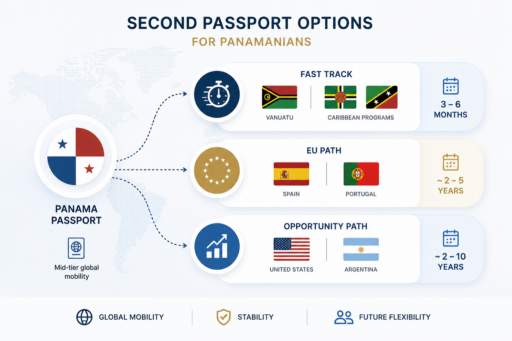
Panamanians can pursue a second passport through legal residency and naturalization in countries such as the United States, Spain, Portugal, and Caribbean citizenship-by-investment programs.
This topic is most relevant for investors, long-term residents, and expats seeking greater flexibility or a more stable base abroad.
This article covers:
- Does Panama allow dual nationality?
- What is the best country to get a second passport?
- What is the fastest way to get a second passport for Panamanians?
- How powerful is the Panamanian passport?
- What are the advantages and disadvantages of dual citizenship?
Key Takeaways:
- Panama allows dual citizenship in practice, though naturalization may require formal renunciation in procedure.
- Planning for a Panama second citizenship typically focuses on countries with faster or stronger passport routes abroad.
- The Panamanian passport is mid-tier globally, offering moderate travel freedom.
- A second citizenship for Panama provides mobility and financial flexibility but can involve tax and legal complexities.
My contact details are hello@adamfayed.com and WhatsApp +44-7393-450-837 if you have any questions.
For digital nomad or residence visas that require income, assets, or qualifying investments, we can help structure suitable investment solutions that may align with those requirements, depending on your circumstances.
The information in this article is for general guidance only. It does not constitute financial, legal, or tax advice, and is not a recommendation or solicitation to invest. Some facts may have changed since the time of writing.

Does Panama allow multiple citizenships?
Panama does not formally recognize dual or multiple citizenship for naturalized citizens, and the legal framework requires applicants to renounce their previous nationality during the naturalization process.
In practice, outcomes vary based on whether the applicant’s original country enforces renunciation.
Naturalization requires a declaration of intent and an oath of renunciation as part of the citizenship process.
This applies mainly to residency-based citizenship routes.
Citizenship treatment also differs by origin:
- Birthright citizens generally retain Panamanian citizenship even if they acquire another nationality
- Naturalized citizens are subject to renunciation rules and risk loss of citizenship if they later acquire another nationality
As a result, dual nationality operates in a practical gray area where legal requirements and enforcement do not always fully align.
Which country is best for a second passport for Panamanians?
Based on Panama’s citizenship framework, the best countries for a second passport for Panamanians commonly include the United States, Spain, Portugal, Paraguay, and select Caribbean CBI countries, based on goals such as mobility, cost, and speed.
Each option differs significantly in requirements, timeline, and accessibility:
- Routes: Family sponsorship, employment visas, or long-term residency (Green Card)
- Key requirements: Sponsorship, work eligibility, or family ties
- Investment: Not required for standard immigration routes (EB-5 exists for investors)
- Timeline: 5 years to citizenship depending on pathway
- Why it’s relevant: Largest Panamanian diaspora, strong job market, and education opportunities
- Routes: Naturalization after legal residency or ancestry (for some Latin Americans)
- Key requirements: Legal residency and integration (language/cultural ties)
- Investment: None, as there is no CBI route
- Timeline: 2 years for Latin Americans in some cases
- Why it’s relevant: Historical ties with Latin America and EU passport access after naturalization
- Routes: Residency visa (D7, D8, or investment routes)
- Key requirements: Proof of income or qualifying investment
- Investment: Typically ranges from €250,000 to €500,000, depending on the route)
- Timeline: 5 years to citizenship
- Why it’s relevant: One of the easiest EU residency-to-citizenship pathways with strong mobility benefits
- Routes: Permanent residency leading to naturalization
- Key requirements: Residency maintenance and basic documentation
- Investment: No fixed investment requirement; typically involves demonstrating economic solvency (e.g., local bank deposit of around $5,000 or proof of stable income)
- Timeline: 3 years residency before eligibility
- Why it’s relevant: One of the simplest long-term residency programs in Latin America
Caribbean Citizenship-by-Investment Countries
(e.g., Dominica, St. Kitts & Nevis, Antigua and Barbuda)
- Routes: Direct citizenship by donation or investment
- Key requirements: Clean background check and qualifying investment
- Investment: Typically $200,000+ depending on country and family size
- Timeline: 3–6 months
- Why it’s relevant: Fastest legal Panama second passport option with strong travel mobility
Which country gives the quickest citizenship?
The quickest countries to obtain second citizenship for Panamanians are Vanuatu (as fast as 1–3 months), Dominica and St. Kitts and Nevis (3–6 months), followed by Turkey (6–12 months), and faster residency-based options like Spain (2 years for Latin Americans) and Argentina and Dominican Republic (both 2 years).
In Latin America, Argentina and Dominican Republic stand out as the only countries with citizenship timelines of around 2 years, making them the fastest non-investment options in the region.
- Caribbean nations (e.g., Dominica, St. Kitts and Nevis, Antigua and Barbuda)
– Timeline: 3–6 months
– Key consideration / drawback: Requires a non-refundable government donation or real estate investment; limited physical residency but upfront cost is significant - Vanuatu
– Timeline: 1–3 months
– Key consideration / drawback: Fastest option available, but passport strength and visa-free access are more limited than Caribbean programs - Turkey
– Timeline: 6–12 months
– Key consideration / drawback: Higher investment threshold (e.g., real estate), but offers access to a large economy and long-term residency benefits - Spain
– Timeline: 2 years (for Latin American nationals, including Panamanians)
– Key consideration / drawback: Requires actual residency and integration; not passive like investment programs - Argentina
– Timeline: 2 years of residency before applying
– Key consideration / drawback: Requires physical presence and legal process can be inconsistent despite short legal timeline - Dominican Republic
– Timeline: 2 years of residency before naturalization eligibility
– Key consideration / drawback: Requires maintaining legal residency status and meeting integration requirements; slower administrative processing in some cases
Where is the largest diaspora of Panamanians?
The largest Panamanian diaspora is in the United States, with an estimated over 200,000 Panamanians or Panamanian-origin residents, making it by far the main destination, followed by smaller but established communities in Spain and nearby Latin American countries.
- United States
– Largest community
– Major hubs: Florida, New York, California
– Driven by education, military ties (historic Panama Canal Zone links), and job opportunities - Spain
– One of the fastest-growing destinations for Latin American migrants
– Attracts Panamanians through language, residency options, and EU mobility potential - Colombia
– Regional mobility and border proximity
– Common for work, trade, and education - Costa Rica
– Close geographic and cultural ties
– Popular for employment and regional relocation - Venezuela
– Historically significant but smaller today due to economic shifts
– Some Panamanian families and mixed migration flows
Why are people leaving Panama?
People are leaving Panama mainly due to economic mobility gaps, rising urban living costs, and limited high-paying career specialization compared to larger economies like the United States.
Key reasons include:
- Higher-paying jobs abroad
– Many Panamanians move to the US and Spain for stronger salaries and broader job markets - Education opportunities
– Studying in countries like the US or Europe offers more specialized programs and international credentials - Family migration patterns
– Established diaspora networks in the US and neighboring countries encourage chain migration - Cost of living in urban areas (especially Panama City)
– Rising housing and daily expenses push some residents to seek more affordable locations - Limited local career specialization
– Certain professional or technical fields have fewer high-level opportunities domestically
At the same time, Panama continues to attract expatriates and retirees due to its dollarized economy, relatively stable banking system, and retiree-friendly visa programs, making it both a sending and receiving country in global migration flows.
Is Panama a strong passport?
The Panamanian passport is a moderately strong travel document, offering visa-free or visa-on-arrival access to around 140 countries, placing it in the mid-to-upper tier globally but below top-tier EU and Asian passports.
| Index | Ranking | Key insights |
| Henley Passport Index | 25th | Focuses on pure travel freedom (visa-free/visa-on-arrival access only); Panama ranks mid-tier globally |
| Arton Capital Passport Index | 27th | Uses a broader real-time mobility model including visa-free, visa-on-arrival, and eTA access, resulting in a similar upper-mid global ranking |
| Nomad Capitalist Passport Index | 67th | Weighs broader factors beyond travel (taxation, perception, dual citizenship flexibility, global reputation), not just visa-free access |
Is there an advantage to dual citizenship?
Yes, dual citizenship is particularly advantageous for Panamanians because it expands global mobility beyond Panama’s mid-tier passport and improves access to higher-income job markets.
It can also support more efficient cross-border tax planning and wealth structuring when coordinated with professional financial guidance.
- Expanded travel freedom – Combines Panama’s access with stronger passports for broader visa-free travel
- Better job opportunities – Opens access to higher-paying labor markets abroad
- Improved education and healthcare – Access to stronger public systems and universities
- Greater financial flexibility – Easier cross-border banking, investing, and asset diversification
- Risk diversification – Provides a backup citizenship during economic or political instability
For Panamanians, dual citizenship is often less about identity and more about strategic mobility and financial optionality, especially given Panama’s role as a regional financial hub and transit economy.
What are the negatives of dual citizenship?
For Panamanians, dual citizenship can create legal and financial complications, especially when managing obligations between Panama and a second country with different tax, residency, or citizenship rules.
- Double taxation risk – Income or assets may be taxed in both countries depending on residency rules
- Military obligations – Some countries still require compulsory service from citizens
- Compliance burden – More complex reporting across different legal and tax systems
- Restricted public roles – Certain government or security positions may be off-limits
- Legal conflicts – Inheritance, tax, and exit rules may not align between jurisdictions
Panama as a Tax and Financial Base for Dual Citizens
For many dual citizens, Panama functions as a strategic financial base due to its territorial tax system, dollarized economy, and established banking sector.
Panama taxes only income generated within the country, making it attractive for individuals with foreign-sourced earnings such as investments, remote work, or international business activity.
This allows for legal tax efficiency while maintaining stable residency.
Key advantages include a US dollar–based economy that reduces currency risk and simplifies international transactions, along with a developed banking system that supports corporate structuring and regional business operations.
Its geographic position as a logistics and financial hub in Latin America also supports cross-border asset management and company setup.
As a result, Panama is often used as a base for wealth and mobility planning alongside holding a stronger second passport elsewhere.
Conclusion
Panama sits in a unique position in global citizenship planning: it is not a fast-track passport or a top-tier travel document, but it remains structurally useful within broader mobility and wealth strategies.
Its role is most relevant when viewed alongside other jurisdictions rather than in isolation.
Panama provides continuity, banking access, and territorial tax treatment, while other citizenships typically carry the weight of global mobility or relocation rights.
For most individuals, the key decision is about how it fits into a multi-country structure that balances residency, taxation, and travel access across different systems.
FAQs
Is it hard to get a Panama passport?
Yes, it is moderately difficult compared to Caribbean programs.
To qualify for a passport from Panama, you typically need 3–5 years (in some cases up to 10 years) of legal residency, along with good conduct, stable immigration status, and evidence of integration into Panamanian society before naturalization eligibility.
Which is the toughest citizenship to get?
Some of the toughest citizenships to obtain include Switzerland, Japan, Saudi Arabia, and China, due to strict residency requirements, long naturalization timelines, and highly selective approval processes with very limited acceptance rates.
What is the weakest passport?
The weakest passports are typically those with the lowest visa-free access globally, including Afghanistan, Syria, Iraq, and Yemen, due to conflict, instability, and limited diplomatic agreements resulting in very restricted travel freedom.
How many citizenships can you have in Panama?
Panama does not impose a strict limit on the number of citizenships a person can hold.
However, in practice, dual or multiple citizenship is governed by how nationality is acquired.
Birthright citizens can generally retain Panamanian nationality while acquiring another, while naturalized citizens are typically required to renounce their previous citizenship and may face restrictions if they acquire another nationality later.
The total number of citizenships a person can hold ultimately depends on the laws of each other country involved, as some allow multiple nationality while others restrict or revoke it.