Digital nomads can generate investment income globally, but tax rules, residency status, and investment structure determine whether that income supports or limits long-term mobility.
Without clear tax planning and jurisdictional alignment, global investment income can become inefficient or unintentionally taxable.
This article covers:
- What exactly do digital nomads do?
- What is the average salary of a digital nomad?
- Do you have to pay tax if you’re a digital nomad?
- Is investment income included in taxable income?
- What are some smart investments?
- Where do digital nomads pay income tax?
- Which country has the best taxes for digital nomads?
Key Takeaways:
- Stocks, ETFs, real estate, and mutual funds are top investment options for digital nomads.
- Investment income is generally taxable, even while traveling.
- Choosing a tax-friendly country can reduce global tax obligations.
- Diversifying income streams ensures mobility and long-term financial security.
My contact details are hello@adamfayed.com and WhatsApp +44-7393-450-837 if you have any questions.
The information in this article is for general guidance only. It does not constitute financial, legal, or tax advice, and is not a recommendation or solicitation to invest. Some facts may have changed since the time of writing.

Who qualifies as a digital nomad?
A digital nomad is someone who works remotely while living a location-independent lifestyle.
While travel is a defining trait, what truly qualifies someone as a digital nomad is the ability to work and earn without being tied to a specific country.
Digital nomads prioritize flexibility, choosing destinations based on lifestyle, cost of living, or tax advantages rather than permanent residency.
Importantly, being a digital nomad isn’t just about traveling; it’s about having the financial and professional freedom to work from anywhere in the world.
How much do digital nomads earn?
Digital nomads typically earn between $1,000 and $10,000+ per month, with freelancers and remote employees often at the lower to mid-range and entrepreneurs or investors earning higher amounts.
These earnings can come from a mix of online work, such as freelancing, consulting, remote jobs, or running digital businesses.
Many digital nomads also supplement their income with passive revenue streams, including dividends, rental properties, online courses, or other investment income.
Location can influence earnings as well. Living in countries with a lower cost of living allows nomads to maintain a comfortable lifestyle even with modest income, while high-earning nomads can save or reinvest a significant portion of their revenue.
Ultimately, income levels are shaped by the combination of skills, experience, type of work, and the ability to leverage investment income effectively for long-term financial freedom.
Smart Investment Income Options for Digital Nomads
Digital nomads can earn flexible income through investments like ETFs or rental properties, which allow them to grow wealth while staying location-independent.
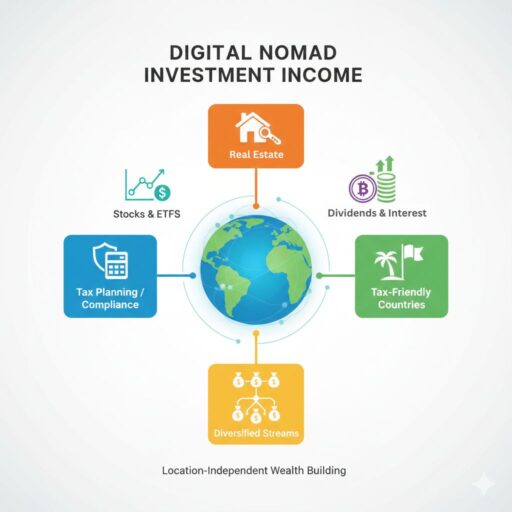
- Location-independent investments: Online stocks, ETFs, and cryptocurrency can be managed entirely online. These assets provide global access without the need for a fixed address.
- Low-maintenance investments: Dividend-paying stocks, REITs, and automated investment platforms generate steady passive income with minimal day-to-day involvement, letting nomads focus on travel or remote work.
- Tax-efficient investments: Assets held in favorable jurisdictions, certain foreign ETFs, or real estate with tax benefits can reduce overall tax liability. Understanding local laws and taking advantage of exemptions or treaties can optimize returns legally.
Do digital nomads pay income tax?
Yes, digital nomads are generally required to pay income tax, with obligations determined by tax residency rules, local laws, and international tax treaties.
Depending on where they are considered tax residents, nomads may be taxed on locally sourced income, worldwide income, or a combination of both.
This tax responsibility applies not only to active income from remote work or freelancing, but also to investment income, including dividends, interest, rental income, and capital gains.
Even when earnings come from foreign brokers, offshore accounts, or digital platforms, most tax authorities require disclosure and reporting.
Some countries offer favorable tax regimes or incentives for digital nomads, while others impose taxes on global income once residency thresholds are met.
Without proper planning, earning income across multiple jurisdictions can lead to double taxation or unexpected liabilities.
Who do you pay taxes to if you are a digital nomad?
Digital nomads are generally required to pay taxes to the country where they are considered a tax resident.
Most countries tax residents on worldwide income, meaning all earnings, including foreign income, may be subject to taxation.
Some countries, however, only tax income sourced locally, so income earned outside the country may not be taxed.
Depending on individual circumstances, digital nomads may need to:
- Declare income in their home country if they maintain tax residency or citizenship obligations.
- Pay taxes in the country where they reside temporarily, if their stay meets residency thresholds (commonly 183 days or more).
- Use tax treaties between countries to prevent double taxation and take advantage of exemptions or credits.
What is the tax strategy for digital nomads?
Digital nomads can legally minimize taxes and protect their income by strategically planning residency, diversifying income, and using tax-efficient structures.
A clear, proactive approach allows them to maintain mobility while complying with global tax laws.
Effective strategies include:
- Residency planning: Establish tax residency in countries with low or favorable tax rates. Some nations offer special digital nomad visas or incentive programs that reduce income tax on earned or investment income. Understanding the residency rules including the 183-day rule or local thresholds, is essential to avoid unintentional tax obligations.
- Income diversification: Combine earned income from remote work with tax-efficient investment income, such as dividends, ETFs, or real estate in favorable jurisdictions. Diversifying income sources helps digital nomads maintain financial stability and reduces the risk of being heavily taxed in a single location.
- Leveraging tax treaties: Use double taxation treaties between countries to avoid paying taxes twice on the same income. Tax treaties often allow exemptions, credits, or reduced rates for foreign-earned income, which can significantly lower overall tax liability.
- Retirement accounts and offshore investments: Utilize accounts that defer taxes or benefit from favorable treatment abroad. Offshore or international retirement accounts, along with certain investment structures, can legally reduce taxes while providing long-term wealth accumulation.
Which country has the best taxes for digital nomads?
Countries like Portugal, Georgia, Estonia, Barbados, Bermuda, and Croatia are considered among the best for digital nomads due to their favorable tax rules, digital nomad visa programs, and incentives for remote workers.
Choosing a location with a tax-friendly environment can significantly reduce obligations on both earned and investment income, while providing legal certainty for mobile professionals.
- Portugal: While the old Non‑Habitual Resident (NHR) regime has ended for new applicants, Portugal still offers tax incentives through the Incentive Fiscal for Scientific Research and Innovation (IFICI) program, sometimes called NHR 2.0. IFICI can provide a 20% flat tax rate on qualifying Portuguese income and exemptions on certain foreign‑source income for up to 10 years if you meet eligibility criteria (including residency and engagement in qualifying activities).
- Georgia: Through the Remotely from Georgia program, freelancers pay a flat 1% tax on income up to a certain threshold. This makes Georgia extremely attractive for digital nomads looking for minimal taxation combined with a low cost of living.
- Estonia: Known for its e-Residency program, Estonia allows digital entrepreneurs to establish and run businesses online. Its tax system is simple and business-friendly, with deferred corporate tax on reinvested profits and clear rules for digital income.
- Barbados, Bermuda, and Croatia: These countries offer short-term digital nomad visas with relaxed or no local income taxes for foreigners, making them suitable for nomads who prefer shorter stays or seasonal mobility while enjoying low-tax regimes.
Digital nomads vs perpetual travelers
Digital nomads maintain income streams while traveling, whereas perpetual travelers avoid establishing residency anywhere to minimize taxes and obligations.
Digital nomads often rely on semi-permanent residencies or visa-based stays, which provides stability for reporting and tax planning.
Perpetual travelers must navigate more complex strategies to prevent global taxation, making investment income management more challenging.
For nomads, this means clearer rules and potential treaty protections, while perpetual travelers face uncertainty across multiple jurisdictions.
Understanding these differences helps mobile professionals choose the approach that best balances freedom, income, and tax efficiency.
Conclusion
Financial freedom for digital nomads comes from aligning income, investments, and location choices with long-term goals.
Strategic planning across tax obligations, investment types, and residency turns mobility into an advantage rather than a complication.
By approaching income and wealth management deliberately, nomads can create a lifestyle where travel, growth, and financial security reinforce each other.
In the end, successful digital nomads are those who make every decision, from investments to country choice, serve both freedom and sustainability.
FAQs
What are the different types of digital nomads?
Digital nomads are generally classified as fully nomadic workers, slow or seasonal nomads, and perpetual travelers.
Fully nomadic workers move frequently between countries while earning online income, while slow or seasonal nomads stay in each location for several months, often following climate or personal schedules.
Perpetual travelers avoid establishing residency anywhere to reduce taxes and maintain flexibility.
Do digital nomads get taxed twice?
Potentially, yes. Without careful planning, you may face taxation in your home country and country of residence.
Tax treaties often mitigate this.
Is income from virtual digital assets taxable?
Yes. Cryptocurrency gains, NFTs, and other digital assets are typically taxable as capital gains in most countries.
Which country is best for digital nomad?
The United Arab Emirates (UAE) is one of the top choices due to its 0% personal income tax and modern infrastructure, making it ideal for remote workers.
Other popular destinations include Spain, Croatia, and Estonia, which offer digital nomad visas, reliable internet, and good quality of life.
Many nomads also consider cost of living, climate, and local communities when choosing a country to live and work in.
Pained by financial indecision?

Adam is an internationally recognised author on financial matters with over 830million answer views on Quora, a widely sold book on Amazon, and a contributor on Forbes.