Portugal is considered the cheapest and safest country to retire in, offering a balance of affordable living, strong healthcare, and secure environments.
Other top options include Costa Rica and Malaysia, which also combine low costs with safety and quality healthcare.
Retiring abroad requires careful planning to balance cost, safety, healthcare access, and lifestyle preferences for a comfortable and worry-free retirement.
This article covers:
- What country is the safest and cheapest to live in?
- Which country is best for senior citizens?
- How much money do you really need to retire comfortably?
- What is the best age to move abroad?
Key Takeaways:
- Retirement costs vary from $800–$5,000/month by country and lifestyle.
- Safety, healthcare, and legal protections are essential.
- Taxes, income, and residency rules require planning.
- Timing and destination affect comfort and long-term well-being.
My contact details are hello@adamfayed.com and WhatsApp +44-7393-450-837 if you have any questions.
The information in this article is for general guidance only. It does not constitute financial, legal, or tax advice, and is not a recommendation or solicitation to invest. Some facts may have changed since the time of writing.

Where is the cheapest place to live when you retire?
The cheapest countries to retire in are Vietnam, Philippines, Thailand, Ecuador, Bulgaria, Romania, and Poland, where low housing, food, and daily expenses allow retirees to live comfortably on modest budgets.
Southeast Asia:
- Philippines: Based on Numbeo data, the Philippines has a cost of living index of 28.8, with average monthly expenses of about $533 for a single person and $1,892 for a family of four, excluding rent. Overall living costs are 56.1% lower than in the United States, while rent is around 80.4% cheaper, allowing retirees to maintain a comfortable lifestyle at relatively low monthly spending levels, particularly outside major city centers.
- Vietnam: Vietnam has a cost of living index of 26.6, with average monthly expenses of around $436 for a single person and $1,572 for a family of four, excluding rent. Overall living costs are about 11.3% lower than in the Philippines, although rent is roughly 29.5% higher, particularly in major cities. Retirees can still enjoy a very affordable lifestyle, especially in smaller cities and coastal areas where housing costs are more manageable.
- Thailand: Thailand has a cost of living index of 33.7, with estimated monthly expenses of about $633 for a single person and $2,311 for a family of four, excluding rent. Overall living costs are around 28.1% higher than in the Philippines, while rent is significantly higher at roughly 83.5% more, particularly in Bangkok and popular expat hubs. Retirees can reduce costs by living in smaller cities or northern regions, while still benefiting from strong healthcare and infrastructure.
Latin America:
- Ecuador: Ecuador has a cost of living index of 30.0, with estimated monthly expenses of about $512 for a single person and $1,890 for a family of four, excluding rent. Everyday costs such as food, transportation, and utilities remain affordable, making Ecuador attractive for retirees seeking a lower-cost lifestyle with access to private healthcare and established expat communities.
- Mexico: Mexico has a cost of living index of 34.5, with estimated monthly expenses of about $733 for a single person and $2,720 for a family of four, excluding rent. Daily costs such as food, transportation, and services remain relatively affordable, while strong healthcare options and diverse expat communities make Mexico a practical retirement destination across multiple regions.
Eastern Europe:
- Bulgaria: Bulgaria has a cost of living index of 35.4, with estimated monthly expenses of about $722 for a single person and $2,615 for a family of four, excluding rent. Affordable utilities, groceries, and transportation, combined with a lower-cost lifestyle and access to European infrastructure, make Bulgaria an attractive retirement option for budget-conscious expats.
- Romania: A single retiree can live on about $705/month (excluding rent), while a family of four may spend around $2,503/month, making Romania an affordable European retirement option with a cost of living index of 34.0.
- Poland: A single retiree can live on about $865/month (excluding rent), while a family of four may spend around $2,913/month, with a cost of living index of 38.9.
Note on Western Europe:
- Countries like Portugal, Spain, Italy, and France are generally more expensive, with monthly costs often around $3,000–$5,000, making them suitable for retirees with larger budgets.
Where’s the safest place to retire?
The safest countries to retire in are Switzerland, New Zealand, Singapore, and Japan, where extremely low crime, political stability, and high-quality healthcare make them ideal for older adults.
- Switzerland – very low crime and strong public services: Switzerland ranks highly on global safety indexes and has a very low homicide rate, with around 0.49 homicides per 100,000 people, significantly lower than many developed nations. Its combination of political stability, economic security, and high healthcare quality contributes to an excellent overall safety profile.
- New Zealand – peaceful environment and low crime: New Zealand consistently scores near the top of global peace and safety rankings, with a Global Safety Index around 91.7/100 and very low overall crime levels. Its political stability and comprehensive public healthcare support a secure retirement environment.
- Singapore – extremely low crime and strong infrastructure: Singapore is one of the safest countries in the world, with a homicide rate of about 0.25 per 100,000 people, extremely low violent crime, and top‑tier healthcare and public services. Its strict law enforcement and high prevention scores further enhance safety.
- Japan – very low violent crime and reliable public services: Japan’s homicide rate is among the lowest globally, at around 0.21 per 100,000 people, and it ranks high on safety and peace indexes. Coupled with dependable healthcare and efficient public infrastructure, this makes Japan especially safe for retirees.
Where is the safest and most affordable place to retire?
Countries that offer both safety and affordability for retirement include Portugal, Costa Rica, Malaysia, and Slovenia, where low to moderate living costs combine with strong safety records and reliable healthcare systems.
Finding the intersection of safety and affordability is critical. Some top options include:
- Portugal – relatively low cost of living in smaller towns, high safety levels, and a strong public healthcare system
- Costa Rica – moderate living costs, low violent crime, and a high quality of life supported by a solid healthcare system
- Malaysia – affordable daily expenses, low crime rates, and good private healthcare widely used by expats
- Slovenia – lower-cost European living, high safety, and a stable political environment
This balance allows retirees to stretch retirement savings while maintaining personal security.
Which country is senior citizen friendly?
The most senior citizen-friendly countries are Canada, Australia, Portugal, and Spain, as they offer accessible healthcare, age-related social benefits, and legal protections that support older residents.
- Canada – strong healthcare and senior support programs: Canada provides universal public healthcare to residents and offers senior-specific benefits such as the Old Age Security (OAS) pension and Guaranteed Income Supplement (GIS) for low-income retirees, alongside age-friendly housing and transport initiatives.
- Australia – healthcare access and senior concessions: Australia’s Medicare system ensures affordable healthcare for residents, while seniors benefit from age pension programs, discounted public transport, and widespread senior concession cards that reduce everyday living costs.
- Portugal – senior-friendly residency and healthcare access: Portugal allows retirees to access its public healthcare system after residency and is known for age-friendly residency rules, discounted transport for seniors, and municipal programs designed to support older residents, particularly in expat-heavy regions.
- Spain – social protections and long-term residency: Spain offers retirees access to a robust public healthcare system once resident, long-term residence permits, and extensive senior social services, including subsidized transport, community health programs, and strong family and social support structures.
Countries that prioritize healthcare access, legal stability, and age-inclusive public services tend to provide the most supportive environments for retirees and aging populations.
How much money do you need to retire well?
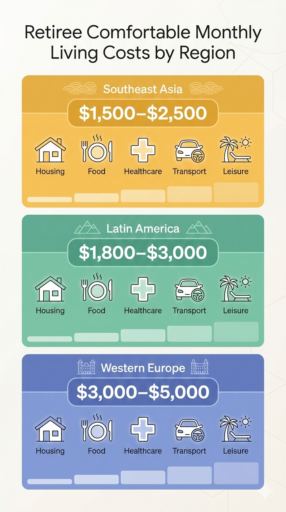
A comfortable retirement generally requires between $1,500 and $5,000 per month.
The exact amount varies by destination, lifestyle choices, and healthcare needs. As a general guide:
- Comfortable retirement in Southeast Asia: $1,500–$2,500 per month
- Comfortable retirement in Latin America: $1,800–$3,000 per month
- Comfortable retirement in Western Europe: $3,000–$5,000 per month
Planning should include housing, healthcare, daily expenses, travel, and an emergency fund for unexpected costs.
What’s the best age to live internationally?
The best age to live internationally is between 55 and 70, when retirees typically have financial stability, good health, and the flexibility to relocate.
Common guidelines include:
- Early retirement (55–65): maximizes active years abroad and allows easier physical and cultural adjustment
- Later retirement (65–75): enables full pension access before moving but may involve greater healthcare and mobility considerations
- Flexible timing: influenced by personal health, family ties, and long-term financial planning
Early preparation and understanding residency, tax, and healthcare requirements help ensure a smooth transition.
What makes for a good retirement country?
A good retirement country balances affordability, safety, healthcare quality, social support, and lifestyle opportunities.
Key factors include:
- Low cost of living relative to income or savings
- Political stability and low crime
- Access to reliable healthcare and prescription medications
- Expat communities and language accessibility
- Climate, cultural amenities, and recreational opportunities
Countries scoring highly across these factors create the most fulfilling retirement experiences.
Conclusion
Over time, factors like currency stability, reliable healthcare, legal protections, and the ability to adjust to changes in health or income often outweigh headline living costs or popular expat rankings.
Retirement abroad is ultimately as much a risk-management decision as it is a lifestyle choice, so there is no universally perfect country.
The most resilient retirement plans are those that allow for flexibility.
Diversifying income sources, maintaining access to familiar healthcare systems, and choosing countries with clear residency and property regulations can protect retirees from unexpected challenges.
When adaptability is built into the plan, living internationally can remain both secure and fulfilling well beyond the early years of retirement.
FAQs
Can I retire at 60 with 300k?
Yes, many retirees can live comfortably with $300,000 if they choose countries with lower costs of living, manage expenses wisely, and consider investment income or pensions.
What countries do not tax US social security?
Countries that generally do not tax US Social Security benefits at the local level include Canada, Costa Rica, Panama, and Mexico, though US federal taxes may still apply and local rules or tax treaties should always be reviewed.
What is the best climate for retirees?
The best climate for retirees is generally mild, moderate, and comfortable year-round, with low humidity and minimal extreme weather.
Many retirees prefer:
-Mediterranean climates – Spain, Portugal, Italy
-Tropical climates – Philippines, Thailand, Costa Rica
-Temperate climates – New Zealand, Canada’s coastal regions
Pained by financial indecision?

Adam is an internationally recognised author on financial matters with over 830million answer views on Quora, a widely sold book on Amazon, and a contributor on Forbes.