Indonesia offers pathways for foreigners over 55 to stay long-term: the Retirement Visa and the Silver Hair Visa.
Both options provide legal residence with different eligibility and income requirements, allowing retirees to enjoy Indonesia’s lifestyle with extended stay permissions.
This article covers:
- How do you get a retirement visa for Indonesia?
- What documents are needed for a retirement visa?
- How much does a retirement visa cost in Indonesia?
- How long does it take for an Indonesian visa to be approved?
- What is the retirement visa age in Indonesia?
Key Takeaways:
- The official retirement visa for Indonesia is the Retirement KITAS.
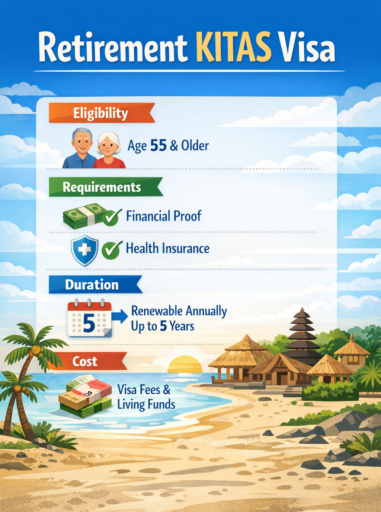
- The visa is initially valid for one year and can be renewed annually for up to five consecutive years.
- Applicants must be at least 55 years old to qualify.
- Eligibility requires proof of financial self-sufficiency and valid health insurance coverage in Indonesia.
My contact details are hello@adamfayed.com and WhatsApp +44-7393-450-837 if you have any questions.
The information in this article is for general guidance only. It does not constitute financial, legal, or tax advice, and is not a recommendation or solicitation to invest. Some facts may have changed since the time of writing.

What is the retirement visa for Indonesia?
Indonesia offers two main long-term stay options for foreigners aged 55 and above: the Retirement Visa and the Silver Hair Visa.
Both visas allow eligible applicants to live in Indonesia without employment, subject to financial, health, and accommodation requirements.
The Retirement Visa, officially for retirees or senior citizens, is issued as a Retirement KITAS, allowing eligible foreigners to reside in Indonesia long-term.
It is designed for retirees who want to enjoy Indonesia’s tropical climate, affordable cost of living, and vibrant cultural lifestyle.
The Silver Hair Visa provides an alternative pathway for seniors, typically aged 60 and above, who wish to reside long-term in Indonesia.
It allows access to banking, healthcare, and property rental, while also supporting hobbies, volunteer work, and social activities.
Both visas provide a legal and flexible way for older foreigners to enjoy a relaxed and financially secure retirement in Indonesia.
How long is a retirement visa in Indonesia?
An Indonesia retirement visa is valid for one year. It is initially issued as a limited stay visa (VITAS) for entry into Indonesia and is converted into a one-year Retirement KITAS after arrival.
It can be renewed annually for up to five consecutive years, as long as retirees continue to meet the required financial, health, and accommodation conditions.
The Silver Hair Visa is designed for seniors aged 60 and above and grants a 5-year KITAS from the start, removing the need for yearly renewals.
For both visas, adhering to Indonesian immigration rules is essential to avoid overstaying.
Many retirees use local agents or visa consultants to ensure smooth processing and proper compliance with all requirements.
How to get a retirement visa in Indonesia?
Foreign retirees can apply for either the Retirement Visa or the Silver Hair Visa through an Indonesian embassy or a licensed agent.
The process generally involves the following steps:
1. Confirm eligibility: Ensure you meet age requirements (55+ for Retirement Visa, 60+ for Silver Hair Visa) and have the necessary financial proof, health coverage, and accommodation.
2. Engage a sponsor or agent: Work with a local sponsor, company, or licensed visa agent to guide the application process.
3. Prepare required documents: Include your passport, proof of income or bank balance, health insurance, accommodation details, and any sponsor letters.
4. Submit the application: Apply through the Indonesian embassy in your home country or via your chosen visa agent.
5. Receive visa approval: Once approved, the Retirement Visa (1-year) or Silver Hair Visa (5-year) is issued.
6. Process KITAS upon arrival: Convert the visa into the corresponding KITAS (limited-stay permit) in Indonesia.
7. Maintain compliance: For the Retirement Visa, renew annually for up to five years. Silver Hair Visa holders must continue meeting visa conditions, though yearly renewal is not required.
What are the requirements for retirement visa in Indonesia?
To qualify for a long-term stay in Indonesia, applicants must meet age, financial, health, accommodation, and passport requirements. The exact criteria is determined by the visa applied for: a Retirement Visa (55+) or a Silver Hair Visa (60+).
| Requirement | Retirement Visa | Silver Hair Visa |
|---|---|---|
| Age | 55 years or older | 60 years or older |
| Financial Proof | Pension or regular income, typically ≥ USD 1,500/month | Sufficient funds or income, usually slightly lower threshold (depends on sponsor) |
| Health Insurance | Valid in Indonesia for duration of stay | Same as Retirement Visa |
| Accommodation | Rental agreement or property ownership | Same as Retirement Visa |
| Employment | Must not intend to work | Must not intend to work |
| Passport Validity | Minimum 18 months from entry date | Same as Retirement Visa |
How much is the retirement visa in Indonesia?
An Indonesian retirement visa typically costs USD 800–USD 1,200 for the initial one-year permit, while a Silver Hair Visa generally costs around USD 1,950–USD 2,012 for a five-year KITAS.
These figures usually cover the basic visa processing and service fees if you apply through a visa agent, but additional expenses can apply.
For the Retirement Visa, annual renewal fees, health insurance premiums, and administrative charges should be budgeted for each year.
The Silver Hair Visa, being valid for five years, avoids yearly renewals, but applicants still need to cover health insurance and any agent or administrative costs upfront.
Actual costs can vary depending on the visa service provider, whether you apply from inside or outside Indonesia, and whether express or priority processing is requested.
Planning for these supplementary fees ensures retirees can accurately estimate the total cost of long-term residence in Indonesia.
How long does it take to get a retirement visa?
The processing time for both the Retirement Visa and the Silver Hair Visa from submitting a complete application to receiving the KITAS, typically ranges from 4 to 8 weeks (approximately 1 to 2 months).
Actual timelines can vary depending on the completeness of documents, the efficiency of the sponsor or agent, whether the application is submitted from inside or outside Indonesia, and the workload at the local Indonesian immigration office.
Applications processed with priority or express service may be completed more quickly, while delays can occur during peak travel seasons or public holidays.
Applicants should also allocate additional time for pre-departure preparations, including gathering required documents, obtaining sponsorship letters, and scheduling consular appointments.
These steps can add several weeks to the overall process, especially for first-time applicants or those applying from abroad.
How much money do I need to retire in Indonesia?
To retire in Indonesia and qualify for the Retirement KITAS, applicants must demonstrate a minimum monthly income of approximately USD 1,500 (or roughly USD 18,000 per year) to show financial self-sufficiency.
Typical monthly living expenses for retirees vary by lifestyle and location:
- Basic/Modest lifestyle: approximately USD 1,200–1,800 per month, covering local housing, food, transportation, insurance, and healthcare.
- Comfortable lifestyle: around USD 1,900–2,500 per month, including higher-quality accommodation, mixed local and Western meals, and leisure or travel activities.
- Upscale/luxury lifestyle: expenditures can exceed USD 3,000 per month for premium housing, frequent dining, and high-end services.
These estimates provide a practical overview for retirement in popular destinations like Bali or Jakarta, while costs are generally lower in smaller cities or rural areas.
Is it good to retire in Indonesia?
Yes, retiring in Indonesia can be an excellent choice for foreign nationals seeking a combination of affordability, cultural richness, and a comfortable tropical lifestyle.
Key advantages include:
- Affordable cost of living: Daily expenses, housing, and services are generally lower than in many Western countries.
- Beautiful beaches and cultural experiences: Indonesia offers world-renowned destinations such as Bali, Yogyakarta, and Lombok, alongside a rich heritage of arts and traditions.
- Expat-friendly communities: Well-established expat networks make integration and socializing easier.
- Access to healthcare: Both private and public healthcare facilities are available, particularly in major cities and tourist regions.
However, retirees should carefully consider language barriers, variable healthcare quality outside major urban areas, and strict visa compliance to ensure a smooth and enjoyable retirement experience.
Practical Tips for Retiring in Indonesia
Successfully retiring in Indonesia goes beyond obtaining a Retirement KITAS or Silver Hair Visa; careful planning ensures a comfortable and fulfilling experience.
Key considerations for a smooth transition include:
- Choosing the right location: Popular destinations like Bali and Jakarta offer vibrant communities and amenities, while smaller cities or rural areas provide lower living costs and a quieter lifestyle. Understanding regional differences in healthcare, infrastructure, and cultural dynamics is essential.
- Healthcare planning: Enroll in comprehensive private health insurance to complement the public system. Familiarize with local hospitals and clinics, especially in regions outside major cities.
- Banking and finances: Open a local bank account for convenience, plan for currency transfers, and ensure regular pension or investment income is accessible. Budgeting for both everyday expenses and emergencies is critical.
- Housing options: Decide between renting or purchasing property, understand local lease agreements, and confirm legal compliance for foreign ownership or tenancy.
- Cultural adaptation: Learn basic Indonesian phrases, respect local customs, and engage with both expat and local communities to foster smooth social integration.
- Visa maintenance: Keep all documentation up to date, track annual KITAS renewals, and work with licensed agents to prevent delays or complications.
Addressing these practical aspects allows retirees to fully enjoy Indonesia’s tropical climate, rich culture, and affordable living while avoiding common pitfalls that can disrupt long-term stays.
Conclusion
Securing a Retirement KITAS or a Silver Hair KITAS shapes retirement in Indonesia as much as personal choice does, defining not only legal residency but the practical framework for living comfortably and securely.
Beyond paperwork and renewals, these visas encourage retirees to plan strategically, from selecting locations and arranging finances to integrating into local communities in ways that align with both regulations and lifestyle goals.
Approached thoughtfully, either visa becomes more than an administrative requirement.
It’s a tool that transforms compliance into long-term stability and meaningful experiences in Indonesia.
Understanding the nuances of both the Retirement and Silver Hair visas early can save time, reduce stress, and allow retirees to fully leverage the benefits of living in one of the world’s most vibrant and diverse countries.
FAQs
What is the rejection rate for Bali visa?
Visa rejections for Bali and other Indonesian visas are not officially published, but applications are commonly rejected when requirements are incomplete or documents are inconsistent.
What is the retirement system in Indonesia?
Indonesia has a multi-tiered retirement system for citizens and formal sector workers, combining government-managed social security with voluntary private plans.
Foreign retirees are not covered by this system and typically rely on personal savings, pensions, or foreign income to support themselves while living in Indonesia.
What are three types of retirement?
Retirement can generally take three forms: active retirement, where individuals pursue hobbies, part-time work, or volunteering; passive retirement, living primarily off pensions or investments; and nomadic retirement, which involves traveling and residing in multiple countries.
Pained by financial indecision?

Adam is an internationally recognised author on financial matters with over 830million answer views on Quora, a widely sold book on Amazon, and a contributor on Forbes.