Creating a will in Canada requires you to put your wishes in writing and sign the document in front of two witnesses (in most provinces) for it to be legally valid.
Beyond that, you’ll need to clearly name beneficiaries, appoint an executor, and follow provincial rules to ensure your estate is handled exactly as intended.
This article covers:
- What is a valid will in Canada?
- Is a self-written will legal in Canada?
- What are the different types of wills?
- How do you write a will?
- How much does a good will cost?
Key Takeaways:
- A valid will in Canada must be written, signed, and follow provincial rules; most formal wills need witnesses, but holographic and notarial wills do not.
- You can make your own will, but errors or non-compliance can invalidate it.
- Certain assets override your will, including insurance beneficiaries, jointly owned property, and trusts.
My contact details are hello@adamfayed.com and WhatsApp +44-7393-450-837 if you have any questions. We also offer bespoke structuring solutions tailored to your situation.
The information in this article is for general guidance only, does not constitute financial, legal, or tax advice, and may have changed since the time of writing.

Why do you need a will in Canada?
You need a will in Canada to legally control how your assets are distributed, who manages your estate, and who cares for your dependents after your death.
Without one, provincial intestacy laws decide who inherits your assets, which may not reflect your wishes.
Key reasons to have a will:
- Decide who receives your assets so your estate is distributed according to your intentions, not default legal rules
- Appoint guardians for minor children to ensure they are cared for by someone you trust
- Minimize family disputes by clearly outlining your wishes and reducing ambiguity
- Speed up the probate process by providing clear instructions to the court and your executor
- Potentially reduce taxes and legal complications through proper estate planning and structuring
What are the different types of wills in Canada?
The main types of wills in Canada include formal wills, holographic wills, joint wills, mirror wills, and living wills, each serving different estate planning needs.
- Formal will (typed and witnessed): This is the most common and legally robust option, typically prepared with legal guidance and signed in front of witnesses
- Holographic will: A handwritten and signed will that can be valid in certain provinces if it meets specific legal criteria
- Joint will: A single will created by two people, usually spouses, though it is rarely used and can create legal complications
- Mirror wills: Separate but nearly identical wills used by couples to reflect similar wishes while maintaining individual control
- Living will: A document that outlines healthcare and end-of-life decisions, but does not replace a last will and testament
Can I do my own will in Canada?
Yes, you can create your own will in Canada using templates or online tools. However, DIY wills come with risks if not done correctly.
You may consider a DIY will if:
- Your estate is simple
- You have few assets
- Your beneficiaries are straightforward
Mistakes in wording, signing, or witnessing can make the will invalid or lead to legal disputes.
Do you need a lawyer to make a will in Canada?
You are not legally required to hire a lawyer, but it is strongly recommended for more complex situations.
A lawyer is especially helpful if:
- You own property in multiple provinces or countries where different laws may apply and create conflicts in your estate
- You have a blended family and need to clearly define how assets are divided among spouses, children, and stepchildren
- You run a business that requires succession planning and proper transfer of ownership
- You want to minimize estate taxes through structured planning and legal strategies
Legal guidance ensures your will is enforceable and tax-efficient.
A wealth manager can also assist by coordinating your estate planning with your broader financial strategy, helping to align your assets, tax planning, and long-term targets.
What are the requirements for a will to be valid in Canada?
A Canadian will is valid if you are at least 18 years old, put your wishes in writing, sign the document, and have it witnessed by two adults (in most provinces).
While rules vary by province, most valid wills must meet these basic criteria:
- You must be of legal age (usually 18 or older) to have the legal authority to create a will
- You must be mentally competent to understand the nature of your assets and the effect of your decisions
- The will must be in writing as oral wills are generally not recognized
- It must be signed by you to confirm that the document reflects your final intentions
- It must be witnessed by two adults (except holographic wills where allowed) who are present at the signing and can attest to its validity
Witnesses should not be beneficiaries, or their inheritance could be invalidated.
How to make a will in Canada
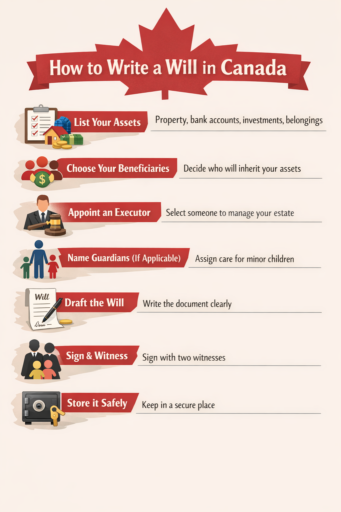
To create a will in Canada, you need to document your assets, name beneficiaries and an executor, and sign the will in accordance with legal requirements.
Follow these steps to write a clear and legally sound will:
1. List your assets: Include all property, bank accounts, investments, and personal belongings to ensure nothing is overlooked.
2. Choose your beneficiaries: Decide who will inherit your assets and specify what each person will receive.
3. Appoint an executor: Select a trusted person who will manage your estate, pay debts, and distribute assets according to your instructions.
4. Name guardians (if applicable): Assign a responsible person to care for minor children if both parents pass away.
5. Draft the will: Write the document clearly using a lawyer or reputable template.
6. Sign and witness the document: For formal wills, sign the will in the presence of two qualified witnesses as required by your province.
7. Store it safely: Keep the will in a secure location and ensure your executor knows where to find it.
Who is the best person to have as executor of your will?
The best person to have as will executor is someone you trust who is organized, financially responsible, and capable of managing legal and financial tasks.
The executor manages your estate, pays debts, and distributes assets.
Choose someone who is:
- Trustworthy and organized so they can follow your instructions accurately and handle paperwork efficiently
- Financially responsible to manage estate funds, settle debts, and oversee distributions properly
- Willing to take on the role because the responsibilities can be time-consuming and complex
- Ideally located in Canada (to simplify legal processes) so they can more easily deal with courts, banks, and other institutions
Common choices include a spouse, adult child, close friend, or a professional executor.
What is the cost of a will in Canada?
In Canada, the cost of making a will typically ranges from virtually nothing for a basic non-professional option to several hundred dollars (or more) for a professionally prepared document, based on complexity and method.
- Self-prepared will: You can write one yourself for free or use inexpensive templates with minimal cost (often under about CAD 100).
- Online will services: Online platforms and guided kits usually cost between about CAD 40 and CAD 300 for a complete, legally valid will.
- Lawyer‑drafted will: A basic will prepared by a lawyer generally costs around CAD 300 to CAD 1,000+, and more complex estate planning can increase fees further.
- Wealth managers / estate planners: For coordinated estate planning (including will guidance), fees typically range from about CAD 1,000 to CAD 5,000+ depending on the advisor, scope of financial planning, number of assets, and complexity of your estate. Some charge a flat project fee, while others include it as part of an ongoing wealth advisory relationship.
Complex estates, additional planning (like trusts or tax strategies), and detailed customization can increase costs but may save money and legal issues over the long term.
What is the cheapest way to make a will?
The most affordable option is a self-prepared or online will, which can be suitable for very simple estates with few assets.
While the upfront cost is low, these wills carry a higher risk of errors, disputes, or invalidation if legal requirements are not fully met.
For estates with even moderate complexity, relying solely on templates or online tools may result in costly corrections or legal challenges later.
Online platforms can provide a reasonable balance between cost and convenience for straightforward situations, but professional legal guidance is strongly recommended for high-net-worth individuals or complex estates.
What is the process with wills in Canada?
After death, a will in Canada must go through probate, a legal process that validates the document, settles debts, and ensures assets are distributed according to the deceased’s wishes.
- The executor locates the will and gathers all relevant documents, financial accounts, and information about the estate
- Files it with the probate court to have the will legally recognized and obtain the authority to act as executor
- Pays outstanding debts and taxes using estate assets, ensuring all liabilities are settled before distributions
- Distributes assets to beneficiaries according to the instructions in the will, completing the estate transfer process
Probate timelines vary by province but generally take several months to over a year, depending on estate complexity and court workload.
Understanding the Will Landscape Across Canada
Wills in Canada are primarily governed at the provincial and territorial level, meaning legal requirements, witnessing rules, and probate processes can differ significantly based on where you live.
High-net-worth individuals with assets in multiple provinces need to understand these nuances to ensure their estate plans are fully enforceable.
Key provincial differences include:
- Age and competency: Most provinces require the testator to be at least 18 years old (e.g., Ontario, British Columbia, Alberta), while Quebec sets the age at 18 but has unique civil law rules regarding capacity and notarization.
- Types of valid wills:
- Formal wills (typed and witnessed) are universally recognized.
- Holographic wills (entirely handwritten) are valid in most provinces except British Columbia.
- Notarial wills are unique to Quebec, where a notary prepares and certifies the document without the need for witnesses.
- Witness requirements: Most provinces require two witnesses who are not beneficiaries. However, provinces like Quebec do not require witnesses for notarial wills.
- Probate processes and fees: Probate fees vary widely. For example, Ontario charges about 0.5%–1.5% of estate value, while British Columbia uses a flat scale of 0.6% on the first CAD 50,000 and 1.4% on amounts above that.
Timelines can range from several months to over a year depending on the estate’s complexity and the province.
- Cross-provincial or multi-jurisdictional estates: Assets located in multiple provinces or countries require careful planning.
Executors may need to file separate probate applications in each province, and different rules can affect taxes, creditor claims, and asset transfers.
For HNWIs, engaging a lawyer with experience in multi-provincial and international estate planning is highly recommended.
Professional guidance ensures your will is enforceable, minimizes tax exposure, and helps prevent disputes across different jurisdictions.
Conclusion
A will in Canada is the foundation of thoughtful wealth stewardship.
For high-net-worth individuals, a well-structured will is a strategic tool that ensures assets are distributed according to your vision while navigating the complexities of provincial laws and multi-jurisdictional holdings.
Choosing the right executor, anticipating tax implications, and incorporating professional guidance can prevent costly disputes and preserve family harmony.
Beyond legal compliance, a carefully crafted will reflects your values, safeguards your legacy, and provides clarity for those you leave behind.
Investing time and expertise into your estate planning today transforms what might seem like paperwork into a long-term strategy for control, efficiency, and peace of mind.
FAQs
What is the most important thing to put in a will?
The most important elements are a clear identification of beneficiaries and the appointment of a reliable executor.
You should also provide specific instructions for asset distribution to prevent disputes and delays.
What is the most common inheritance mistake?
The most common mistake is failing to update a will after major life events such as marriage, divorce, or having children.
Outdated wills can lead to unintended beneficiaries receiving assets.
In which circumstances will a will be invalid?
A will can be invalid if it was not properly signed or witnessed, if the person lacked mental capacity, or if it was created under undue pressure or fraud.
It may also be invalid if it fails to meet the specific legal requirements of the province.
What can override your will?
Certain assets can pass outside your will, including beneficiary designations on insurance policies and retirement accounts, jointly owned property with right of survivorship, and assets held in trusts.
These transfers occur automatically and take precedence over the instructions in your will.
Pained by financial indecision?

Adam is an internationally recognised author on financial matters with over 830million answer views on Quora, a widely sold book on Amazon, and a contributor on Forbes.