Writing a will in Texas involves meeting specific legal requirements, choosing the right format, and properly executing the document to ensure it is valid.
This process determines who receives your assets, who manages your estate, and how smoothly your estate is settled under Texas law.
This article covers:
- What is a valid will in Texas?
- Can you do a will without a lawyer in Texas?
- How to write a simple will in Texas?
- What is the cheapest way to do a will?
- What can I use instead of a will?
Key Takeaways:
- A valid Texas will must be written, signed, and properly witnessed (except for holographic wills).
- Writing your own will is allowed, but errors can cause disputes or probate delays.
- Notarization isn’t required, but a self-proving affidavit speeds up probate.
- Living trusts and beneficiary designations can simplify asset transfer and maintain privacy.
My contact details are hello@adamfayed.com and WhatsApp +44-7393-450-837 if you have any questions. We also offer bespoke structuring solutions tailored to your situation.
The information in this article is for general guidance only, does not constitute financial, legal, or tax advice, and may have changed since the time of writing.

What are the different types of wills in Texas?
Texas law primarily recognizes two valid types of wills—attested wills and holographic wills—while also allowing wills to be made self-proving to simplify probate.
Attested (Formal) Will – This is the most common type of will in Texas.
It is typically typed, signed by the testator, and witnessed by at least two credible witnesses. This format offers stronger legal reliability and is less likely to be challenged.
Holographic Will – A holographic will is entirely handwritten and signed by the testator.
It does not require witnesses, but it must be fully in the testator’s handwriting.
While valid, it can be more difficult to prove and interpret during probate.
Self-Proving Will – This is not a separate type of will but a will that includes a notarized affidavit signed by the testator and witnesses.
A self-proving will can be admitted to probate without requiring witness testimony, making the process faster and more efficient.
Texas no longer recognizes oral (nuncupative) wills made after September 1, 2007, so they should not be relied upon for estate planning.
In practice, most people use an attested will with a self-proving affidavit because it provides stronger legal protection and streamlines probate.
Do you need to file a will with the court in Texas?
You do not need to file your will while you are alive, but after your death, the executor must file the original will with the Texas probate court to begin the probate process.
Keeping the will in a safe but accessible location ensures it can be located and submitted without unnecessary delays.
- Filing is required after death
The executor submits the will to the probate court in the county where the testator resided. Texas law generally allows probate to be initiated within four years of death, although delays can complicate estate administration. - Executor’s role
The executor is responsible for locating the will, filing it, and managing the probate process. If the named executor is unable or unwilling to serve, an alternate executor or interested party can step in. - Initiating probate
Filing the will formally starts probate, which is the legal process of validating the will, paying debts and taxes, and distributing assets to beneficiaries under court supervision.
Can I write a will myself in Texas?
Yes, you can write your own will in Texas.
Texas law allows individuals to create a valid will without hiring a lawyer, as long as the document meets all legal requirements for validity.
This makes DIY wills a practical option for those with simple estates or straightforward asset distribution plans.
However, writing a will yourself comes with risks that should not be overlooked:
- Unclear or ambiguous language
Poorly worded provisions can lead to confusion about your intentions, increasing the likelihood of disputes among beneficiaries. Even small wording issues can significantly affect how assets are distributed. - Failure to meet legal formalities
Missing required elements such as proper signatures or witnesses can render the will partially or entirely invalid. This may result in your estate being distributed under Texas intestacy laws instead of your wishes. - Lack of planning for complex situations
DIY wills often fail to address contingencies, such as what happens if a beneficiary predeceases you or if assets change over time. Without these provisions, your estate plan may not work as intended.
For simple situations, a DIY will may be enough.
For larger or more complex estates, an estate planning attorney or a wealth manager can help coordinate your assets and ensure your plan fits your overall financial strategy.
How to write a will in the state of Texas?
Writing a will in Texas involves documenting your assets, naming beneficiaries and an executor, and properly signing the will in accordance with state legal requirements.
To write a will in Texas, follow these steps:
1. Decide how to create your will. You must choose whether to hire an estate planning attorney, use an online will-making service, or draft the will yourself based on your estate’s complexity and your comfort with legal requirements.
2. List your assets. You should create a detailed inventory of your assets, including real estate, bank accounts, investments, business interests, and personal belongings, to ensure nothing is unintentionally excluded.
3. Name beneficiaries. You need to clearly identify the individuals or entities who will receive your assets, specifying what each beneficiary is entitled to in order to avoid confusion or disputes.
4. Appoint an executor. You must designate a trusted person to act as executor, who will be responsible for filing the will, managing the probate process, paying debts, and distributing assets according to your instructions.
5.Choose guardians (if applicable). If you have minor children, you should name a legal guardian who will take responsibility for their care in the event of your death.
6. Draft and sign the will. You must put the will in writing and sign it to make it legally valid under Texas law.
If you are creating an attested (formal) will, it must also be signed in the presence of at least two credible witnesses, while handwritten wills do not require witnesses.
7. Store the will safely. You should keep the original will in a secure but accessible location and inform a trusted person or your executor where it can be found when needed.
What are the requirements for a will to be valid in Texas?
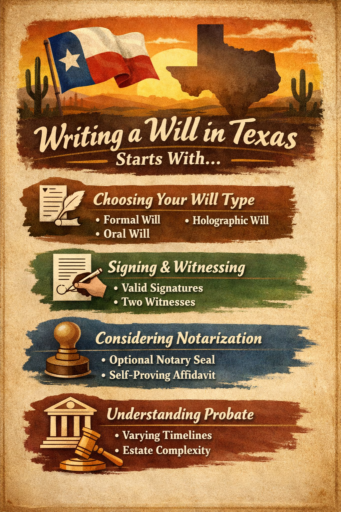
A will is valid in Texas only if it meets specific legal requirements, including that the testator is at least 18 years old, has the necessary mental capacity, and that the document is properly signed and executed according to state law.
- Be created by someone 18 years or older
The person making the will, known as the testator, must be at least 18 years old, which is the minimum legal age to create a binding will in Texas. - Be made by a person of sound mind
The testator must understand the nature of their property, the identity of their beneficiaries, and the effect of signing the will, ensuring they are mentally capable of making informed decisions. - Be in writing
Texas law requires that all wills must be written; verbal or digital-only wills do not satisfy legal standards and will not be recognized by the court. - Be signed by the testator
The testator must personally sign the will to indicate that they approve its contents and intend for it to take effect after their death. - Be witnessed by at least two credible witnesses (for formal wills)
For attested (formal) wills, at least two competent witnesses must observe the signing of the will and then sign it themselves to confirm its authenticity.
Holographic wills do not require witnesses, but they must be entirely handwritten and signed by the testator to be considered legally valid in Texas.
How long does it take to process a will in Texas?
In Texas, probate for a will typically takes 3 to 6 months for simple estates, 6 to 12 months for moderate estates, and over a year for complex or contested estates.
- Simple estates – 3 to 6 months
Estates with minimal assets, no disputes among heirs, and clear documentation usually complete the probate process in a few months. - Moderate estates – 6 to 12 months
Estates that include multiple properties, accounts, or minor complications can take up to a year to fully process. - Complex or contested estates – 1 year or more
Estates with disputes, creditor claims, or complicated asset structures may take a year or longer, especially if litigation or extensive court involvement is required.
Delays often arise from missing documents, challenges by beneficiaries, or unresolved debts, which can extend the probate timeline.
How much does a will cost in Texas?
In Texas, creating a simple will typically costs about $0–$200 for DIY or online options, and about $300–$1,500+ when using an attorney, with more complex planning costing more based on circumstances.
- DIY or handwritten will – Free to minimal cost
If you write a holographic (handwritten) will yourself, there is no required fee beyond the cost of paper and storage, making this the lowest‑cost option. - Online will services – Often $50 to $200
Many online platforms and software tools allow you to generate a legally valid will for a modest fee, typically under $200 for a basic document tailored to Texas law. - Attorney‑drafted will – Typically $300 to $1,500+
Working with a licensed Texas attorney to draft a customized will generally costs a few hundred to over a thousand dollars, depending on the lawyer’s experience, geographic area, and the complexity of your estate.
More complex planning such as wills involving trusts, blended family considerations, business succession provisions, or integrated estate planning packages can drive legal fees higher, sometimes into several thousand dollars depending on the depth of services provided.
Is a notarized will legal in Texas?
A notarized will by itself is not required for validity in Texas.
However, notarization is used to create a self-proving affidavit, which:
- Confirms the authenticity of the will
- Eliminates the need for witnesses to testify in court
- Speeds up probate
So while notarization isn’t mandatory, it is highly recommended.
What is a better alternative to a will?
A living trust or other estate planning tools can be a more effective way to manage and transfer assets than relying solely on a will.
- Living trust – Avoids probate and offers more privacy
A living trust, often considered the superior option especially for more complex estates, allows you to transfer assets directly to beneficiaries without going through probate, keeping your estate matters private and often speeding up distribution. - Joint ownership with right of survivorship – Transfers assets automatically
Holding property jointly with this designation ensures that when one owner passes away, the surviving owner automatically receives the property, bypassing probate. - Beneficiary designations – For life insurance, retirement accounts, etc.
Accounts such as life insurance, 401(k)s, IRAs, and payable-on-death bank accounts transfer directly to named beneficiaries, making the process simple and immediate.
Why Consider a Living Trust Instead of a Will in Texas?
A living trust can be a more efficient and flexible way to manage your estate than relying solely on a will, especially for larger or more complex estates.
Unlike a will, a living trust allows assets to pass to beneficiaries without going through probate, providing faster access and greater privacy.
- Avoids probate delays
Assets held in a living trust can be distributed directly to beneficiaries after your death, bypassing the lengthy probate process and reducing court involvement. - Maintains privacy
Unlike a will, which becomes part of the public record during probate, a living trust generally keeps details of your estate and asset distribution confidential. - Provides control and flexibility
You can manage your assets during your lifetime, make changes as circumstances evolve, and include provisions for how and when beneficiaries receive their inheritance. - Reduces the risk of disputes
Clear instructions within a trust can minimize misunderstandings or challenges among heirs, helping your estate be administered smoothly.
While living trusts offer significant benefits, they can be more complex and expensive to create than a will, so consulting a qualified estate planning attorney is recommended to ensure it meets your specific needs.
Conclusion
Creating a will in Texas is a critical step in ensuring your estate is distributed according to your intentions.
Beyond the basic legal requirements, effective planning anticipates potential disputes, changes in family circumstances, and the complexities of probate.
Using tools like a living trust or clear beneficiary designations can simplify the transfer of assets, reduce court involvement, and maintain privacy.
By taking a proactive, thoughtful approach to estate planning, you protect your loved ones and provide clarity and security when it matters most.
FAQs
How long is a will valid after death in Texas?
A will remains legally valid indefinitely after the testator’s death as long as it has not been revoked or found invalid by the court.
Probate must be initiated within the statutory period, typically within four years of death, for the will to be enforced.
Who inherits if there is no will?
If someone dies without a will in Texas (intestate), their estate is distributed according to state law.
Typically:
-Spouse and children are first in line
-If none, parents, siblings, or extended family inherit
What is the order of inheritance in Texas?
If a person dies without a will in Texas, their estate is distributed first to a surviving spouse and children, then to parents, siblings, and more distant relatives if no immediate family exists.
The exact share each heir receives depends on whether the property is community or separate property.
What is the easiest way to write a will?
The easiest way is to use an online will-making service or a simple template that complies with Texas law.
These tools guide you step-by-step and reduce the risk of errors.
How to process a will in Texas?
To process a will in Texas, the executor must file it with the probate court, notify beneficiaries and creditors, settle debts and taxes, and then distribute the remaining assets according to the will.
This process is typically managed by the executor or a probate attorney to ensure legal compliance.
Pained by financial indecision?

Adam is an internationally recognised author on financial matters with over 830million answer views on Quora, a widely sold book on Amazon, and a contributor on Forbes.