Paraguay recently introduced formal crypto reporting requirements for 2026, requiring investors and platforms to disclose all crypto activity through the Marangatu system, the country’s online tax administration platform.
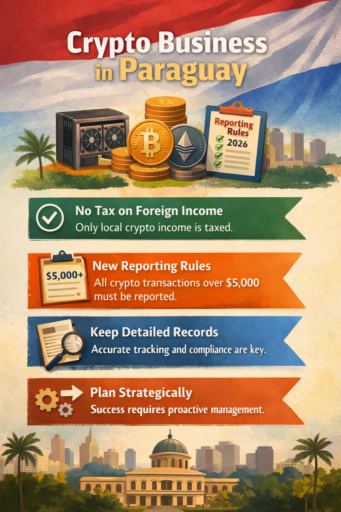
Paraguay crypto tax reporting now applies to transactions over $5,000, ensuring all significant crypto activity is recorded accurately.
While foreign-sourced income may still be untaxed, proper classification and timely reporting have become essential under the new rules.
This article covers:
- Do you have to report your crypto on your taxes?
- Where to declare crypto income?
- How to report crypto currency income?
- What happens if you don’t declare crypto?
- Is there a way to avoid paying taxes on crypto?
Key Takeaways:
- Paraguay taxes local-source crypto income; foreign income is generally exempt.
- Crypto activity over US $5,000 must be reported via DNIT’s Marangatu system.
- Businesses and investors must maintain detailed records of all transactions for compliance.
- Proper income classification determines taxability, making accurate records essential.
My contact details are hello@adamfayed.com and WhatsApp +44-7393-450-837 if you have any questions.
The information in this article is for general guidance only. It does not constitute financial, legal, or tax advice, and is not a recommendation or solicitation to invest. Some facts may have changed since the time of writing.

Is Paraguay crypto-friendly?
Yes, Paraguay is generally considered crypto-friendly, though its environment is shaped more by openness than detailed regulation.
Its territorial tax system means only locally sourced income is taxed, leaving most foreign-sourced crypto gains untaxed. Cheap electricity, especially near the Itaipu Dam, has attracted crypto miners.
However, crypto is not legal tender, and the legal framework is still evolving.
With the 2026 reporting requirements from Paraguay’s tax authority, the Dirección Nacional de Ingresos Tributarios (DNIT), all significant crypto activity must now be disclosed through the Marangatu system.
This creates a compliance obligation even if the income is foreign-sourced.
In practice, Paraguay offers flexibility for crypto investors, but proper reporting and understanding local rules are increasingly essential.
When did you have to start reporting crypto on taxes?
Paraguay crypto tax reporting starts from the 2026 tax year, with the first filings due in early 2027.
Paraguay introduced formal crypto reporting requirements under Resolución General N.° 47/2026 issued by the Dirección Nacional de Ingresos Tributarios (DNIT).
All crypto transactions—income and transfers—must be disclosed through the Marangatu system.
Before 2026, Paraguay had no crypto-specific reporting framework, and obligations were based only on general tax principles.
Deadlines follow the annual filing calendar, typically early in the year after the fiscal year ends, and reporting applies to both individuals and businesses.
What is the tax reporting limit for crypto?
Paraguay does not have a minimum threshold for platform reporting, but for resident individuals and entities, there is a reporting threshold of US $5,000 in annual crypto activity.
- Platform operators inside Paraguay must report every user transaction, regardless of size.
- Residents and entities must file an annual informational crypto return (Declaración Jurada Informativa de Criptoactivos) if their total crypto activity exceeds US $5,000, including transactions on foreign platforms or peer-to-peer without intermediaries.
| Requirement | Details |
| ✅ Transaction date & time | Record the exact date and time of each crypto transaction |
| ✅ Counterparty | Identity of the other party or their wallet address |
| ✅ Crypto asset info | Name, ticker symbol, and blockchain network of the asset |
| ✅ Quantity | Exact amount, up to ten decimal places |
| ✅ Gross value | Value in US dollars at the time of the transaction |
| ✅ Fees & gas costs | All transaction-related fees, including gas |
| ✅ Transaction hash | Unique transaction ID with origin and destination addresses |
This threshold is for reporting purposes only. Even small transactions must be reported by platforms, and taxation depends separately on whether the crypto income is considered Paraguayan-source.
Where do you report crypto on taxes?
Crypto reporting in Paraguay is handled by the Dirección Nacional de Ingresos Tributarios (DNIT), the country’s national tax authority.
Crypto activity must be reported through:
- The Marangatu system (DNIT’s official online tax platform)
- A dedicated filing called the Declaración Jurada Informativa de Criptoactivos
This is a separate informational return, distinct from standard income tax filings.
In addition:
- Platform operators report all user transactions automatically
- Individuals and entities exceeding the US $5,000 threshold must file their own crypto report
Crypto may still be classified as business or personal income for tax purposes, but reporting is now done through a specific, centralized system, not just general tax forms.
How to report crypto income on tax return?
Crypto income in Paraguay is reported by classifying it under existing income categories, declaring it in your annual tax return, and filing a separate crypto disclosure if your activity meets reporting thresholds.
Step-by-step process:
1. Identify your crypto activity type
Determine how your crypto income should be classified:
-Trading profits → business or investment income
-Mining income → typically local-source business income
-Foreign-sourced gains → often not taxable
2. Calculate your total income
-Determine gains, income, or receipts from crypto transactions
-Use consistent valuation (usually based on transaction value in USD or local currency)
3. Convert values into local currency
-Convert all amounts into Paraguayan guaraní (PYG)
-Use a reasonable and consistent exchange rate method
4. Report income in your annual tax return
-Declare crypto income under the appropriate category (business or personal income)
-Include only taxable Paraguayan-source income
5. Check if separate crypto reporting is required
Under rules issued by the Dirección Nacional de Ingresos Tributarios:
-If your total crypto activity exceeds US $5,000, you must file Declaración Jurada Informativa de Criptoactivos
-Submit this through the Marangatu system
6. Maintain detailed records
Keep records of:
-Transaction dates and values
-Wallet addresses or counterparties
-Fees, gas costs, and transaction hashes
Because the rules are still evolving, many investors take a conservative approach, ensuring both income and reportable activity are properly disclosed.
What happens if you forget to report crypto on taxes?
Failing to report taxable crypto income or the required 2026 informational disclosure in Paraguay can result in fines, interest on unpaid taxes, and potential reassessment by DNIT.
- Penalties or fines may apply for underreporting or non-filing
- Interest can be charged on unpaid taxes
- Authorities may reassess your filings and request additional documentation
While enforcement is still limited compared to countries like the United States, the introduction of the Marangatu reporting system increases DNIT’s ability to track crypto transactions, making compliance increasingly important.
Can I avoid paying taxes on crypto?
In Paraguay, you can legally avoid taxes on crypto only if the income is foreign-sourced or not realized within Paraguayan territory.
Legal ways crypto investors may reduce or avoid taxes include:
- Earning foreign-sourced crypto income (excluded under Paraguay’s territorial tax system)
- Holding crypto without selling, so gains are unrealized
- Structuring crypto-related activities outside Paraguay
However:
- Mining or business operations inside Paraguay are generally taxable as local-source income
- Attempting artificial schemes or misreporting activity can result in penalties or fines
Paraguay Crypto Tax: Global Trends
Paraguay’s 2026 crypto reporting rules place it squarely in a growing global trend of mandatory crypto disclosures.
Countries around the world are increasingly requiring detailed reporting of crypto transactions, either through tax returns or centralized platforms, to enhance transparency and enforcement.
How Paraguay compares:
- United States: Crypto must be reported on annual tax returns, with platforms providing Forms 1099‑B or 1099‑K.
- European Union (DAC8): Platforms disclose transaction-level data to tax authorities, similar to Paraguay’s granular reporting via the Marangatu system.
- Brazil & South Korea: Brazil now taxes and requires reporting for crypto gains under its new capital gains regime, while South Korea’s crypto tax framework is evolving and delayed, with reporting and compliance obligations expanding as part of broader regulatory reforms.
- Other territories (Canada, UK, Australia): Reporting depends on taxable events, with clear classification rules and increasing platform reporting obligations.
Is It Still Worth Doing Crypto Business in Paraguay?
Yes, Paraguay remains an attractive location for crypto business despite the 2026 reporting rules.
Its low operational costs and relatively open environment continue to benefit activities like mining and blockchain development.
The new reporting requirements increase transparency but also provide clearer regulatory expectations, which can reduce uncertainty for companies planning long-term operations.
Entrepreneurs who structure their activities carefully and maintain robust compliance procedures can still capitalize on the country’s advantages.
While additional record-keeping is required, this shift toward transparency creates a more predictable business environment, helping firms avoid future disputes with tax authorities.
Overall, success in Paraguay now depends on proactive planning and strategic management, rather than relying solely on favorable conditions.
Conclusion
Paraguay offers a uniquely favorable environment for crypto activity, combining full exemption on foreign-sourced income with growing transparency requirements under the 2026 reporting rules.
Investors can benefit from the territorial tax system, but mandatory disclosures signal that regulatory oversight is catching up with the market.
Success in Paraguay’s crypto landscape depends less on avoiding taxes and more on strategic planning, meticulous record-keeping, and understanding local reporting obligations.
Placing Paraguay in a broader international context highlights both the opportunities of its territorial system and the importance of proactive compliance as platform-level reporting and granular transaction disclosures become the global standard.
For both residents and platforms, following the DNIT’s Marangatu system is now essential to safely leverage Paraguay’s crypto-friendly environment while minimizing risk.
FAQs
Can you buy bitcoin in Paraguay?
Yes, you can legally buy Bitcoin in Paraguay through exchanges, peer-to-peer platforms, or brokers.
Adoption is growing, especially among younger investors and miners.
What is the crypto regulation agreement between El Salvador and Paraguay?
Paraguay and El Salvador have a crypto cooperation agreement focused on blockchain development, regulatory knowledge sharing, and anti-money laundering practices.
It does not make Bitcoin legal tender in Paraguay.
Does Paraguay have a tax treaty with the USA?
No, Paraguay does not have a comprehensive tax treaty with the United States.
As a result, US taxpayers in Paraguay may face double taxation and additional reporting obligations.
Which country has the lowest crypto tax?
Some of the lowest‑tax crypto jurisdictions include the United Arab Emirates (0% personal income and capital gains tax), Switzerland (tax-free private capital gains, though wealth and staking income may be taxed), and El Salvador (no direct crypto tax as Bitcoin is legal tender).
Other favorable locations like Portugal, Singapore, or Germany may also offer minimal or zero personal crypto taxation depending on residency, holding period, and type of crypto activity.
Does Paraguay tax foreign income?
No, Paraguay generally has no tax on foreign-sourced income.
This is the key reason why many crypto investors consider relocating there.
What is the tax loophole in Paraguay?
There is no official tax loophole in Paraguay, but its territorial tax system excludes foreign-sourced income, which can reduce taxable obligations.
The lack of detailed regulations in some areas provides flexibility, though relying on these unclear rules carries risk as laws may change.
Pained by financial indecision?

Adam is an internationally recognised author on financial matters with over 830million answer views on Quora, a widely sold book on Amazon, and a contributor on Forbes.