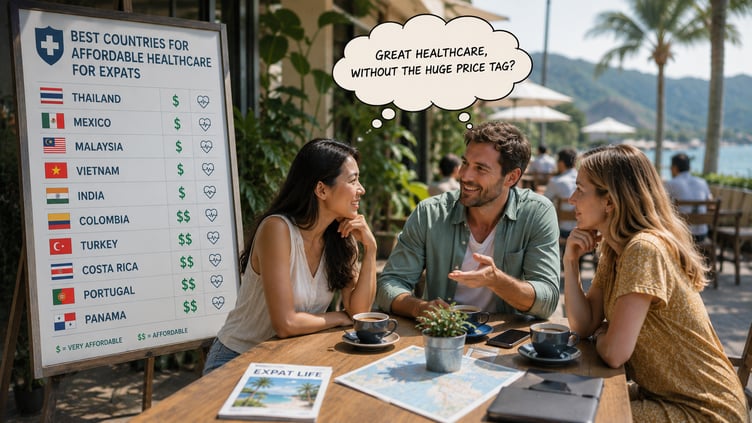
Thailand, Malaysia, Mexico and Spain are among the best countries for expats seeking affordable healthcare without sacrificing access to quality medical services.
The cheapest option, however, is not always the best, so expats should compare healthcare costs alongside quality, public and private access, insurance and eligibility.
If you are unsure which country fits your healthcare needs and budget, you can contact us to compare healthcare costs, insurance options and access to private medical care.
Key Takeaways
- Private healthcare can offer faster access and convenience, while public care is generally cheaper.
- Low cost does not always mean good value; quality and accessibility also matter.
- Healthcare costs can rise sharply for major treatment, so expats should consider coverage for hospitalization and specialist care.
- Thailand and Malaysia combine relatively affordable private healthcare with developed medical facilities.
My contact details are hello@adamfayed.com and WhatsApp +44-7393-450-837 if you have any questions.
The information in this article is for general guidance only. It does not constitute financial, legal, or tax advice, and is not a recommendation or solicitation to invest. Some facts may have changed since the time of writing.
 What factors influence the cost of healthcare?
Healthcare costs are mainly influenced by government funding, medical and specialist fees, medication prices, insurance structures, technology, demand for care and administrative expenses.
For expats, the final cost also depends on whether they can access subsidized public healthcare or must pay for private treatment and insurance.
The most important factors include:
- Public healthcare funding: Countries that heavily subsidize healthcare through taxation or social insurance can reduce the amount patients pay directly.
- Private healthcare infrastructure: Private hospitals generally cost more than public facilities but can offer shorter waiting times, modern facilities and more convenient access.
- Doctor and specialist fees: Countries with lower labor costs often have considerably cheaper consultations and procedures.
- Medication prices: Government regulation, pharmaceutical pricing and the availability of generic drugs can affect prescription costs.
- Insurance structure: Mandatory insurance, employer-based coverage and private insurance can all change how much an individual ultimately pays.
- Healthcare utilization: Older populations and higher rates of chronic disease can increase national healthcare spending.
- Medical technology: Advanced diagnostic equipment, specialized treatments and newer medicines can increase costs.
- Administrative expenses: Complex billing and insurance systems can add significant costs without directly improving medical care.
For expats, eligibility for public healthcare is particularly important.
A system may be inexpensive for citizens but considerably more expensive for foreigners who are not entitled to the same subsidies.
What is the best country to live in for healthcare?
Taiwan ranks as the best country for healthcare in the 2025 CEOWORLD Health Care Index, followed by South Korea, Australia, Canada and Sweden.
However, this ranking measures overall healthcare performance rather than specifically the cost of healthcare for expats, so the highest-ranked countries are not necessarily the most affordable.
|
Rank |
Country |
Healthcare Index |
|
1 |
Taiwan |
78.72 |
|
2 |
South Korea |
77.70 |
|
3 |
Australia |
74.11 |
|
4 |
Canada |
71.32 |
|
5 |
Sweden |
70.73 |
|
6 |
Ireland |
67.99 |
|
7 |
Netherlands |
65.38 |
|
8 |
Germany |
64.66 |
|
9 |
Norway |
64.63 |
|
10 |
Israel |
61.73 |
The rankings assess healthcare systems based on quality, accessibility, cost efficiency, health outcomes and infrastructure, providing a broad view of how healthcare systems perform globally.
For expats seeking cheap healthcare, however, overall performance is only one consideration.
Which country has the cheapest healthcare for expats?
Thailand is one of the cheapest countries for expats seeking quality private healthcare, with routine consultations often costing only a few hundred US dollars or less.
Other affordable options include Mexico, Malaysia, Vietnam and India, although actual costs vary by treatment, hospital, location, insurance and eligibility for public healthcare.
There is no universally accepted ranking of the cheapest healthcare for expats, so the countries below are selected based on their combination of low treatment costs, private healthcare quality and accessibility for foreigners.
Thailand
Thailand offers one of the strongest combinations of low-cost healthcare and high-quality private hospitals.
A private GP consultation typically costs around THB 500–1,500 (US$15–45), while specialist consultations can cost approximately THB 1,500–3,000 (US$45–90).
Private hospitals in Bangkok and other major cities commonly cater to international patients, with modern facilities and English-speaking staff.
Public hospitals can be substantially cheaper, although expats may encounter longer waiting times and greater language barriers.
Mexico
Mexico is another affordable option, particularly for North American expats.
A private GP consultation can cost around US$18–25, while specialist consultations may start at approximately US$40.
Private hospitals in major cities are accustomed to treating international patients, while public healthcare can provide an even lower-cost option for eligible residents.
Costs for surgery and complex treatment vary significantly between facilities.
Malaysia
Malaysia combines relatively low medical costs with a well-developed private healthcare sector.
Private GP consultations can typically cost around RM50–150 (US$12–35), while specialist consultations commonly fall around RM100–300 (US$24–70).
Kuala Lumpur and other major cities have private hospitals that regularly serve international patients, making Malaysia particularly attractive to expats who want affordable private care without relying entirely on public facilities.
Vietnam
Vietnam offers some of the lowest costs for routine medical care in Southeast Asia.
A private GP consultation typically costs around VND 800,000–1.5 million (US$32–60), while specialist consultations can range from about VND 1.2–2.5 million (US$48–100). International clinics and hospitals may charge more.
Ho Chi Minh City and Hanoi have a growing number of private and international healthcare facilities, although expats should check the credentials and standards of individual providers rather than choosing solely on price.
India
India is particularly competitive for specialist treatment, surgery and other medical procedures, with major private hospitals offering advanced care at substantially lower prices than many Western countries.
A private GP consultation can commonly cost around ₹300–1,000 (US$4–12), while specialist consultations may range from approximately ₹500–2,000 (US$6–24).
Costs can vary considerably between local clinics and internationally accredited private hospitals.
For complex treatment, the reputation and accreditation of the hospital should therefore be considered alongside the quoted price.
Colombia
Colombia offers relatively inexpensive private healthcare alongside a public health insurance system for eligible residents.
Private GP consultations generally cost around US$30–50, while specialist consultations can range from US$50–100.
Major cities such as Bogotá, Medellín and Cali have private hospitals with advanced equipment and international-facing services, making Colombia particularly attractive to expats who want affordable specialist care without relying entirely on the public system.
Turkey
A private GP consultation can cost roughly €25–40 (US$29–47), although consultations involving additional tests can reach around €50–70.
The country also has a large private healthcare sector catering to international patients, while expats enrolled in Turkey's SGK system can access public healthcare and certain participating private facilities at subsidized rates.
Costa Rica
Costa Rica is a strong option for expats who want affordable healthcare alongside access to both public and private systems.
Private healthcare is considerably cheaper than comparable care in the US, while legal residents can access the country's public healthcare system through the Costa Rican Social Security Fund.
A private GP consultation typically costs around US$50–80, while specialist consultations generally range from US$80–120.
Private healthcare can be particularly attractive for expats seeking shorter waiting times and more convenient access to specialists.
Current comparisons put private health insurance at roughly US$300–700 per month, although premiums vary substantially by age and coverage.
Portugal
Portugal combines low-cost public healthcare with relatively affordable private care, making it one of the more attractive European options for expats.
Private GP consultations generally fall around €50–100 (US$58–117), while private health insurance can cost roughly €30–100 per month depending on the plan.
Specialist consultations commonly range from €55–120 (US$65–141).
Legal residents who qualify for Portugal's National Health Service can access public healthcare at substantially lower costs, while private care provides a useful alternative for expats who prioritize faster appointments and greater choice.
Panama
Panama is an attractive option for expats seeking lower-cost private healthcare in the Americas, with a general private doctor consultation typically costing around US$30–80 and specialist visits about US$50–150.
Private hospitals in Panama City offer modern facilities, internationally trained doctors and English-speaking staff, while healthcare costs are generally well below comparable private care in the US.
For example, an MRI can cost around US$300–700, compared with roughly US$1,000–3,000 in the US.
This combination of relatively low out-of-pocket costs and access to high-quality private hospitals makes Panama particularly attractive to North American expats.
However, major procedures and hospital stays can still run into thousands of dollars, so private health insurance remains worth considering.
| Country | Typical Private GP Consultation | Typical Specialist Consultation |
|---|---|---|
| Thailand | From ~THB 500 (US$15) | From ~THB 1,500 (US$45) |
| Mexico | US$18–25 | From ~US$40 |
| Malaysia | RM50–150 (US$12–35) | RM100–300 (US$24–70) |
| Vietnam | VND 800,000–1.5m (US$32–60) | VND 1.2m–2.5m (US$48–100) |
| India | ₹300–1,000 (US$4–12) | ₹500–2,000 (US$6–24) |
| Colombia | US$30–50 | US$50–100 |
| Turkey | From ~€25 (US$29) | From ~€40 (US$47) |
| Costa Rica | US$50–80 | US$80–120 |
| Portugal | €40–80 (US$47–94) | €55–120 (US$65–141) |
| Panama | US$30–80 | US$50–150 |
Note: Costs are approximate and may vary by city, provider, hospital, tests required, and whether an international facility is used.
Is private healthcare better than public?
Private healthcare is generally better for expats who prioritize faster appointments, shorter waiting times, greater choice and more convenient access to specialists, while public healthcare is usually more affordable.
However, private care is not necessarily better in terms of medical outcomes, and the quality of both systems varies by country and provider.
Private hospitals often provide:
- Shorter waiting times
- More comfortable facilities
- Easier appointment scheduling
- Greater access to specialists
- English-speaking staff
- More personalized service
- Modern diagnostic equipment
- Direct billing arrangements with insurers
For many expats, a combination of public healthcare and private international insurance can offer the best balance, allowing them to use subsidized public services while having private care available when they want faster access or greater choice.
Which country has the most expensive healthcare in the world?
The United States has the world's highest healthcare spending among OECD countries.
Based on OECD data In 2024, the US spent more than US$14,880 per person on healthcare, approximately 2.5 times the OECD average.
Switzerland, Norway and Germany followed at roughly US$9,300–10,000 per person.
The US also spent approximately 18% of GDP on healthcare in 2024, nearly twice the OECD average.
For expats, this makes healthcare insurance particularly important when considering a move to the US.
Even people with insurance can face substantial deductibles, copayments and other out-of-pocket costs.
Conclusion
The real advantage of choosing a lower-cost healthcare country is not simply paying less when you visit a doctor; it is reducing the financial uncertainty that comes with living abroad.
A country can have inexpensive routine care but still become costly if specialist treatment, hospitalization or private insurance is difficult to access.
For expats, the smarter approach is to find the level of care they need at a cost they can reliably sustain.
That shifts the decision from chasing the lowest consultation fee to evaluating the entire healthcare system as part of the long-term cost of living abroad.
FAQs
Why is American healthcare so ridiculously expensive?
US healthcare is so expensive largely because medical services, prescription drugs and administrative costs are significantly higher than in other developed countries.
A fragmented insurance system, high provider prices and limited price regulation further contribute to the country's unusually high healthcare costs.
Which country has the most free healthcare?
Brazil, the UK, Norway and Australia all provide publicly funded healthcare with little or no payment at the point of use for many essential services, although the systems differ in eligibility and user charges.
Brazil's SUS is particularly notable for providing universal healthcare free at the point of care, while Norway and Australia generally require some patient contributions for certain services.
Is healthcare 100% free in Germany?
No, Germany does not have 100% free healthcare; residents are required to have health insurance and generally pay income-based contributions to the statutory system.
Once insured, most medically necessary doctor and hospital care is covered without direct payment at the time of treatment, although some services and co-payments still apply.
What is the biggest issue in healthcare today?
Severe healthcare workforce shortages and rising costs are among the biggest challenges facing healthcare systems today, contributing to staff burnout, longer waiting times and reduced access to care.
The WHO projects a global shortage of 11 million health workers by 2030, with difficult working conditions and high stress further affecting recruitment and retention.
Related Articles
- Top Health Insurance Providers in the UAE for Expats
- International Health Insurance for Expats in Panama: Coverage, Costs & Providers
- Top Expat Health Insurance in Thailand
- Best Health Insurance in Mauritius for Expats
- International Health Insurance With Maternity Coverage: A Global Guide
- What to Do If Your International Health Insurance Claim Is Rejected