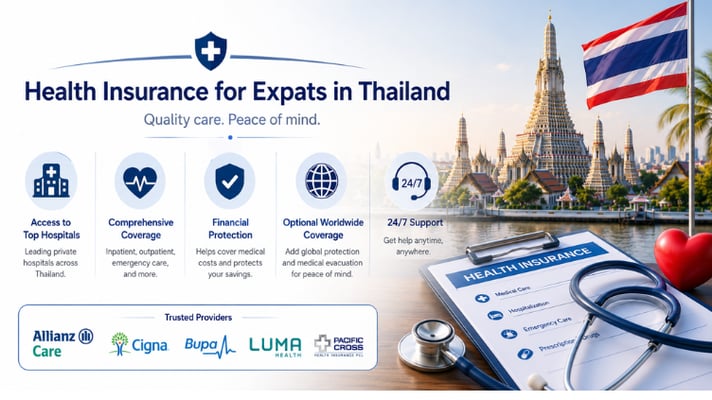
Some of the best expat health insurance providers in Thailand include Allianz Care, Cigna Healthcare, AXA Global Healthcare, Bupa Global, William Russell, APRIL International, Luma Health, and Pacific Cross Health Insurance.
International plans generally offer broader worldwide protection, while local policies are often more affordable for expats who expect to receive most of their treatment within Thailand.
The providers featured in this guide are included for comparison and do not represent a definitive ranking or endorsement.
Expats can contact us for help comparing international and local health insurance options in Thailand based on their medical needs, budget and preferred geographic coverage.
This guide covers:
- What's the best health insurance in Thailand for expats?
- How much is health insurance in Thailand per year?
- What does health insurance not cover in Thailand for foreigners?
- What is the difference between local health insurance and international health insurance?
Key Takeaways:
- International insurers typically offer the broadest coverage, including worldwide treatment and medical evacuation.
- Local Thai plans are generally more affordable for expats receiving most of their healthcare within Thailand.
- Premiums generally increase with age, broader coverage, and lower deductibles.
- The best policy depends on your healthcare needs, budget, travel plans, and preferred hospitals, not simply the premium.
My contact details are hello@adamfayed.com and WhatsApp +44-7393-450-837 if you have any questions.
The information in this article is for general guidance only. It does not constitute financial, legal, or tax advice, and is not a recommendation or solicitation to invest. Some facts may have changed since the time of writing.
What Are the Healthcare Options in Thailand for Expats?
Expats in Thailand can receive healthcare through public hospitals, private hospitals, employer-sponsored insurance, local private insurance, international private medical insurance (IPMI), or by paying for treatment out of pocket.
Public Hospitals
Public hospitals provide affordable healthcare and generally accept foreign patients on a fee-paying basis.
They may be a practical option for routine or non-urgent care, although waiting times can be longer.
Private Hospitals
Private hospitals are the preferred choice for many expatriates because they offer faster access to treatment, modern facilities, and English-speaking medical staff.
Costs are higher than at public hospitals, making health insurance valuable.
Many expatriates receive health insurance through their employer.
However, coverage limits and benefits vary, so some employees purchase additional insurance for more comprehensive protection.
Local Private Insurance
Local health insurance is generally suitable for expatriates who expect to receive most of their medical care within Thailand and want a lower-cost alternative to international cover.
International Private Medical Insurance (IPMI)
IPMI is designed for expatriates who want broader protection, including access to treatment in multiple countries and higher levels of coverage.
Paying Out of Pocket
Paying directly for medical care may be practical for routine consultations and minor treatment, but it can become costly if hospitalization or major medical care is required.
What Is the Best Health Insurance for Expats in Thailand?
Some of the best health insurance providers for expats in Thailand include Allianz Care, Cigna Healthcare, AXA Global Healthcare, Bupa Global, William Russell, APRIL International, Luma Health, and Pacific Cross Health Insurance.
Many expatriates choose international private medical insurance (IPMI) for its higher annual benefit limits, worldwide protection, and access to leading private hospitals in Thailand and abroad.
Others prefer local Thai insurers because they generally offer lower premiums for those planning to receive most of their treatment within Thailand.
The following providers are among the available options for expatriates:
| Provider | Best For | Key Strengths | Potential Considerations |
|---|---|---|---|
| Allianz Care | Families, executives, globally mobile expats | Worldwide cover, high annual limits, strong evacuation benefits, extensive hospital network | Premiums are generally higher than local plans |
| Cigna Healthcare | Frequent travelers and flexible coverage | Modular plans, optional US cover, extensive direct billing, worldwide protection | Optional modules can increase overall cost |
| AXA Global Healthcare | Comprehensive international cover | Strong cancer and specialist treatment, worldwide network, multiple deductible choices | Premium plans may be relatively expensive |
| Bupa Global | Premium private healthcare | Excellent access to private hospitals, high benefit limits, strong international reputation | Often among the higher-priced providers |
| William Russell | Long-term expatriates | Flexible international plans, worldwide medical evacuation, customizable benefits | Smaller direct billing network than some larger insurers |
| APRIL International | Younger expats and professionals | Competitive premiums, flexible plans, good outpatient options | Some benefits vary significantly by plan level |
| Luma Health | Expats based primarily in Thailand | Thailand-focused products, local expertise, partnerships with leading Thai private hospitals | International coverage may be more limited than global insurers |
| Pacific Cross Health Insurance | Long-term residents seeking value | Affordable premiums, regional expertise, strong local hospital network | Worldwide benefits are generally more limited than comprehensive IPMI plans |
Comparison of Expat Health Insurance Providers in Thailand
When comparing health insurers, consider more than just the monthly premium.
A lower-cost policy may provide significantly less protection if you require hospitalization, specialist treatment, or emergency medical evacuation.
The following factors are often the most important when choosing an expat health insurance policy in Thailand.
- Annual benefit limits: Higher limits generally provide better protection against expensive illnesses or prolonged hospitalization.
- Hospital network: Check whether your preferred hospitals offer direct billing with the insurer.
- Direct billing: This allows eligible medical bills to be settled directly between the insurer and the hospital, reducing upfront payments.
- Emergency medical evacuation: Particularly valuable if specialist treatment or transport to another country becomes necessary.
- Chronic condition cover: Not all policies cover ongoing medical conditions, and coverage often varies between insurers.
- Worldwide protection: International plans may cover treatment across multiple countries, while local plans usually focus on Thailand.
- Premium flexibility: Deductibles, co-payments, and optional benefits can help tailor premiums to your budget.
International vs Local Health Insurance in Thailand
International health insurance generally offers broader coverage and greater flexibility, while local Thai health insurance is usually more affordable for expatriates who expect to receive most of their treatment within Thailand.
The right choice depends on your healthcare needs, budget, and whether you require coverage outside the country.
| Feature | International Health Insurance | Local Thai Health Insurance |
|---|---|---|
| Geographic coverage | Worldwide | Mostly Thailand |
| Private hospitals | Excellent | Good |
| Medical evacuation | Usually included | Often limited |
| Premium | Higher | Lower |
| Portability | Excellent | Limited |
| Long-term flexibility | High | Moderate |
Who Should Choose Each Option?
International health insurance is typically better suited to executives, frequent travelers, retirees seeking comprehensive protection, and families who may require treatment both inside and outside Thailand.
Local health insurance may be a better fit for expatriates on tighter budgets, long-term residents who expect to remain in Thailand, and those who primarily need access to private healthcare within the country.
It can provide good value if international portability and overseas treatment are not priorities.
Expats can compare international health insurance plans through insurance.adamfayed.com to find coverage that best matches their health coverage requirements and financial circumstances.
Should I Get Health Insurance for Thailand as an expat?
Yes, most expatriates should get health insurance for Thailand, particularly if they plan to live there long term.
While health insurance is not mandatory for every foreign resident, certain Thai visa categories require qualifying cover, and private insurance protects against potentially high medical costs.
As immigration rules can change, expats should always check the latest visa requirements before applying or renewing.
Thailand has an excellent private healthcare system, but treatment for serious illnesses, surgery, or prolonged hospitalization can still be expensive without insurance.
Private plans provide access to leading hospitals, shorter waiting times, English-speaking medical staff, direct billing, and, with international policies, treatment outside Thailand and emergency medical evacuation.
Medical evacuation is a key benefit of many international health insurance plans.
If specialist treatment is unavailable locally or an emergency transfer is required, air ambulance evacuation can cost tens or even hundreds of thousands of dollars.
Coverage for medical evacuation can therefore provide valuable financial protection for expatriates.
Which Is Usually Not Covered in Health Insurance?
Health insurance policies typically exclude pre-existing medical conditions, cosmetic surgery, certain treatments, and other activities unless specifically stated otherwise.
Coverage varies between insurers, so it is important to review the policy wording before purchasing a plan.
Common exclusions include:
- Pre-existing conditions: May be permanently excluded, subject to a waiting period, or covered for an additional premium.
- Waiting periods: Certain benefits, such as maternity or specific illnesses, may not be available immediately after the policy begins.
- Cosmetic surgery: Usually excluded unless medically necessary following an illness or injury.
- Fertility treatment: IVF and other assisted reproductive treatments are often excluded or available only as optional benefits.
- Experimental treatments: Procedures that are not widely accepted or medically established are commonly excluded.
- Self-inflicted injuries: Treatment resulting from intentional self-harm is generally not covered.
- Drug and alcohol-related treatment: Claims arising from substance misuse are often excluded or restricted.
- Professional sports: Injuries sustained while participating in professional sports are commonly excluded.
- Hazardous activities: High-risk pursuits such as mountaineering, skydiving, or scuba diving may require additional cover.
- Routine dental care: Regular check-ups, fillings, and cleanings are often excluded unless dental cover is added.
- Routine vision care: Eye examinations, glasses, and contact lenses are typically not included under standard medical plans.
- Alternative medicine: Treatments such as acupuncture or chiropractic care may only be covered under selected policies.
Policy Endorsements and Optional Add-Ons
Many insurers allow policyholders to customize their cover through endorsements and optional benefits.
Depending on the insurer, these may include outpatient treatment, dental and vision care, maternity benefits, mental health services, wellness programs, alternative medicine, or enhanced medical evacuation cover.
Reviewing both the standard exclusions and available add-ons can help ensure your policy provides the level of protection that best suits your healthcare needs.
How Much Is Health Insurance for Expats in Thailand?
Health insurance for expats in Thailand typically costs between US$1,000 and US$12,000+ per year, based on your age, medical history, coverage level, and insurer.
Several factors influence the cost of your premium, including:
- Age: Older applicants generally pay higher premiums.
- Medical history: Pre-existing conditions may increase premiums or affect coverage.
- Deductible: Choosing a higher deductible can reduce your premium.
- Insurer: Premiums vary between international and local providers.
- Coverage area: Worldwide cover typically costs more than Thailand-only protection.
- Outpatient benefits: Including outpatient care usually increases the premium.
- Family members: Adding a spouse or children raises the overall cost.
Young Single Expat
A healthy young expatriate can generally expect to pay around US$1,000–$3,000 per year for comprehensive health insurance.
Local Thai plans are often available toward the lower end of this range, while international policies with worldwide coverage generally cost more.
Couple
Couples typically pay between US$2,500 and US$6,500 per year, depending on their ages, coverage level, deductibles, and whether they choose local or international insurance.
Family
Family policies generally range from US$5,000 to US$12,000+ per year. Premiums increase with each insured family member and optional benefits such as maternity, outpatient care, and dental cover.
Retirees
Retirees generally face the highest premiums due to increased health risks.
Comprehensive health insurance commonly costs US$4,000–10,000+ per year, although premiums may be considerably higher for older applicants or those with pre-existing medical conditions.
How to Reduce the Cost of Health Insurance in Thailand
You can reduce the cost of health insurance as an expat in Thailand by choosing a higher deductible, limiting your coverage area, removing unnecessary optional benefits, and comparing multiple insurers.
These strategies can lower your premium while maintaining the level of protection you need.
Choose a Higher Deductible
Selecting a higher deductible usually lowers your annual premium because you agree to pay more of the initial medical costs yourself before insurance applies.
Limit Your Coverage Area
If you expect to receive all of your treatment in Thailand, choosing Thailand-only or regional coverage is generally less expensive than worldwide cover.
Review Optional Benefits
Removing benefits you do not need such as outpatient treatment, maternity cover, dental care, or vision care, can help reduce premiums.
Compare Multiple Insurers
Premiums and benefits can vary significantly between insurers.
Comparing several providers allows you to find the best value rather than simply choosing the lowest price.
Pay Annually
Some insurers offer discounts for paying premiums annually instead of monthly or quarterly.
Buy Insurance While You Are Younger
Premiums generally increase with age, and purchasing cover earlier may help you secure lower rates before developing medical conditions that could affect future premiums or coverage.
Reducing the cost of health insurance should not come at the expense of adequate protection.
Before choosing a lower-priced policy, compare annual benefit limits, exclusions, hospital access, and medical evacuation benefits to ensure the cover still meets your healthcare needs.
Conclusion
Thailand offers expatriates access to one of Asia's most established private healthcare systems, giving them a wide range of insurance options to choose from.
However, the abundance of plans also makes it important to look beyond premiums and marketing claims when comparing policies.
The most suitable health insurance is the one that aligns with how you live, travel, and expect to use healthcare.
Someone spending most of the year in Thailand may benefit from an affordable local policy, while retirees, families, and internationally mobile professionals may find greater value in the broader protection offered by international health insurance.
Ultimately, the cost of a medical emergency is often impossible to predict, but choosing appropriate cover before you need it can provide both financial security and peace of mind throughout your time in Thailand.
FAQs
What Type of Travel Insurance Do I Need for Thailand?
For short trips to Thailand, a comprehensive travel insurance policy that includes emergency medical treatment, medical evacuation, trip cancellation, and baggage cover is generally sufficient.
If you are living or working in Thailand long term, comprehensive international or local health insurance is usually more appropriate, as travel insurance is not designed to provide ongoing medical coverage.
Does health insurance cover thyroid?
Yes. Health insurance generally covers hypothyroidism, hyperthyroidism, and thyroid cancer unless they are pre-existing conditions, which may be excluded or subject to waiting periods.
Coverage for medications and ongoing treatment also varies between insurers.
What Is the Most Common Medical Insurance Used by Thai Nationals in Thailand?
Most Thai nationals receive healthcare through the Universal Coverage Scheme (Gold Card), the Social Security Scheme for private-sector employees, or the Civil Servant Medical Benefit Scheme for government employees.
Many also purchase private health insurance to supplement these schemes and gain access to broader benefits or private hospitals.
Related Articles
- Insurance Providers List
- International Health Insurance With Maternity Coverage
- Best Pregnancy Health Insurance for Expats in Thailand
- Best Expat Health Insurance in Malaysia
- Best Expat Health Insurance in UAE
- Best Health Insurance in Mauritius
- Best International Health Insurance for British Expats in Singapore
- IPMI vs Local Health Insurance — Which Do Expats Need?